
Bedtime Duas for Kids: What to Recite Before Sleep (With a 7-Night Plan)
Pyjamas on, teeth brushed, one more glass of water… and then what? Many Muslim parents want bedtime to end with Allah’s name, but aren’t sure which bedtime duas to teach kids, in what order, or how to keep it short enough that tired children actually enjoy it.
The Prophet ﷺ had a beautiful bedtime routine, and much of it is perfect for children: short, rhythmic, and comforting. This guide gives you the key bedtime duas and recitations with meanings, a simple 5-step Sunnah sequence, age bands, and a 7-night plan to build it one piece at a time.
If bedtime itself is a battle, start with calm Sunnah-based fixes for bedtime struggles, then come back and add these duas once the routine is steadier.
The wording below uses transliteration with simple meanings. Use the exact Arabic and translations your family and teachers prefer.
Why Bedtime Duas Matter for Kids
- Comfort. Kids fall asleep feeling safe in Allah’s care, not afraid of the dark.
- Routine. The same words every night tell the body it’s time to sleep.
- Connection. Bedtime duas are often whispered with a parent’s hand on a child’s back. That closeness lasts.
- Lifelong habit. Many adults still say the duas their mothers taught them.
Bedtime is also when kids open up. A short dua pocket often turns into the best conversation of the day.
The Core Bedtime Duas and Recitations
1. The sleeping dua
“Bismika Allahumma amutu wa ahya.” Meaning: “In Your name, O Allah, I die and I live.” For kids: “With Your name, Allah, I go to sleep and wake up.” The Prophet ﷺ said this when he lay down to sleep (Bukhari). It’s short, so even three-year-olds can learn it.
2. The three Quls (Surah Al-Ikhlas, Al-Falaq, An-Nas)
Every night the Prophet ﷺ cupped his hands, blew lightly into them, recited these three surahs, and wiped his hands over as much of his body as he could, starting with his head and face. He did this three times (Bukhari). For kids: “We read Allah’s protection words, blow into our hands, and wipe them over us like a blanket of protection.”
3. Ayat al-Kursi (Al-Baqarah 2:255)
The Prophet ﷺ confirmed that whoever recites Ayat al-Kursi when going to bed has a protector from Allah until morning (Bukhari). For kids: “This is the greatest verse in the Quran. It tells us how big and strong Allah is, and He looks after us all night.”
4. The last two verses of Surah Al-Baqarah (2:285–286)
The Prophet ﷺ said these are enough for whoever recites them at night (Bukhari). For kids (older): Learn these over time, or listen to them recited.
5. Tasbih of Fatimah
The Prophet ﷺ taught his daughter Fatimah and Ali to say at bedtime: SubhanAllah 33 times, Alhamdulillah 33 times, Allahu Akbar 34 times (Bukhari). For kids: Count on fingers or with a soft counter. Younger kids can do 3-3-4.
6. One own-words dua
After the Sunnah words, invite one sentence from the heart: “Ya Allah, thank You for today. Please help Grandma feel better.” Our guide to teaching kids dua from the heart has easy scripts for this part.
The 5-Step Sunnah Bedtime Sequence (Kid Version)
Put it together in an order kids can remember:
- Wudu (or wash hands and face for little ones). The Prophet ﷺ advised making wudu before sleeping (Bukhari).
- Lie on the right side, with the right hand under the cheek if they like.
- Three Quls + blow + wipe (or listen while you do it for them).
- Ayat al-Kursi (recited, listened to, or a short part for young kids).
- “Bismika Allahumma amutu wa ahya” + one own-words dua + a kiss goodnight.
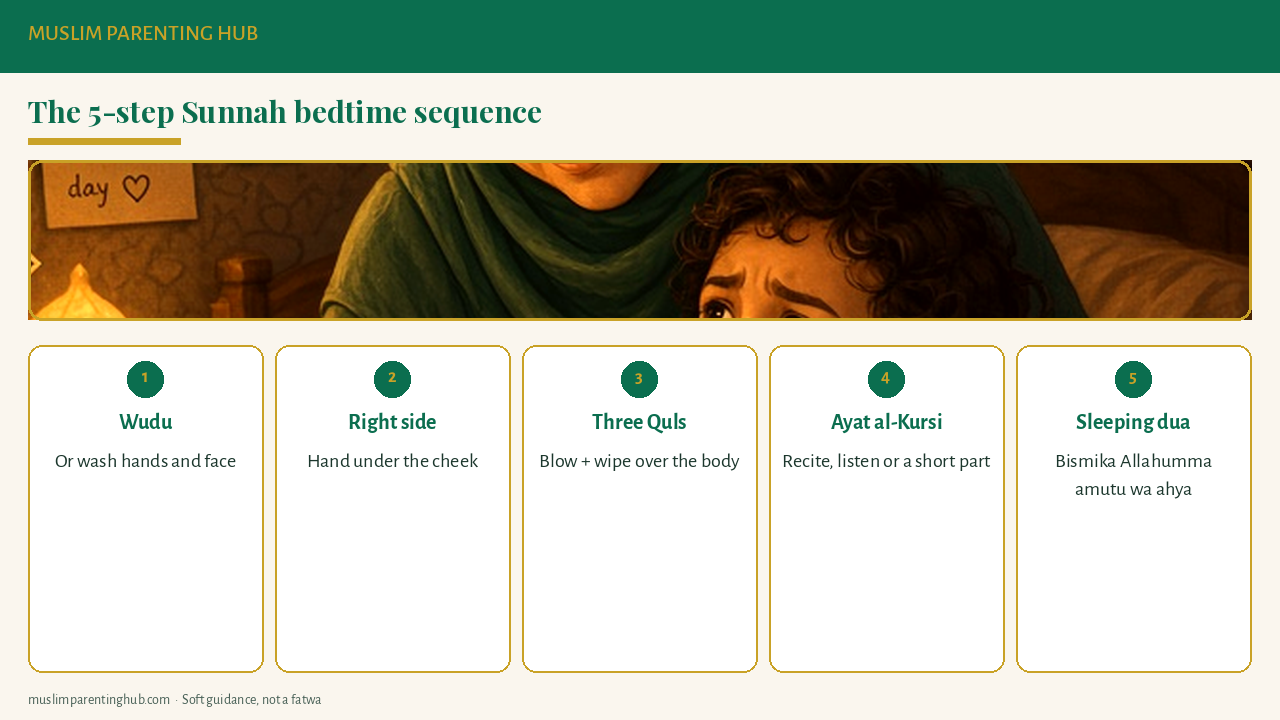
Total time: 3–5 minutes once learned. On hard nights, steps 2 and 5 alone are enough.
Script to start:
“Lights low, right side, hands ready. Let’s wrap ourselves in Allah’s protection words.”
Age Bands: How Much Is Enough?
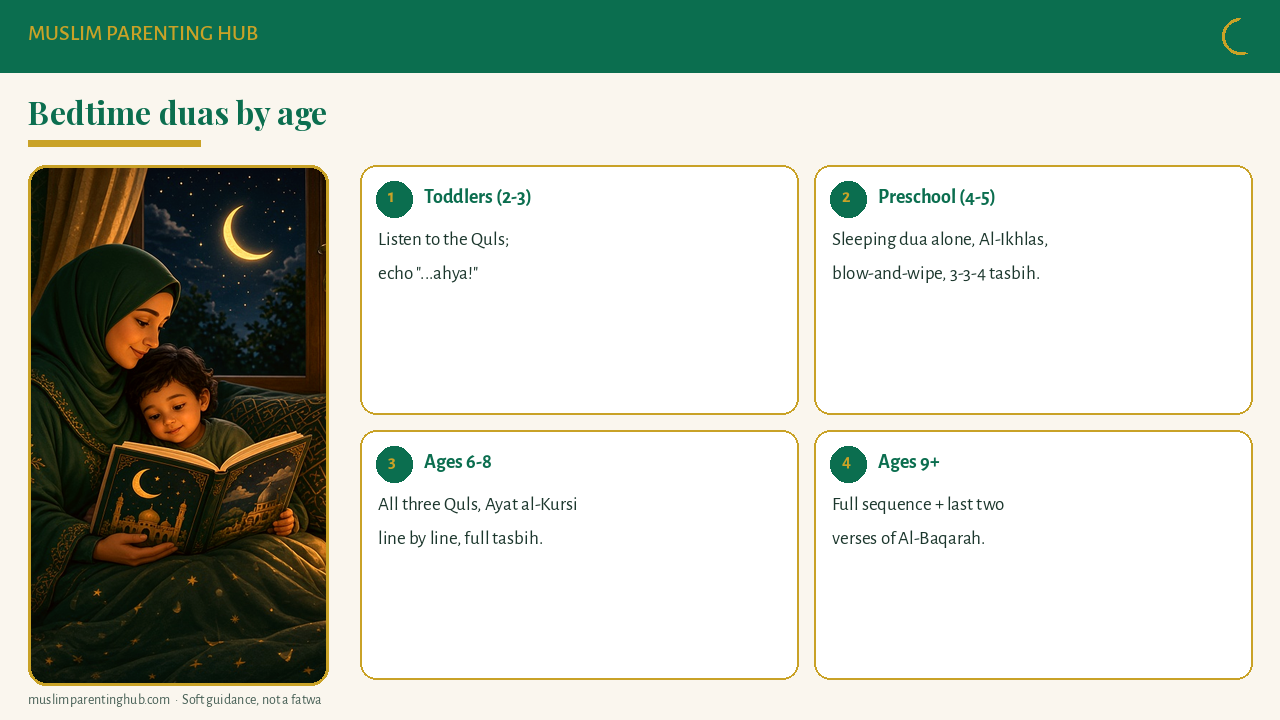
Toddlers (2–3)
- Listen while you recite the Quls and wipe over them
- Echo the last word of the sleeping dua (“…ahya!”)
- One own-words line from you: “Ya Allah, keep [name] safe tonight.”
Preschool (4–5)
- Say the sleeping dua independently
- Recite Al-Ikhlas with you; listen to Al-Falaq and An-Nas
- Do the blow-and-wipe themselves
- Add a 3-3-4 mini tasbih
Early school-age (6–8)
- Recite all three Quls
- Learn Ayat al-Kursi gradually (one line a week)
- Full tasbih of Fatimah with a counter
- Lead the family dua sometimes
Older kids (9+)
- The full sequence, including Ayat al-Kursi
- Begin learning the last two verses of Al-Baqarah
- Own their routine, with parent check-ins rather than leading every night
A 7-Night Plan to Build the Routine
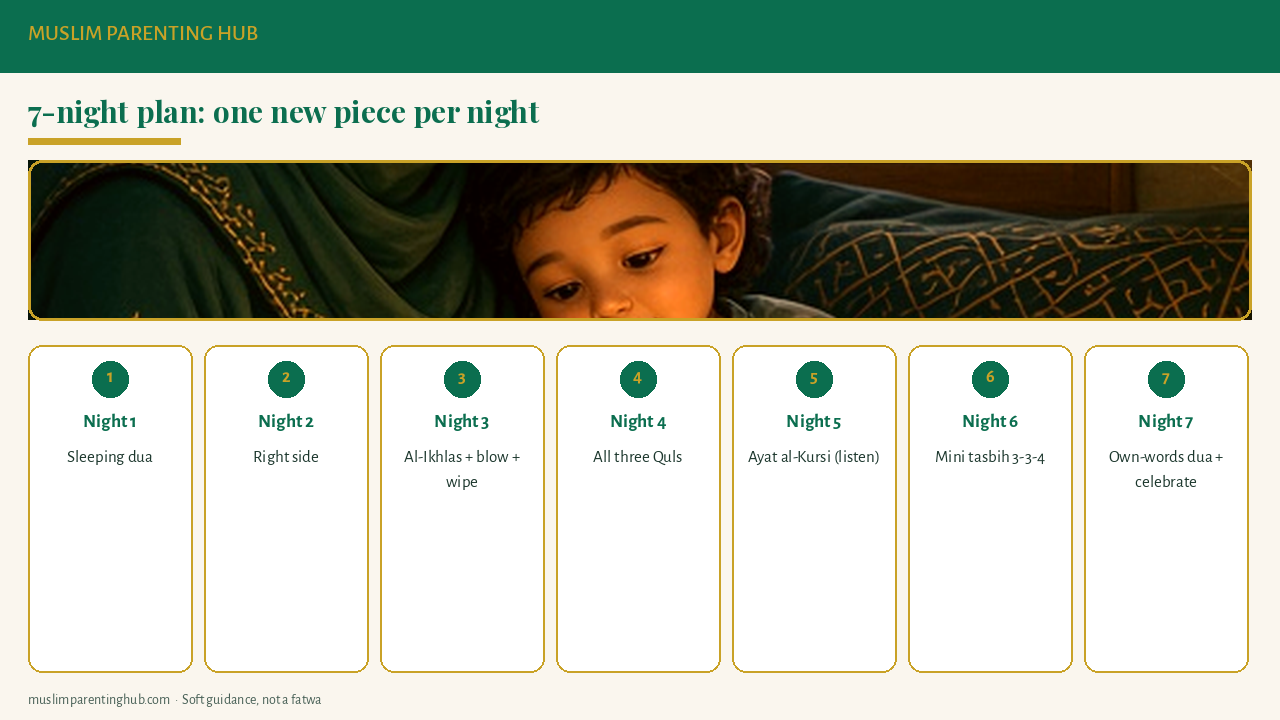
Don’t add everything at once. One new piece per night, keeping what came before:
Night 1 — The sleeping dua. Say Bismika Allahumma amutu wa ahya together. Explain the meaning with a cuddle.
Night 2 — Right side + sleeping dua. Add lying on the right side. Make it a game: “Which side? Right side!”
Night 3 — Al-Ikhlas + blow + wipe. You recite, they blow and wipe. Giggles allowed.
Night 4 — All three Quls. Recite all three, three times (or once for toddlers).
Night 5 — Ayat al-Kursi (listen). Recite it or play a gentle recitation. Explain: “Allah’s protection all night.”
Night 6 — Mini tasbih. Add 3-3-4 (or 33-33-34 for older kids).
Night 7 — Own-words dua + celebrate. Each child adds one sentence to Allah. Celebrate the full routine: “Seven nights! Alhamdulillah.”
After the first week, keep the routine steady for a month before adding the last verses of Al-Baqarah or longer duas.
Making It Stick (Without a Fight)
- Same order every night. Predictability is soothing.
- Parent voice first. Kids learn by hearing it hundreds of times.
- Use a soft light, not a phone screen, for reading.
- A dua card by the bed for early readers, with transliteration and meaning.
- Recitation audio for nights when you’re exhausted. Low volume, then off. Our Quran listening guide has gentle tips.
- Praise effort, not perfection. A sleepy “Bismika…” counts.
Scripts for Real Bedtime Moments
“I’m too tired for duas.”
“Okay, mini version: right side, Bismika Allahumma amutu wa ahya, kiss. Done.”
“I’m scared of the dark.”
“Let’s do our protection words together. Allah is awake all night and He never sleeps. You’re safe.” For harder nights, see our scary dreams comfort scripts.
“Why do we blow in our hands?”
“The Prophet ﷺ did it every night. It’s like wrapping ourselves in Allah’s protection words.”
Siblings in one room:
Let them take turns leading one dua each. Or recite together in a soft “whisper choir.”
When you forget:
“Oh! We forgot our duas. Let’s do them now, lying down.” Doing it late beats skipping.
Pairing Bedtime Duas With Stories
Many families do a short prophet story first, then the duas. The story fills the heart, and the duas seal the night. Try our 5-minute bedtime prophet story method for a simple pairing: story, then lights low, then the dua sequence.
And in the morning, close the loop with the waking dua: “Alhamdu lillahil-ladhi ahyana ba’da ma amatana wa ilayhin-nushur” (“Praise be to Allah who gave us life after He caused us to die, and to Him is the return”) (Bukhari). The morning protection dua routine builds on it.
FAQ
What dua should kids say before sleeping?
The simplest bedtime dua is “Bismika Allahumma amutu wa ahya”, which means “In Your name, O Allah, I die and I live” (Bukhari). Children can also recite the three Quls, Ayat al-Kursi, and a short dua in their own words.
What should kids recite before bed in Islam?
Following the Sunnah, kids can recite Surah Al-Ikhlas, Al-Falaq and An-Nas (blowing into their hands and wiping over the body), Ayat al-Kursi, the sleeping dua, and the tasbih of Fatimah (SubhanAllah 33, Alhamdulillah 33, Allahu Akbar 34). Start with one or two and build up.
How long should a bedtime dua routine take?
About 3–5 minutes once learned. On very tired nights, lying on the right side and saying the short sleeping dua is enough. Consistency matters more than length.
At what age can kids learn bedtime duas?
Toddlers can listen and echo from around age 2. Many children say the sleeping dua by 4, recite the three Quls by 6, and learn Ayat al-Kursi gradually between ages 6 and 9.
Should kids make wudu before bed?
The Prophet ﷺ advised making wudu before sleeping, and it’s a lovely habit to build. For very young or very sleepy children, washing hands and face is a gentle start.
What if my child is scared at night?
Recite the protection words together (the three Quls and Ayat al-Kursi), remind them that Allah never sleeps and is always caring for them, and keep bedtime talk calm and safe. Avoid scary stories at night.
Related guides
- When Your Muslim Toddler Fights Bedtime: Calm Sunnah-Based Fixes
- Bedtime Prophet Stories for Toddlers: A 5-Minute Method
- Duas for Kids to Learn: 10 Easy Duas + Dua From the Heart
- Morning Protection Dua Routine for Kids
Quick steps
5-step Sunnah bedtime dua sequence for kids. A short bedtime sequence of wudu, lying on the right side, the three Quls, Ayat al-Kursi and the sleeping dua.
- Wudu — Make wudu before sleeping, or wash hands and face for little ones.
- Lie on the right side — With the right hand under the cheek if they like.
- Three Quls, blow and wipe — Recite the three Quls, blow lightly into the hands and wipe over the body, or listen while you do it for them.
- Ayat al-Kursi — Recited, listened to, or a short part for young kids.
- Sleeping dua, own words, goodnight — Say 'Bismika Allahumma amutu wa ahya', add one own-words dua and a kiss goodnight.
Related articles

A 5-Minute Morning Protection Dua Routine Muslim Kids Can Grow Into
A gentle 5-minute morning protection dua routine for Muslim kids—wake-up words, short adhkar by age, and scripts that grow with toddlers to school-age.
Read guide →
Duas for Kids to Learn: 10 Easy Duas + How to Make Dua From the Heart
10 easy duas for kids to learn, with meanings, plus a simple way to help children make dua from the heart in their own words. Scripts for tonight.
Read guide →
Bedtime Prophet Stories for Toddlers: A 5-Minute Storytelling Method
Tell bedtime Prophet stories for ages 2–4 with a 5-minute method—story frame, weekly rotation, empathy questions, scripts, and calm tips. Soft Sunnah storytelling for tired parents.
Read guide →
When Your Muslim Toddler Fights Bedtime: Calm Sunnah-Based Fixes
Calm Sunnah-based fixes when your Muslim toddler fights bedtime—stalling, fear, separation, dua, boundaries, and age tips. Soft routines that actually stick.
Read guide →