
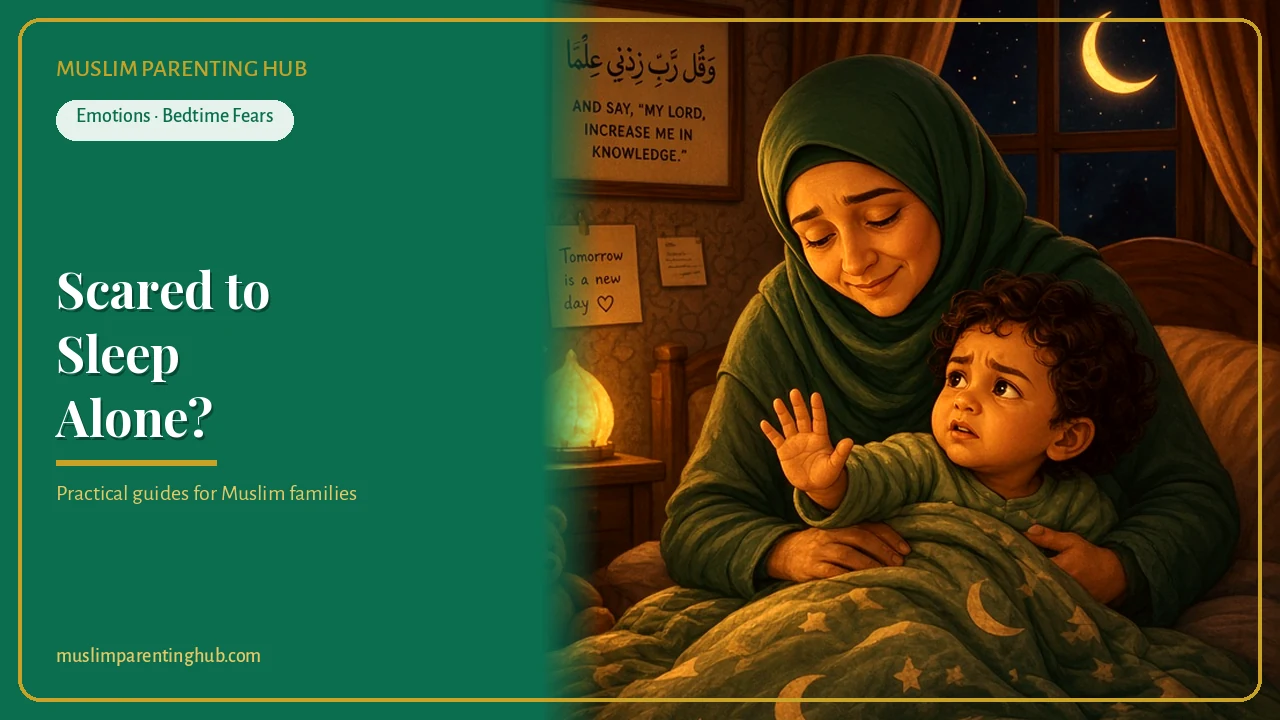
Child Scared to Sleep Alone? Islamic Bedtime Duas and a Gentle 10-Night Plan
It’s 9:40 p.m. You finally sit down, and there they are again in the hallway, blanket in hand: “I can’t sleep by myself. Can I sleep with you?” Some nights you say yes because you are exhausted. Other nights you walk them back four times. By morning, everyone is tired and a little cranky.
A child who is scared to sleep alone is not being naughty. Night-time fears are one of the most common stages of childhood, and they often peak between ages three and eight, exactly when imagination is growing fastest. This week, Halloween decorations and darker evenings after the clocks change can make it worse.
This guide gives you calm Islamic scripts, the short bedtime duas that genuinely comfort children, a cozy room setup and a gentle ten-night plan to help your child feel brave in their own bed. If your child’s fear is mainly about nightmares, start with our guide to scary dreams and calm comfort scripts, then come back here for the sleeping-alone plan.
This is parenting guidance, not medical advice. If fears are severe, sudden, or come with other changes in your child, talk to your pediatrician.
Why Kids Become Scared to Sleep Alone
- Separation. Bedtime is the longest time your child spends away from you each day.
- Imagination. Shadows, sounds and “What if?” thoughts are louder in the dark.
- Something scary they saw. A movie, a YouTube clip, Halloween masks in a neighbor’s yard.
- Changes. A new sibling, a move, a new school or a family stress.
- A bad dream. One nightmare can make the bed itself feel unsafe for a while.
- Habit. If they’ve slept with you for months, alone simply feels strange.
Knowing the reason helps you choose the right words. Often it’s a mix.
Does Islam Require Kids to Sleep Alone?
Many parents wonder this. There is no rule that a young child must sleep alone. Families throughout Muslim history have shared rooms, and many still do.
What the Sunnah does mention is separating children’s beds as they get older. The same hadith that tells parents to teach prayer at seven says: “…and separate them in their beds” at ten (Abu Dawud). Scholars understand this as giving older children their own sleeping space, especially siblings of different genders. It doesn’t require a separate room.
So the goal is not “alone at any cost.” It is a child who feels safe and calm sleeping in their own bed, with a routine you can sustain. Choose the timing that suits your family.
What to Say: Calm Scripts
When they first call out
“I hear you. You’re safe. I’m right here in the house. Let’s take three slow breaths together and say Bismillah.”
Keep your voice low and slow. Your calm is the strongest message.
When they say “I’m scared”
“It’s okay to feel scared. Even brave people feel scared sometimes. Do you know who never sleeps? Allah. When you close your eyes, Allah is still awake, taking care of you.”
This comes straight from Ayat al-Kursi: “Neither drowsiness overtakes Him nor sleep” (Quran 2:255). Children find this deeply comforting. Our Ayatul Kursi for kids guide explains the verse line by line.
When they ask “Is something in my room?”
“No. Your room is the same room it is in the daytime: your bed, your books, your toys. We said our bedtime duas, and those protect us. Let’s turn on the night-light and look together.”
Avoid detailed talk about jinn or Shaytan at bedtime. If your child asks, keep it short and confident. Our guide on talking to kids about jinn without fear helps for daytime conversations.
When they beg you to stay all night
“I’ll stay for two more minutes, then I’ll check on you in five. I always come back.”
Then really come back. Trust is built by keeping that promise.
Bedtime Duas That Comfort
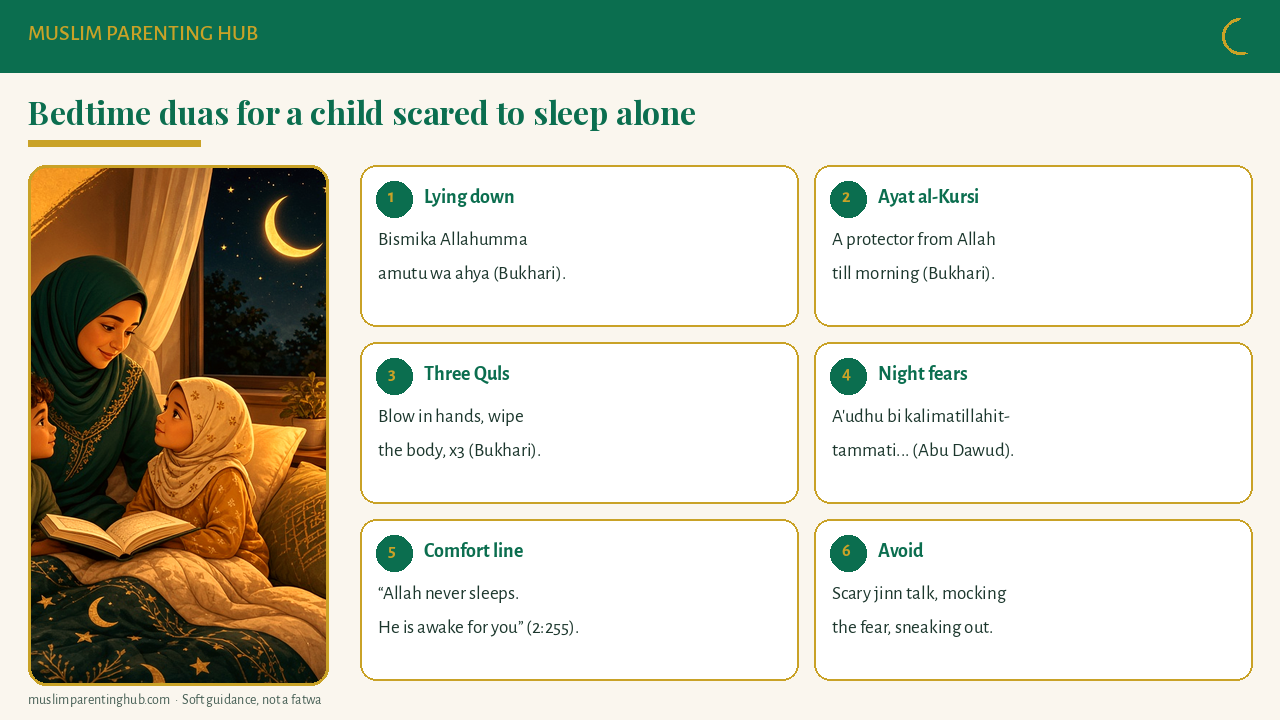
You don’t need many. Pick two or three and say them together every night in the same order. Repetition is what makes them feel safe.
- Bismika Allahumma amutu wa ahya. “In Your name, O Allah, I die and I live.” The Prophet ﷺ said this when lying down to sleep (Bukhari). For kids: “In Your name, Allah, I sleep and I wake up.”
- Ayat al-Kursi (2:255). The Prophet ﷺ confirmed that whoever recites it when going to bed has a protector from Allah with them, and Shaytan cannot come near until morning (Bukhari). You can recite it while your child listens.
- The three Quls. The Prophet ﷺ would cup his hands, recite Al-Ikhlas, Al-Falaq and An-Nas, blow lightly into them and wipe over as much of his body as he could, three times (Bukhari). Kids love doing the wiping. See our guide to Surah Al-Falaq and An-Nas for kids.
- A dua for fear at night (older kids). The Prophet ﷺ taught this for someone frightened in their sleep: A’udhu bi kalimatillahit-tammati min ghadabihi wa ’iqabihi, wa sharri ’ibadihi, wa min hamazatish-shayatini wa an yahdurun — “I seek refuge in the perfect words of Allah from His anger and punishment, from the evil of His servants, and from the whispers of the devils and their coming near” (Abu Dawud, Tirmidhi).
For a fuller routine, our bedtime duas for kids: 7-night plan shows how to build these up one night at a time.
Set Up a Brave Room
- A warm, dim night-light. Fine in Islam and very helpful. Amber light is gentler on sleep than blue.
- A comfort object. A soft toy or a blanket that smells like home.
- A “brave card” by the bed. Draw or print the first line of Bismika Allahumma with a picture your child chooses.
- A clear floor. Piles of clothes become “shapes” in the dark.
- White noise or soft Quran recitation at low volume, if it helps your child settle.
- No scary content before bed. Screens off at least an hour before sleep, and especially no Halloween clips this week. If decorations on your street are the problem, our guide for a child scared of Halloween decorations has calm scripts.
The Gentle 10-Night Plan
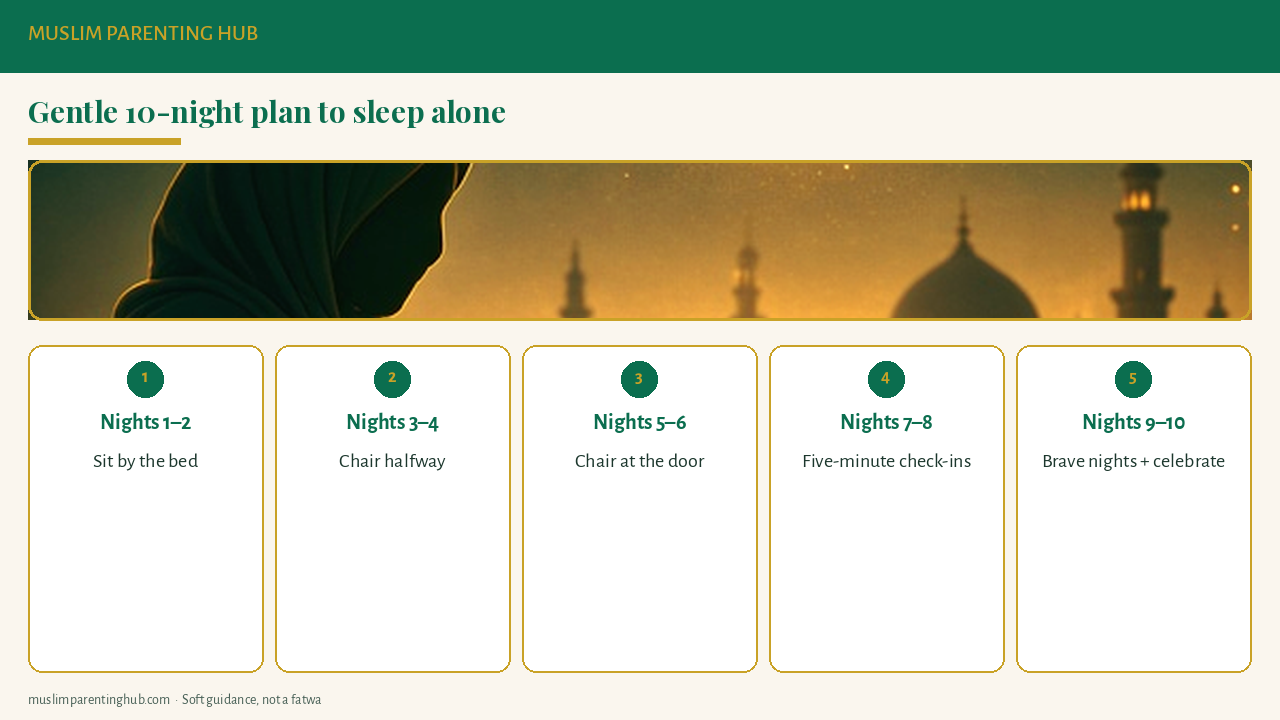
This plan uses gradual steps. Many families find it works within two weeks. Go slower if your child needs it; never jump steps because of a hard night.
Before you start: Keep your normal bedtime routine (bath, pajamas, teeth, story, duas). Tell your child about the plan in the daytime, not at bedtime.
- Nights 1–2 — Sit by the bed. After duas, sit right beside the bed until your child falls asleep. Keep chat to a minimum and hum or recite softly.
- Nights 3–4 — Chair halfway. Move your chair to the middle of the room. Same calm presence, a little farther away.
- Nights 5–6 — Chair at the door. Sit in the doorway where your child can see you.
- Nights 7–8 — Check-ins. Say goodnight, leave and promise to check in five minutes. Come back every five minutes until they’re asleep, making each visit a quiet “I’m here. Bismillah. Goodnight.”
- Nights 9–10 — Brave nights. Goodnight, duas and one promised check-in. In the morning, celebrate: “You slept in your own bed! Alhamdulillah!” A sticker, a special breakfast or a trip to the park.
If your child comes to your room during the night, walk them back calmly and quietly, every time, without a long conversation. Consistency matters more than any single night.
A daylight-saving tip: Clocks fall back on Sunday 1 November. The first few nights, 8 p.m. on the clock feels like 9 p.m. to your child’s body, so they’ll be sleepier at bedtime. That makes this a good week to start the plan. Our daylight-saving Maghrib and bedtime guide helps you shift the whole evening.
What to Avoid
- Mocking the fear. “There’s nothing to be scared of, don’t be a baby” makes a child feel alone and ashamed.
- Scary religious warnings. Don’t use jinn, punishment or “Allah will be angry” to keep a child in bed.
- Sneaking out. If they wake and you’ve vanished, fear grows. Always say goodnight.
- Big rewards for every night. Small celebrations work better and fade naturally.
- Changing the plan every night. Pick a step and stay with it for at least two nights.
When to Get Extra Help
Most bedtime fears fade with patience and routine. Talk to your pediatrician if your child’s fear is intense, lasts for months, appears suddenly after something upsetting, or comes with daytime anxiety, panic or changes in eating and play. For daytime worries, our duas for worried kids guide offers seven short duas.
FAQ
What dua can my child say when scared to sleep alone?
Start with “Bismika Allahumma amutu wa ahya” (Bukhari), the bedtime dua. Recite Ayat al-Kursi and the three Quls together. Older children can learn “A’udhu bi kalimatillahit-tammati…” for night fears (Abu Dawud, Tirmidhi).
At what age should a Muslim child sleep in their own bed?
There’s no fixed age in Islam. The Sunnah mentions separating children’s beds by about age ten (Abu Dawud). Many families move children to their own bed between three and seven, whenever it suits the family.
Is co-sleeping allowed in Islam?
Yes, sharing a room or bed with young children is permissible and common in Muslim families. As children grow, especially near ten, they should have their own bed. Choose a gradual transition rather than a sudden change.
How long does it take for a child to sleep alone?
With a gradual plan like the 10-night plan, many children adjust within one to three weeks. Some need longer. Consistency matters more than speed, so slow down rather than skipping steps.
My child keeps coming to our bed in the middle of the night. What should I do?
Walk them back to their own bed calmly and quietly every time, with a short “You’re safe. Bismillah. Goodnight.” Avoid long talks. Praise them in the morning for any part of the night they stayed in their bed.
Is a night-light okay for Muslim kids?
Yes. A dim, warm night-light is perfectly fine and helps many children feel safe. Pair it with bedtime duas so the light isn’t the only thing that comforts them.
Related guides
- Scary dreams in kids: Islamic dua + calm comfort
- Child afraid of the dark? Calm scripts and duas
- Bedtime duas for kids: 7-night plan
- Ayatul Kursi for kids: meaning + plan
- Muslim toddler bedtime struggles: Sunnah fixes
Closing
A child who is scared to sleep alone needs two things: to know they are safe, and to practice being brave a little at a time. Give them the same calm duas every night, remind them that Allah never sleeps, and move your chair one step farther away when they’re ready. One morning, very soon, inshaAllah, they will run in to tell you that they did it.
Quick steps
Gentle 10-night plan to help a child sleep alone. Gradual steps that move a parent out of the room over ten nights while keeping the same calm bedtime duas.
- Nights 1–2 — Sit by the bed — After duas, sit right beside the bed until your child falls asleep, keeping chat to a minimum.
- Nights 3–4 — Chair halfway — Move your chair to the middle of the room with the same calm presence.
- Nights 5–6 — Chair at the door — Sit in the doorway where your child can see you.
- Nights 7–8 — Check-ins — Say goodnight, leave and check in every five minutes until your child is asleep.
- Nights 9–10 — Brave nights — Goodnight, duas and one promised check-in, then celebrate in the morning.
Related articles

Scary Dreams and Nighttime Fear: Islamic Comfort Scripts for Muslim Kids
Child woke from a scary dream? What to say, the Sunnah steps after a bad dream, a short dua, and a calm return-to-sleep plan for Muslim kids. Gentle, no fear.
Read guide →
Muslim Kid Afraid of the Dark? Calm Scripts, Duas and a Night Plan
Is your Muslim child afraid of the dark? Use calm scripts, short bedtime duas, a cozy room setup and a 7-night plan that builds courage without scary talk.
Read guide →
Bedtime Duas for Kids: What to Recite Before Sleep (With a 7-Night Plan)
Bedtime duas for kids made simple: the sleeping dua, the 3 Quls, Ayat al-Kursi and a calm Sunnah sequence, with meanings, age bands and a 7-night plan.
Read guide →
Ayatul Kursi for Kids: Meaning, Easy Transliteration and a Line-by-Line Way to Learn It
Teach your child Ayatul Kursi with simple kid meanings, easy transliteration in 9 short lines, a bedtime habit and a line-by-line plan for ages 3–10.
Read guide →