
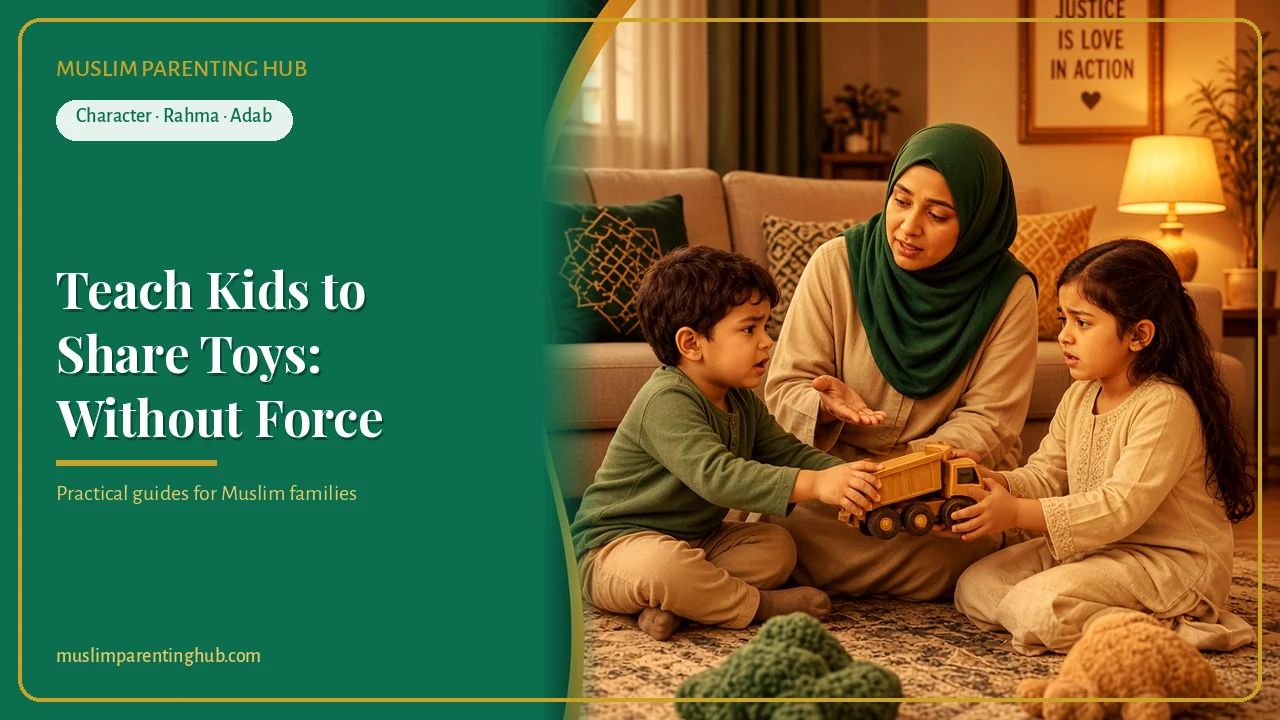
Teach Kids to Share Toys: Islamic Scripts That Stick (Without Forced Sharing)
The playdate is going fine until it isn’t. One Hot Wheels car. Two kids. One shout of “MINE!” that could power a small city.
Or it’s siblings on a rainy Saturday after soccer: the same stuffed animal, the same tug, the same parental fantasy that a speech about “sharing is caring” will fix character forever.
Forced sharing—“Give it to him right now or else”—often teaches fear or sneaky hoarding, not generosity. Islam calls us to rahma, justice, and real generosity of the heart. That grows with practice, modeling, and scripts kids can actually say.
This guide gives US Muslim families a kinder path: taking turns, protecting special toys, timers, and age-fit prophetic stories—without turning every living-room conflict into a court case.
Sharing vs Taking Turns (Teach the Difference)
Sharing sometimes means enjoying something together at the same time (a big puzzle, a blanket fort, a plate of dates).
Taking turns means one person uses it, then the other—cars, scooters, tablets, the “good” scissors.
Toddlers rarely “share” in the adult sense. They can learn wait, trade, and use a timer. When we praise “You waited for your turn—Allah loves fairness,” we build adab without fake smiles.
Link this to your wider kindness muscle with rahma activities that teach Muslim kids kindness. Sharing is one doorway into rahma—not the only one.
What Islam Nudges Us Toward (Soft, Not a Fatwa)
The Prophet ﷺ was the most generous of people, especially in Ramadan—but his generosity wasn’t performative snatching of a child’s comfort object. He taught preferring others (ithar) and he honored people’s rights.
Hadith kids can hold:
- Preferring others softens hearts—but parents should model it first with their own things.
- Smiling is charity; returning a toy gently can be charity too.
- The strong person isn’t the one who wrestles the toy away; it’s the one who controls anger in the moment of “MINE!”
Keep stories age-appropriate. A 4-year-old needs “The Prophet ﷺ loved to give and also loved being kind when someone was upset,” not a graduate lecture on zuhd.
Special Toys That Don’t Have to Be Shared
Every child may keep 1–3 special toys in a “not for playdates” bin or shelf. Explain before guests arrive:
“These three are Yusuf’s quiet toys. Everything in the living room basket is for taking turns.”
This is not selfishness. It is amanah and emotional safety. Kids who know one bear is safe are more willing to rotate the rest. Sibling homes need this even more—see fairness scripts in our guide on sibling jealousy in a Muslim home.
Put the special-toy rule on a sticky note for visiting cousins at Thanksgiving. Clear rules prevent public melt-downs in front of relatives.
Scripts for “Mine!” Moments
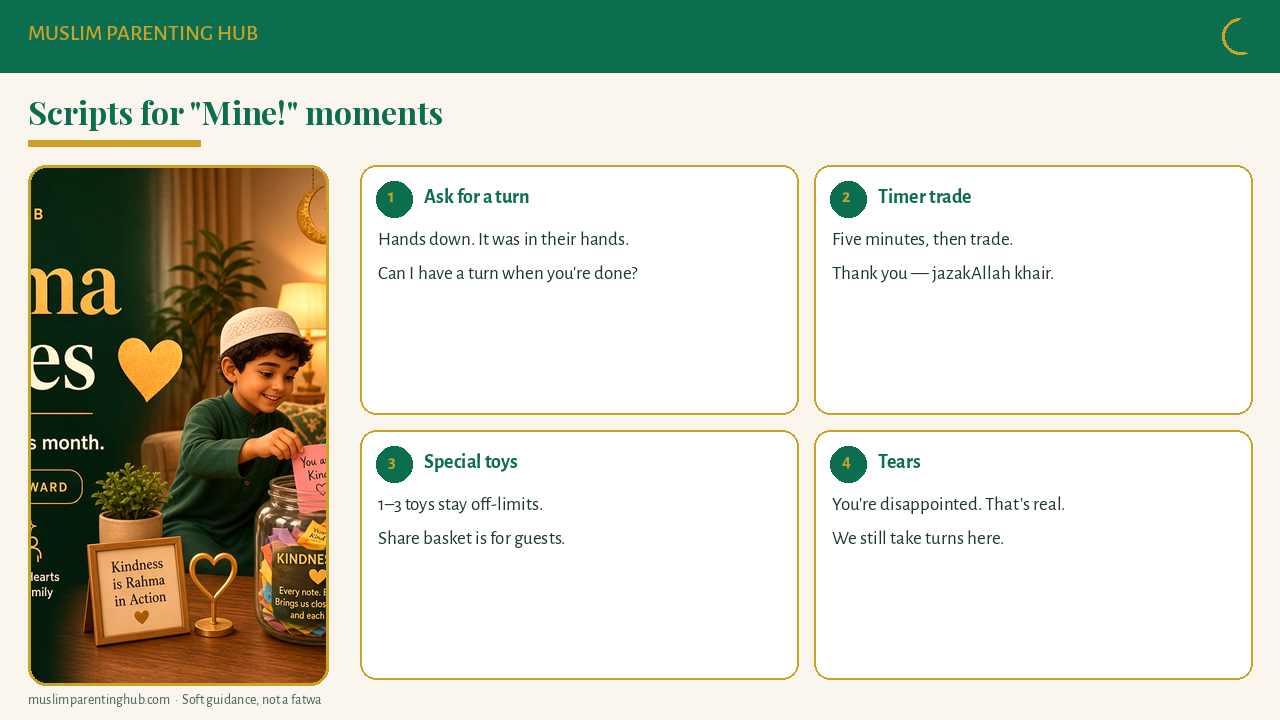
When a child grabs
“Hands down. This was in Sara’s hands. You can ask, ‘Can I have a turn when you’re done?’”
When a child refuses any turn ever
“You don’t have to finish this second. You do need a plan. Timer for five minutes, then trade—or choose a different toy from the basket.”
When tears start
“You’re disappointed. That’s real. We still take turns in this house. I’ll sit with you while we wait.”
Playdate parent peer pressure
If another parent says, “Make him share!”, you can smile and say:
“We’re practicing turns with a timer. Special toys stay put. It works better for us than forced sharing.”
You are allowed to parent your values kindly in your own living room.
The Timer Method (Works for Ages 3–10)
- Name the toy.
- Set a visual timer (sand timer or phone screen facing kids).
- Say whose turn it is.
- When it rings, coach the handoff: “Thank you for the turn. JazakAllahu khairan.”
- If the next child isn’t ready to release later, same timer—no random exceptions because someone yelled louder.
Teach kids to say jazakAllah khair on handoffs. Gratitude language turns a trade into adab.
For tablet turns after school, the same method applies—screens are just shiny toys with stronger hooks.
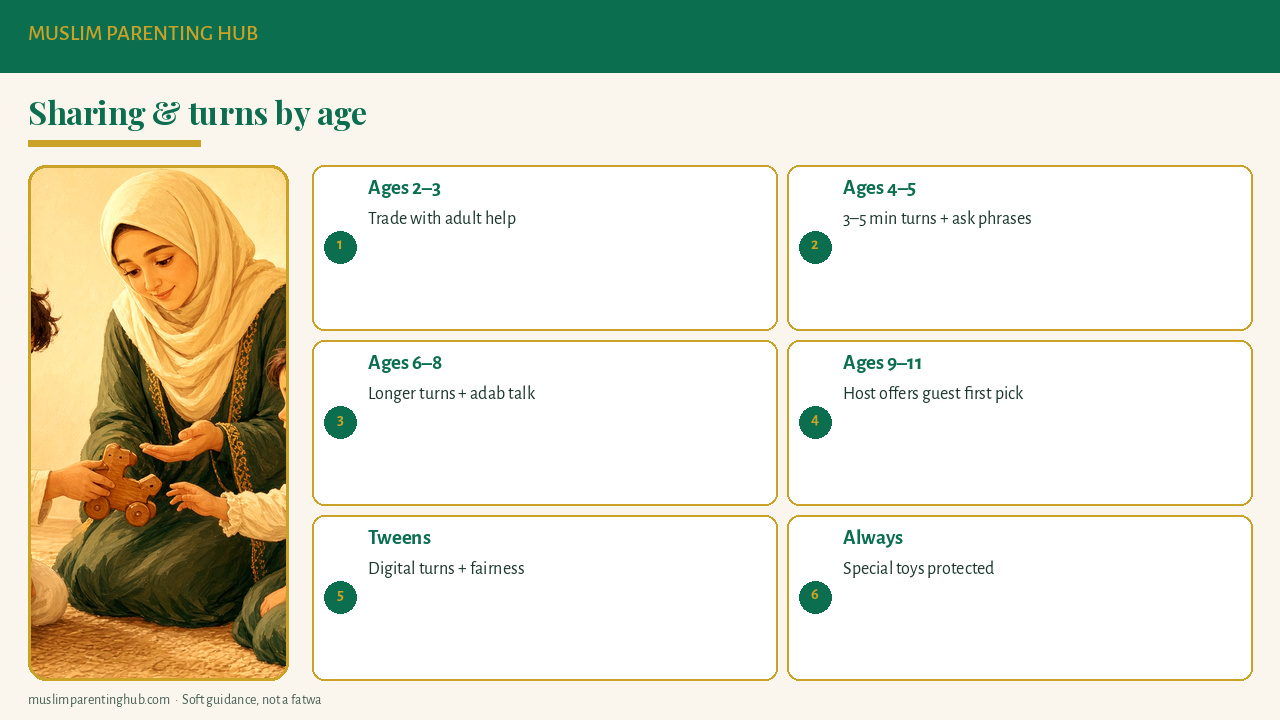
Age Chart: What to Expect
Ages 2–3: Parallel play. “Trade” with adult help. Celebrate any release. Don’t moralize.
Ages 4–5: Short turns (3–5 minutes). Practice asking phrases. Special toys protected.
Ages 6–8: Longer turns, board games, fairness talk. Connect to Islamic manners and daily adab.
Ages 9–11: Hosting skills—offer the guest first choice from the share basket. Talk about ithar as a choice, never as humiliation.
Tweens: Digital sharing (games, accounts) needs separate family rules. Generosity online still counts as character.
Prophet ﷺ Generosity Stories (Keep Them Light)
Story 1 — Giving what he loved. Soften it: “The Prophet ﷺ felt happy when he could give something useful to someone who needed it. We can practice giving with our extra toys, not by ripping a toy from your brother’s hands.”
Story 2 — Kindness to children. He greeted children, shortened prayer when he heard a baby cry, and made room for little hearts. Generosity includes patience with small people.
Story 3 — Not humiliating. Real sunnah character doesn’t shame a child in front of a playdate. Correct privately when possible: whisper, then coach the handoff.
After stories, do one tiny act: donate one outgrown toy together before winter break, or let your child pick a stickers pack for a classmate. Action seals the story. If your child struggles to notice a friend’s feelings, practice with scripts for cheering up a sad friend.
US Playdates, Classrooms, and Carpools
Playdates at your house: Set out a share basket. Hide special toys beforehand. Tell kids the plan in the car on the way home from school—not in front of guests.
Playdates at someone else’s house: Prep: “If they ask you to hand something over right away, you can say, ‘I need a minute,’ and find me.” You’re teaching boundaries and manners together.
School / daycare: Teachers often require sharing. Coach: “At school we follow teacher turns. At home we use timers and special toys.” Two contexts, one character goal.
Siblings in the car after practice: One device? Timer. Or “podcast pick” turns. Don’t let the loudest voice win every highway mile.
Helping kids build peer skills also shows up when they try to make friends at school—generosity and turn-taking are social glue.
What Not to Do
- Don’t force a sobbing toddler to “perform generosity” for adult approval.
- Don’t compare: “Your sister shares so nicely.”
- Don’t confiscate forever as your only tool—teach the skill.
- Don’t shame with heavy religious labels (“You’re so greedy; Allah hates that”) over a toy car. Redirect to the action you want.
A Weekly Micro-Practice (10 Minutes)
Once a week—Sunday evening before the school week—run a tiny drill:
- Pick two toys from the share basket.
- Practice ask → timer → thank-you.
- Role-play a guest arriving.
- End with a one-line dua: “Ya Allah, make us generous and fair.”
Put it on your family meeting agenda if you already hold weekly shura. Character habits stick when they’re scheduled like soccer.
Parent Heart Check
You don’t need perfect sharers by kindergarten. You need kids who are learning to wait, ask, thank, and protect what is sacred to them without trampling others. That is Islamic character work in a living room full of LEGO.
When you mess up and force a share in anger, repair: “I pushed too hard. Let’s try the timer way next time.” Repair is also sunnah-shaped parenting.
Hosting vs Visiting: Two Different Generosity Muscles
At home, your child is the host. Hosts offer the share basket first and keep special toys away. Practice once before the doorbell: “When friends come, we say, ‘Want to play with the basket toys?’”
When visiting, your child is the guest. Guests follow the host family’s rules even if those rules are “everyone dumps everything in one pile.” Prep in the car: “At their house we use their turns. If you feel overwhelmed, come stand by me.”
Thanksgiving cousin weeks blend both roles. Recite the special-toy rule at breakfast before relatives arrive. Give each child a cardboard box labeled “Quiet Toys” in their room. Guests don’t enter bedrooms without asking—another adab win.
Toys, Screens, and Digital “Sharing”
Tablets are the new Hot Wheels. Use the same timer method. Add one digital rule: no grabbing a device from someone’s hands—ask and wait. If two kids share one account for a game, write down whose profile is whose. Digital envy is still envy; An-Nas meanings about whispers and people can come later—for now, fair turns are enough.
For downloaded movies on a family road trip, assign “picker of the day” rather than constant voting wars. Picker-of-the-day is turn-taking in calendar form.
When a Child Hoards Because Life Feels Unsteady
Sometimes “MINE!” spikes after a move, a new baby, a divorce schedule change, or starting a new school. Hoarding can be a safety strategy. Increase one-on-one time, protect more special toys temporarily, and lower public playdate pressure for a few weeks. Generosity grows again when the heart feels safe. Pair with sibling fairness scripts if the new baby is the trigger.
Building a Give-Away Rhythm (Not a Guilt Purge)
Once a season—before winter or before Eid—invite kids to choose outgrown toys for sadaqah. Let them carry the bag to the donation drop. Do not force favorite toys into the bag. Celebrate the choice: “You made space for another child—Allah sees that.” Take a photo of the full bag for the kindness jar if you use one.
If they refuse to donate anything, skip the fight. Model donating something of yours instead. Kids borrow courage from parental action.
Classroom Sharing vs Home Sharing (Say It Out Loud)
Teachers often need quick compliance: “Share the crayons now.” That is classroom logistics. At home you have time to coach turns. Tell your child both are okay:
“At school we follow the teacher’s fast share. At home we use timers and special toys. Both can be kind.”
This dual map reduces confusion when a child says, “But Ms. Lee makes us share everything!” You’re not undermining the teacher; you’re explaining context.
Gratitude After a Good Turn
When a hard handoff goes well, narrate it once: “You wanted that truck and you still gave a turn—that was strong.” Then move on. Over-praising every share can feel manipulative. Specific, rare praise sticks better. Add jazakAllah khair between siblings until it becomes automatic furniture of the house.
FAQ
Should I force my kids to share toys?
Usually no. Forced sharing can create resentment or fake generosity. Teach taking turns with timers, protect a few special toys, and model offering from your own things. Invite sharing; don’t rip and lecture.
How many special toys should not be shared?
One to three is enough for most kids. Label them before playdates. Everything else in the common basket is eligible for turns. Update the special list as kids grow.
What do I say when kids yell “Mine!”?
Stay calm and close. “Hands down. Ask for a turn. We’ll use the timer.” Name the feeling (“You really want it”) without handing them the toy as a reward for yelling.
How does Islam teach generosity to children?
Through stories of the Prophet’s ﷺ kindness, practicing ithar with extras (not comfort objects), thank-you language like jazakAllah khair, and parents who share their own time and things. Soft guidance beats shame.
What if my child shares too much and then melts down?
Some kids people-please, then explode. Teach them it’s okay to say, “Not this one—this is special,” and to offer an alternative from the share basket. Boundaries are part of adab.
How do I handle sharing on playdates with non-Muslim friends?
Explain your house rule kindly once: turns + timer + a few off-limits toys. Most parents relax when they see a clear system. You’re teaching respect, not isolation.
Related guides
- Rahma activities to teach Muslim kids kindness
- Sibling jealousy: fairness scripts
- Islamic manners daily adab checklist
- Teach kids to say jazakAllah khair
Soft guidance, not a fatwa. For detailed questions, please ask a trusted local scholar or your masjid’s imam.
Related articles

10 Rahma Activities to Teach Muslim Kids Kindness This Month
Teach Muslim kids rahma with 10 kindness activities—kindness jar, neighbor drops, Prophet ﷺ mercy stories, age charts, and tonight scripts. Soft, practical monthly plan.
Read guide →
Sibling Jealousy in a Muslim Home: Fairness, Scripts & What Not to Say
Practical Islamic parenting scripts for sibling jealousy—fairness vs sameness, what not to say, conflict coaching, and age tips. Calm tools for Muslim homes.
Read guide →
Islamic Manners for Kids: A Daily Adab Checklist for Home, School and the Masjid (Ages 3–10)
A printable-style Islamic manners checklist for kids: 30 everyday adab habits for home, school, and the masjid, with age guides, scripts, and a weekly focus plan.
Read guide →
Teach Kids to Say JazakAllahu Khayran: Thank-You Manners for Muslim Kids at Home, School and the Masjid
How to teach kids to say JazakAllah khair and thank you: meaning, correct forms and replies, US school and masjid scripts, thank-you notes and a 7-day plan.
Read guide →