Teach Kids to Apologize with Heart: Islamic Repair Scripts (Plus Soft Istighfar)
Someone is crying. Someone else is shouting “I don’t care!” A toy is broken. Your own voice is rising. And then the parenting line we all inherited leaves your mouth: “Say sorry—NOW.”
Sometimes you get a flat “sorry” that means nothing. Sometimes you get refusal. Sometimes you get a second hit.
Islam calls us to truthfulness, mercy, and making things right—not to empty performances. This guide gives you heart-level apology scripts, a simple three-step repair, age bands, and a soft istighfar practice that does not shame your child. Soft parenting guidance, not a fatwa.
Why Forced “Sorry” Often Fails
A rushed apology teaches:
- Words are a ticket out of trouble
- Adults care more about appearances than feelings
- Anger must be hidden, not guided
A repair teaches:
- Someone got hurt (empathy)
- I can help make it better (agency)
- Allah loves those who turn back (hope)
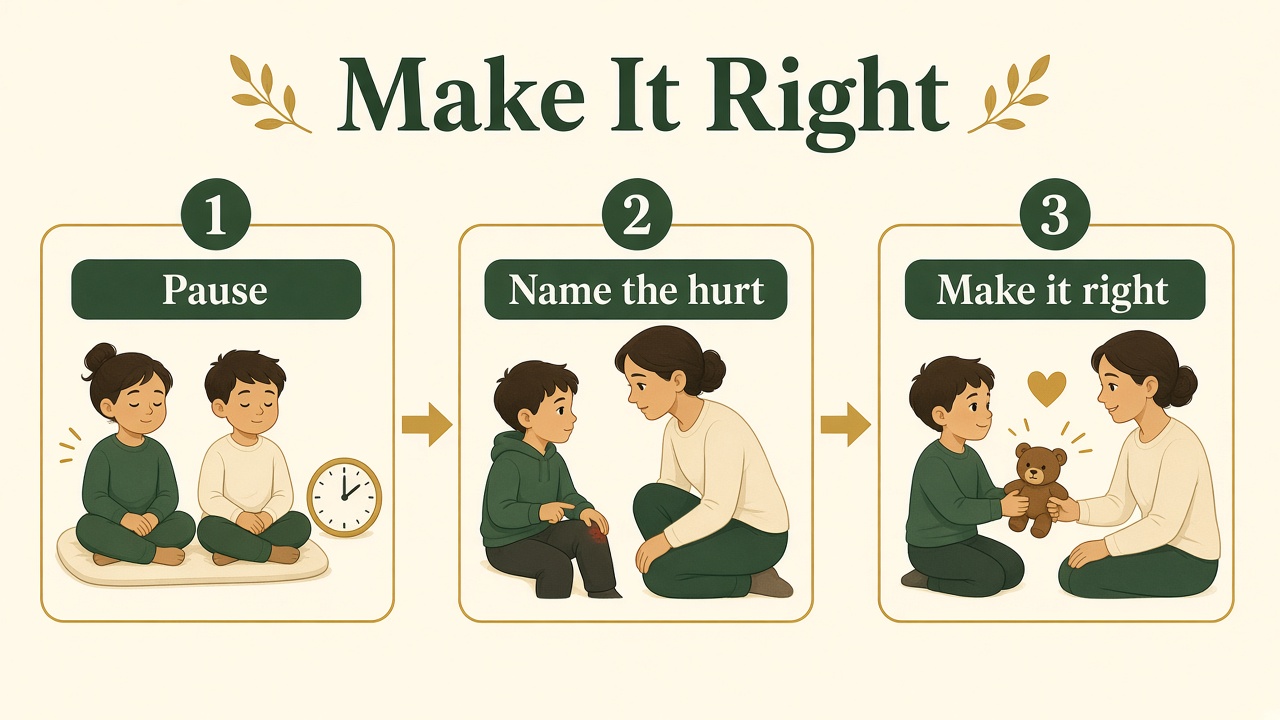
The 3-Step Repair (Use Tonight)
Step 1 — Pause the body
Separate if needed. Sit at eye level. Lower your voice first.
“Stop hands. We’re taking a calm break. Then we fix this.”
No lecture during the storm. Regulate, then educate.
Step 2 — Name the hurt (truth)
Help the child see the impact without character assassination.
“Your hit hurt Yusuf’s arm. He’s sad and scared.”
“You took the toy. Now Maya feels it’s unfair.”
For lying moments, pair with your child lied response guide—truth-telling and apology often travel together.
Step 3 — Make it right (action + words)
Words and a small repair:
- Ice pack / gentle pat (with consent)
- Return the toy
- Rebuild the block tower
- Draw a “sorry picture”
- Give space + later hug if wanted
Script:
“We fix what we can. Say: ‘I’m sorry I hit you. Are you okay?’ Then ask how to help.”
If they cannot say it yet, you model:
“I’m sorry my child hurt you. We’re practicing gentle hands. Can we get you water?”
Age-Band Apology Scripts
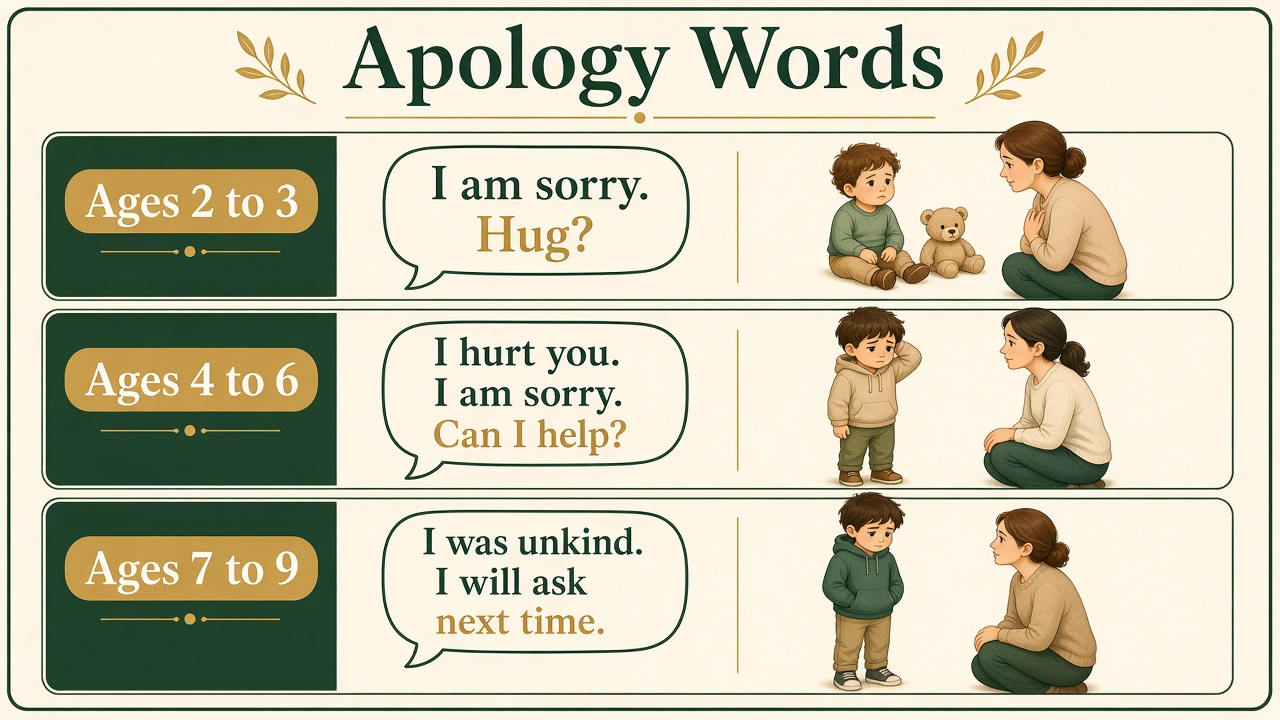
Toddlers (~1–3)
Keep it tiny. You narrate; they echo a word.
Parent: “Oops—hit. Gentle hands. Say: Sorry.”
Child: “Sorry” / wave / forehead touch—celebrate attempts.
Repair: hug (if wanted), toy return, sit apart for 30 seconds of calm.
Do not demand a speech. Demand safety.
Preschool (~3–5)
Add feeling words + one repair choice.
“I threw your puzzle. I’m sorry. I can help pick it up. Will you forgive me when you’re ready?”
Teach that forgiveness is not owed on a timer.
School-age (~6–12)
Add ownership without humiliation.
“I was angry and I called you a name. That was wrong. I’m sorry. I will not do that again. How can I make it right?”
If sibling jealousy is the root, use tools from sibling jealousy fairness scripts.
Soft Istighfar: Turning to Allah Without Shame
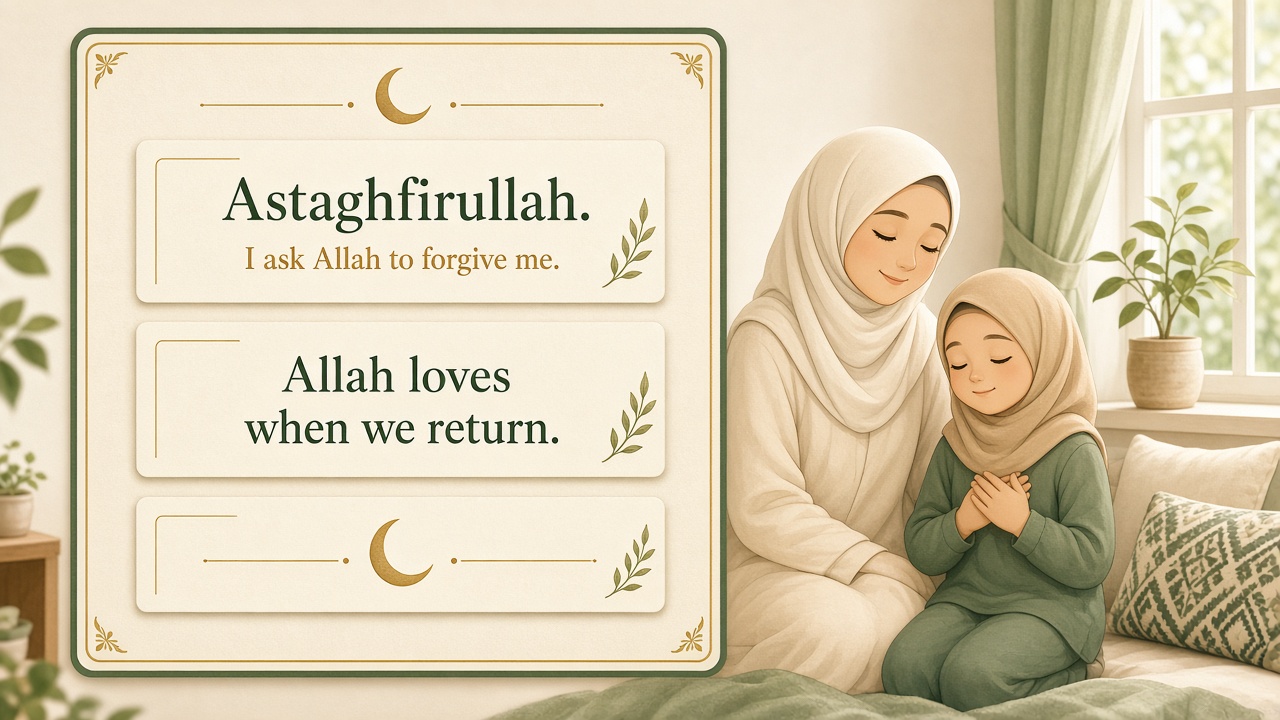
Istighfar is asking Allah for forgiveness. For kids, keep it hopeful, never terrifying.
After human repair (or alongside it), you can say:
“We also tell Allah: Astaghfirullah—please forgive us and help our hands be gentle.”
Or meaning-first for little ones:
“Allah, we made a mistake. Please help our hearts be soft. Ameen.”
Good times for soft istighfar:
- After repair, in a calm whisper
- At bedtime as a family reset (dua from the heart pairs well)
- After you, the parent, lose your temper—model it
Avoid:
- “Allah is angry at you” as a control tool
- Making a child cry “Astaghfirullah” while still dysregulated
- Public shaming istighfar in front of guests
Allah’s mercy is wider than a Tuesday afternoon sibling war. Teach that.
What NOT to Force
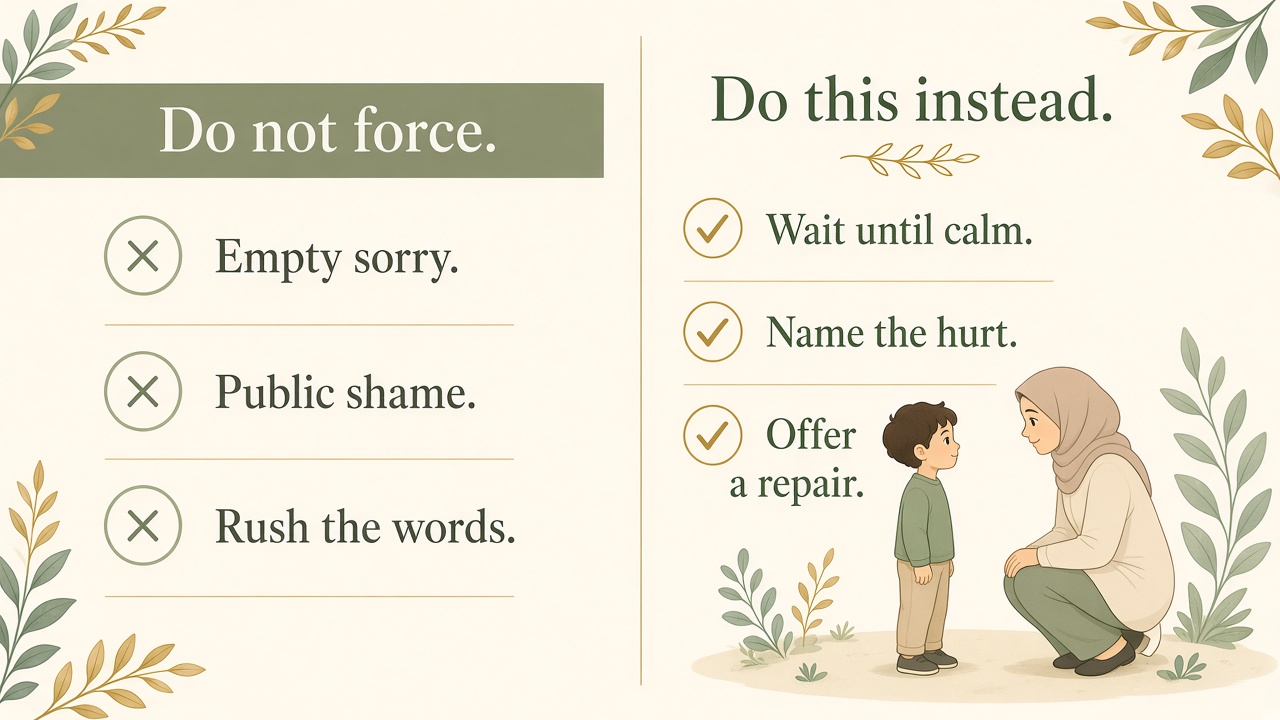
- Immediate forgiveness — the hurt child may need time.
- Matching emotional theater — fake tears are not taqwa.
- Apology as the only consequence — sometimes toys pause; keep consequences related and calm.
- “Hug now” — consent matters; forced hugs confuse body safety.
- Comparing piety — “Your cousin apologizes better” is poison.
- Ignoring the aggressor’s feelings — anger can be named: “You were mad. Mad is okay. Hitting is not.”
Special Case: After Hitting a Sibling
Sequence that protects both kids:
- Safety / separate
- Tend the hurt child first (mercy is visible)
- Calm the hitter’s body
- Repair script + action
- Later: problem-solve the trigger (toy scarcity, hunger, jealousy)
Tonight script for the hurt child:
“You didn’t deserve that. I’m here. When you’re ready, they can apologize.”
Tonight script for the hitter:
“I won’t let you hurt. I also won’t shame you. We practice better hands.”
Layer rahma activities on peaceful days so kindness is not only a post-crisis lecture.
When Your Child Refuses to Apologize
Possible meanings: shame overload, still angry, doesn’t trust fairness, or copying a home pattern.
Try:
“You don’t have to feel soft yet. You do need a safe body. We’ll try words in five minutes.”
Offer a written/drawn sorry for kids who freeze verbally.
If refusal is chronic and contemptuous, look at the whole climate: are adults modeling repair after yelling? Children rarely invent apology culture alone.
Parent model (gold standard):
“I raised my voice. That scared you. I’m sorry. Astaghfirullah. I’m practicing calm too.”
Talk about Allah’s mercy in ordinary moments with toddler Allah talk so “turning back” feels familiar.
Soft Islamic Anchors (Non-Fatwa)
- Muslims are encouraged to repent and seek forgiveness.
- Making amends with people we wrong is part of good character.
- Mercy in the home teaches who Allah is more loudly than a lecture.
Exact rulings on rights of others, qisas, etc., are not toddler parenting—keep this practical and merciful. Ask scholars for serious harm cases.
A Weekly “Repair Culture” Checklist
- [ ] Adults apologized out loud at least once
- [ ] One sibling repair included an action, not only a word
- [ ] Soft istighfar used as hope, not threat
- [ ] Hurt child was tended before the performance
- [ ] No forced hug after conflict
Scripts Bank by Situation
Toy snatching
“You wanted it badly. Snatching hurt. Give it back, say sorry, then we use a timer so both get a turn.”
Mean words
“Words can hit hearts. Say: ‘I’m sorry I said that. It wasn’t true/kind.’ Then say one true kind thing.”
Breaking something
“Accidents and choices are different. If it was a choice, we apologize and help clean or replace what we can. Astaghfirullah—help us be careful.”
Public meltdown (store/masjid)
Repair privately later. In public, prioritize exit and safety. Shame in the aisle creates fear, not character.
When both kids share blame
“Two things can be true: you were poked AND you hit. We repair both sides. No trophy for who was ‘more wrong.’”
Building Empathy on Calm Days (So Crisis Is Easier)
Apology skills collapse if empathy is only demanded after damage. On peaceful days:
- Read a short feelings book and ask, “How does he feel?”
- Practice “gentle hands” on a doll or stuffed animal
- Play “fix the teddy”: knock teddy softly, then apologize and offer a blanket
- Notice kindness out loud: “You shared—that was rahma.”
Five minutes of calm practice beats a twenty-minute post-fight sermon.
Parent Debrief After a Hard Afternoon
When kids are in bed, ask yourself (not them):
- Was anyone hungry, tired, or overstimulated?
- Did I escalate with my tone?
- Did the hurt child feel protected?
- Did the hitter learn a path back, or only a path into shame?
Then make one tiny plan for tomorrow—not a personality overhaul.
Classroom and Playdate Translations
Send kids out with one portable script:
“I am sorry for ___. Are you okay? How can I help?”
Coach once before the playdate. Afterward debrief with curiosity, not prosecution:
“Was there a moment you needed repair today?”
Teachers appreciate children who can repair; it is social Sunnah in shoes.
When Adults Disagree on Apology Style
One parent wants immediate sorry; the other wants feelings first. Agree on a house rule:
- Safety first
- Calm body second
- Repair third (words + action)
- Soft istighfar when hearts are ready
Write it on a sticky note. Consistency between adults matters more than poetic scripts.
Measuring Progress Without Obsession
Once a week, note privately:
- Did repairs get faster?
- Did empty “sorry” decrease?
- Did you model apology?
If yes to any, the culture is moving. Character is a slow plant; water it with mercy.
FAQ
How do I teach my child to apologize in an Islamic way?
Use repair: pause, name the hurt, make it right with words and action, then optionally add a soft Astaghfirullah. Model it yourself when you err.
Should I force my child to say sorry?
Force safety, not theater. Invite a real apology when calm. If they cannot speak yet, you model and return later.
How do I introduce istighfar to kids?
Keep it short and hopeful: “Astaghfirullah—Allah, forgive us and help us do better.” Never use it to terrify.
What if my child hits and laughs?
Treat safety first, then teach empathy in calm time. Laughing can be nervousness or lack of insight—coach concretely: “Hitting hurts. We check if they’re okay.”
What if siblings refuse to forgive each other?
Allow time. Require respectful distance and no revenge. Forgiveness is a gift, not a button parents push.
How is this different from just punishing?
Punishment alone may stop a behavior briefly. Repair builds empathy, responsibility, and a path back through Allah’s mercy.
Related guides
- Sibling Jealousy in a Muslim Home
- When Your Child Lied: An Islamic Parenting Response
- Rahma Activities for Muslim Kids
- Talk About Allah with Toddlers
The goal is not a child who performs “sorry” on command. The goal is a child who knows how to come back—to their sibling, to you, and to Allah—with a heart that can bend without breaking. Practice one soft repair tonight. That is Islamic manners with a pulse.
FAQs
How do I teach my child to apologize in an Islamic way?
Use repair: pause, name the hurt, make it right with words and action, then optionally add a soft Astaghfirullah. Model it yourself when you err.
Should I force my child to say sorry?
Force safety, not theater. Invite a real apology when calm. If they cannot speak yet, you model and return later.
How do I introduce istighfar to kids?
Keep it short and hopeful: Astaghfirullah—Allah, forgive us and help us do better. Never use it to terrify.
What if my child hits and laughs?
Treat safety first, then teach empathy in calm time. Laughing can be nervousness or lack of insight—coach concretely.
What if siblings refuse to forgive each other?
Allow time. Require respectful distance and no revenge. Forgiveness is a gift, not a button parents push.
How is this different from just punishing?
Punishment alone may stop a behavior briefly. Repair builds empathy, responsibility, and a path back through Allah’s mercy.