

Good Sportsmanship for Muslim Kids: Winning, Losing and Teamwork With Islamic Adab
The final whistle blows. Your daughter’s soccer team lost 4–1. She stomps to the car, throws her water bottle into the back seat, and says, “The ref was cheating and Ava never passes. I’m quitting.”
Or it goes the other way: your son’s flag football team wins, and he spends the whole ride home telling his little brother how terrible the other team was.
Fall in America means youth sports—soccer, flag football, volleyball, cross-country, swim, and backyard basketball until the streetlights come on. For Muslim parents, sports aren’t just exercise. They’re one of the best character classrooms we’ll ever get. Every game is a chance to practice patience, humility, controlling anger, honesty, and kindness under pressure.
This guide gives you the Islamic foundation for sportsmanship, scripts for losing and winning, anger tools, sideline manners for parents (yes, us), a simple game-day routine, and age-by-age tips. It’s soft guidance for real families.
Sports Are Part of the Sunnah
Sometimes kids (and adults) feel that religion and sports live in separate worlds. They don’t.
- The Prophet ﷺ raced his wife Aisha. She won the first time. Years later, he won and laughed, “This is for that one” (Abu Dawud). Winning and losing were both part of the fun.
- He encouraged archery, swimming, and horse riding, and he watched young people practice their skills.
- Once, he passed a group of companions in an archery contest and joined one side. The other side stopped shooting. “Why don’t you shoot?” he asked. “How can we, when you are with them?” He said, “Shoot, and I am with all of you” (Bukhari).
That last story is a perfect sportsmanship lesson: competition is fine, but in the end, we’re one community.
The Five Adab of a Good Sport
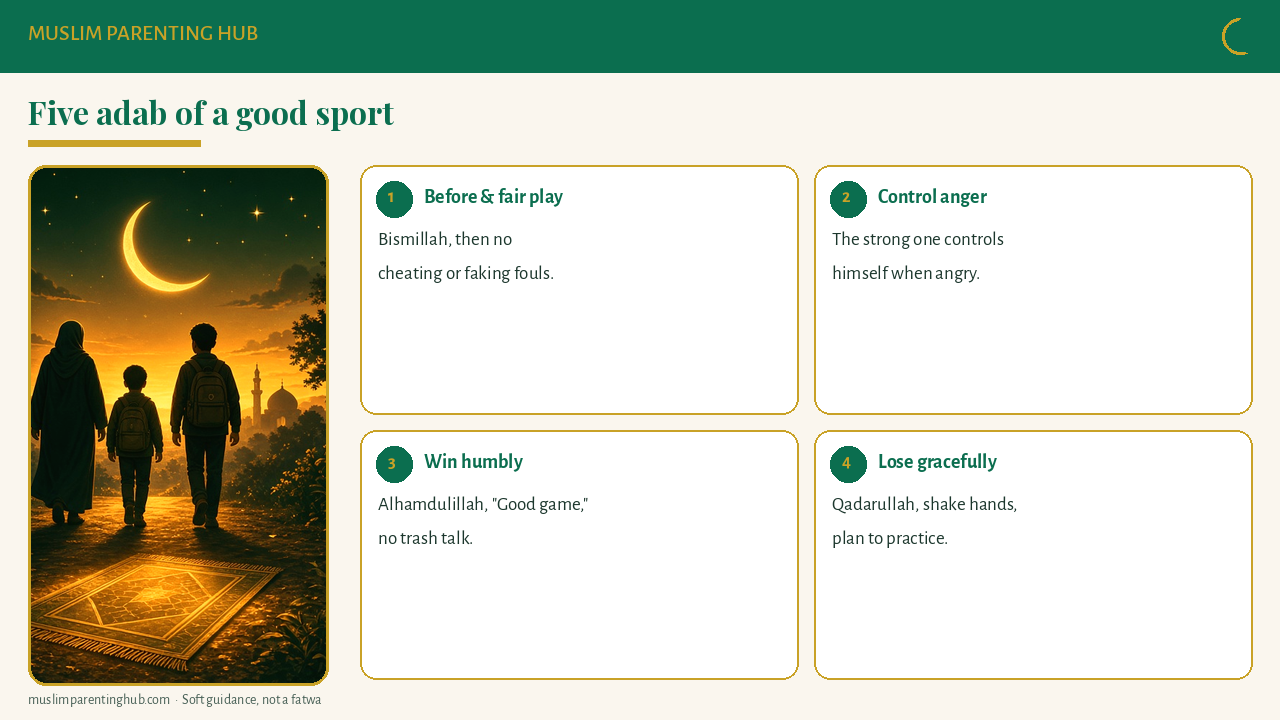
Teach these as a simple list kids can repeat:
- Say Bismillah before you play. Your effort is for Allah, and Allah sees your effort, not just the score.
- Play fair. No cheating, no faking fouls, no “accidentally” tripping. Honesty doesn’t take a day off on the field.
- Control your anger. “The strong person is not the one who overpowers others, but the one who controls himself when angry” (Bukhari, Muslim).
- Win humbly. No bragging, no trash talk. Say “Alhamdulillah” and “Good game.”
- Lose gracefully. Say “Qadarullah” (Allah decreed it), shake hands, and plan to practice.
These five fit right alongside the rest of your family’s everyday manners. Our daily Islamic manners checklist for kids is a nice place to add “good sport” as a habit for fall.
When Your Child Loses
Losing hurts. Big feelings after a loss are normal, especially for younger kids. Your job isn’t to stop the feeling; it’s to help your child move through it with adab.
Step 1: Wait before you talk
Kids are flooded right after a loss. Hand them water, offer a snack, and drive in quiet for a few minutes. Avoid post-game analysis in the parking lot.
Step 2: Name the feeling
“You’re really disappointed. You worked so hard. That makes sense.”
Step 3: Gently bring in the faith frame
“Allah saw every run and every block you made today. The score isn’t the only thing that counts. What’s one thing you did that you’re proud of?”
Step 4: Teach “Qadarullah wa ma sha’a fa’al”
“Allah decreed it, and He does what He wills.” The Prophet ﷺ taught this phrase for disappointments instead of “If only…” (Muslim). It doesn’t mean we don’t care; it means we accept and move forward.
Step 5: Turn to effort
“What do you want to practice this week?”
Then practice together—ten minutes of passing in the backyard does more than ten minutes of lecture.
Scripts for common sore-loser moments
“The ref was cheating!”
“Refs make mistakes sometimes, like all of us. Blaming them won’t help us get better. What could our team do differently?”
“I’m quitting!”
“You can feel like quitting tonight. We made a promise to the team for this season, so we’ll finish strong. We can decide about next season later.”
(Keeping commitments is a big deal in Islam. Our guide to teaching kids to keep promises explains why finishing the season matters.)
“It’s Ava’s fault!”
“In our family, we don’t blame teammates. Teams win together and lose together.”
When Your Child Wins
Winning well is just as important as losing well, and often harder to teach.
- Alhamdulillah first. Teach kids to thank Allah before anything else.
- Thank the team and coach. “We did it together.”
- Encourage the other team. “You guys played hard!”
- No trash talk. The Quran warns, “Let not a people mock another people; perhaps they may be better than them” (Quran 49:11).
- Brag-free car ride. Celebrate with ice cream or a family high five, not by putting the other team down.
A helpful question for the ride home:
“How do you think the other team felt? What could you say to a friend on that team at school tomorrow?”
That simple question grows rahma. For more ways to build empathy, our 10 rahma activities to teach Muslim kids kindness has ideas you can use all season.
Anger Tools for the Field (and the Car)
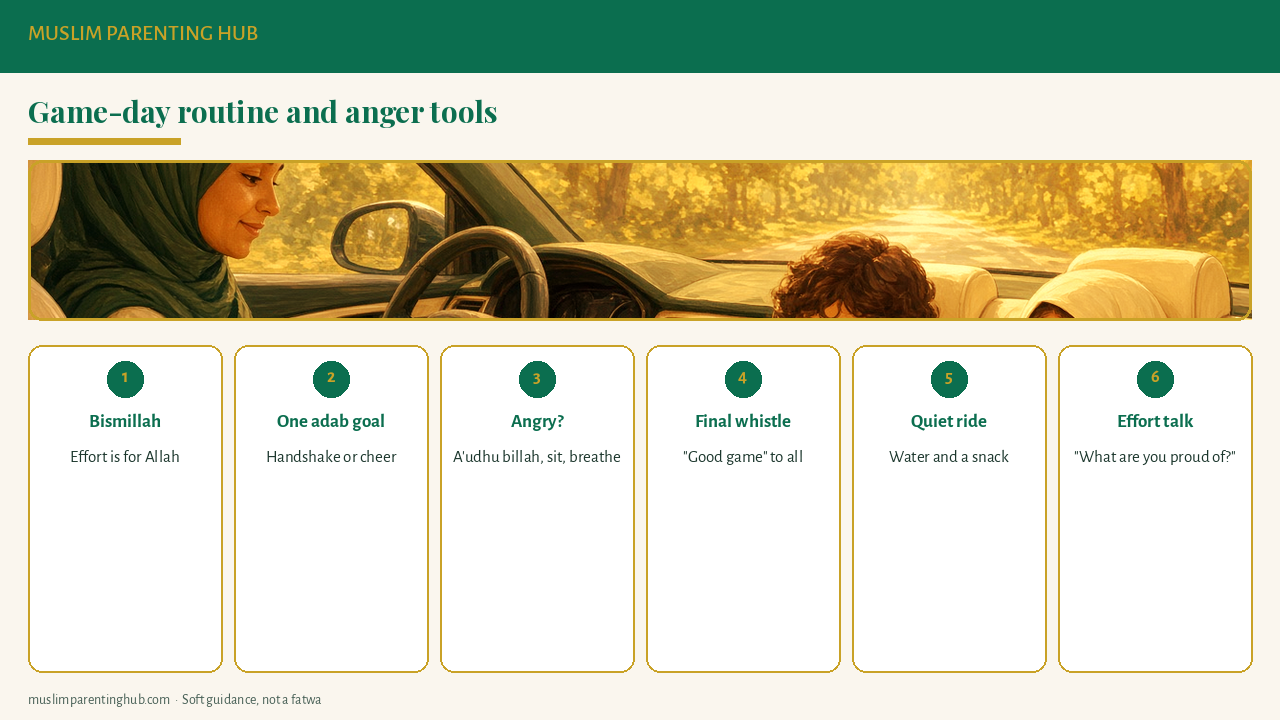
Kids need tools, not just rules. Teach these at home when everyone’s calm:
- Seek refuge. Quietly say, “A’udhu billahi min ash-shaytan ir-rajim.” The Prophet ﷺ taught this for anger (Bukhari).
- Change your position. If you’re standing, kneel or sit down (Abu Dawud). On the field, that might be taking a knee for a moment.
- Breathe in for four, out for four.
- Water. A drink of water—and wudu later—cools the body and heart.
- Silence. “If one of you becomes angry, let him be silent” (Ahmad). Teach kids that closing their mouth is a real skill.
If anger spills over and your child says or does something hurtful, coach a real apology afterward. Our Islamic repair scripts for apologies help kids say sorry with heart—to a teammate, a ref, or a sibling.
Sideline Manners for Parents
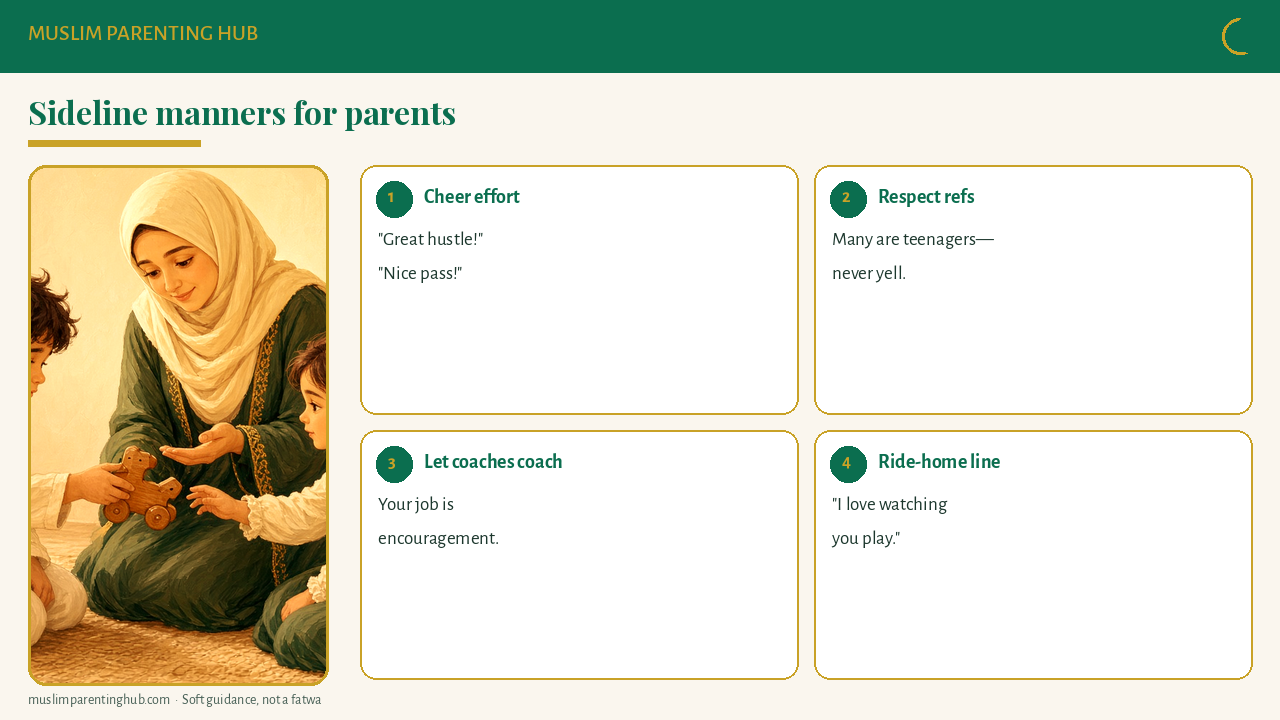
Here’s the uncomfortable truth: kids learn sportsmanship from the sidelines as much as from the field.
- Cheer for effort, not just goals. “Great hustle!” “Nice pass!”
- Never yell at refs. Many youth refs are teenagers. Your child is watching how you treat them.
- Don’t coach from the sideline. Let the coach coach. Your job is encouragement.
- Be kind to other parents and players. Clap for good plays on both teams.
- Ride home rule: Start with “I love watching you play.” That’s it. Let your child bring up the game if they want.
Our faith asks us to be people of good character in public, not only at the masjid. A calm, kind parent on the sidelines is a quiet form of da’wah.
Sibling Sports Rivalry
Backyard games between siblings can turn from fun to fury fast. A few house rules help:
- Younger siblings get a head start or handicap (fair isn’t always equal).
- Rotate who picks teams.
- Anyone can call a “cool-down,” and everyone stops for one minute.
- The winner says, “Good game,” and the loser says, “Good game.” Same words.
If competition is a constant flashpoint, our guide to sibling jealousy in a Muslim home has fairness scripts that work for games too.
Practice at Home: Family Game Night
The best place to practice sportsmanship isn’t the field—it’s your living room floor. Low-stakes games give kids dozens of chances to lose, win, and recover in one evening.
- Pick quick games like Uno, Connect 4, Jenga, or a backyard relay, so there are many rounds.
- Parents lose out loud. “Oh no, I lost! Qadarullah. Good game! Rematch?” Kids copy what they see.
- Pause for big feelings. If someone flips the board, the game pauses for a one-minute cool-down, then everyone tries again.
- End with a “good sport” shout-out. Name one person who handled losing or winning well that night.
A weekly game night after Maghrib on Friday or Saturday turns this into a warm family habit rather than a lesson.
Practical Muslim-Family Notes for Sports Season
- Prayer: Fall sunsets come early, and Maghrib often falls during practice. Talk to the coach at the start of the season and keep a small prayer kit in the car.
- Modest uniforms: Many leagues allow leggings, long sleeves, and sports hijabs. Ask early and kindly.
- Halal snacks: Team snack rotations are common. Offer to bring fruit, juice boxes, or halal-certified snacks when it’s your turn.
- Ramadan seasons: If Ramadan overlaps with a season, older kids who fast may need lighter practice; talk to the coach.
- Jumu’ah: For Friday games or tournaments, plan around prayer when possible.
Age-by-Age Tips
Ages 3–5
Use board games and backyard races to practice. Play “losing practice”: you lose on purpose and model, “Oh well! Good game! Let’s play again.” Praise them when they do the same.
Ages 6–8
This is peak sore-loser age. Practice scripts before games, keep post-game talks short, and focus on effort. Let them choose one “adab goal” per game: shaking hands, cheering a teammate, or no complaining about the ref.
Ages 9–12
Talk about character and leadership. Ask them to be the teammate who encourages others. Discuss real examples from pro sports—both good and bad—and what Islam would say.
FAQ
How do I teach my child to lose gracefully?
Wait until they’re calm, name their feeling, remind them Allah sees their effort, teach “Qadarullah wa ma sha’a fa’al,” and turn the conversation toward practicing. Model losing well yourself in family games.
Is it okay for Muslim kids to play competitive sports?
Yes. The Prophet ﷺ raced, encouraged archery and swimming, and watched young people compete. Keep prayer, modesty, honesty, and good manners at the center.
What should my child say after a game?
“Good game” to the other team, “Thank you, Coach” to the coach, and “Alhamdulillah” whether they won or lost.
My child gets very angry when losing. What can help?
Teach anger tools when calm: seeking refuge in Allah, sitting or kneeling, slow breathing, a drink of water, and staying silent until calm. Practice them in board games at home first.
How should parents behave on the sidelines?
Cheer effort, never yell at refs or coach from the sidelines, clap for both teams, and start the ride home with “I love watching you play.”
Related guides
- Islamic manners for kids: a daily adab checklist
- 10 rahma activities to teach kindness
- Praying Maghrib on the go: sports and carpools
- Teach kids to apologize with heart
Closing: The Score Fades, Character Stays
In five years, nobody will remember the final score of this Saturday’s game. But your child might remember the day they shook hands after a tough loss and said, “Good game—Qadarullah.” That’s a habit that will carry into exams, job interviews, and every hard day of life. Practice it in the backyard this week, cheer for effort from the sidelines, and let fall sports season become a season of good character.
Related articles

10 Rahma Activities to Teach Muslim Kids Kindness This Month
Teach Muslim kids rahma with 10 kindness activities—kindness jar, neighbor drops, Prophet ﷺ mercy stories, age charts, and tonight scripts. Soft, practical monthly plan.
Read guide →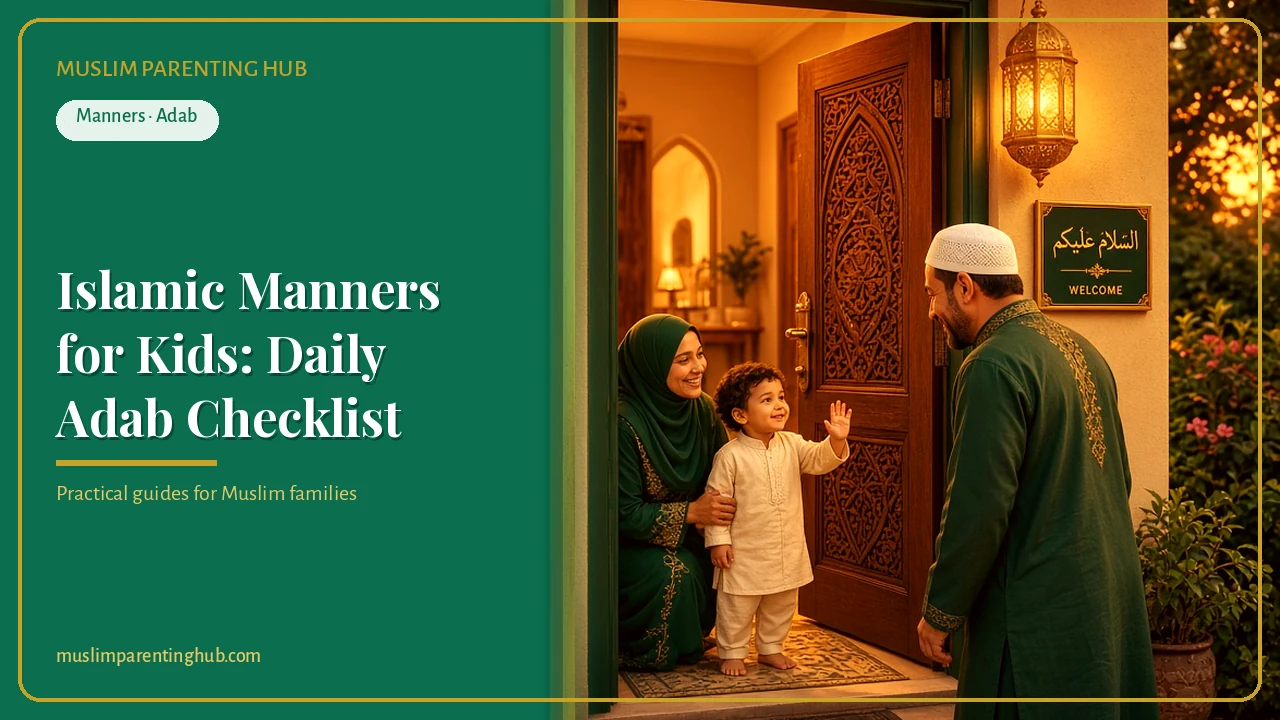
Islamic Manners for Kids: A Daily Adab Checklist for Home, School and the Masjid (Ages 3–10)
A printable-style Islamic manners checklist for kids: 30 everyday adab habits for home, school, and the masjid, with age guides, scripts, and a weekly focus plan.
Read guide →
Teach Kids to Apologize with Heart: Islamic Repair Scripts (Plus Soft Istighfar)
Teach kids to apologize with Islamic repair scripts—pause, name the hurt, make it right—plus soft istighfar without shame. Age bands, what not to force, sibling tips.
Read guide →
Praying Maghrib on the Go With Kids: Soccer Practice, Carpools and Evening Errands
Maghrib hits during soccer practice, carpool, or a Target run? A portable prayer kit, where to pray, a 10-minute on-the-go plan, and coach scripts for US families.
Read guide →