Why Did Allah Create Us? Simple, True Answers for Kids’ Big Question (Ages 4–12)
It often comes at bedtime, or in the car, or right after a sibling fight. “Mama, why did Allah make us?” Sometimes it is a little sharper: “Why did Allah make me? I didn’t ask to be born.”
Take a breath. This is one of the best questions a child can ask. It means they have noticed that the world is not an accident, and they want to know where they fit. You do not need a philosophy degree to answer it. The Quran gives a short, clear answer, and your job is to say it in words that feel warm, not heavy.
This guide gives US Muslim parents a short answer to say first, the three ideas behind it, scripts for ages 4–12, things to avoid, and a five-day plan that helps kids feel they were made on purpose and with love. It is gentle home guidance, not a fatwa. If your child’s weekend school teacher or imam uses particular words, follow that trusted wording.
This question often arrives in the same season as “Where is Allah?” If your child is asking both, start with our main guide to where is Allah answers for kids, then come back here.
The Short Answer (Say This First)
“Allah made you on purpose, because He wanted you to be here. He made you to know Him, to love Him and to worship Him, and worship means doing good things for Allah, like praying, telling the truth and being kind. Allah doesn’t need anything from us. He made us out of His mercy, and He wants us to be with Him in Jannah one day.”
That answer rests on a few true points from the Quran:
- We were made to worship Allah. “I did not create jinn and humans except to worship Me” (Quran 51:56).
- Allah does not need us; we need Him. “O people, you are the ones in need of Allah, and Allah is the Free of all needs, the Praiseworthy” (Quran 35:15).
- Life is a chance to do good. Allah “created death and life to test which of you is best in deeds” (Quran 67:2).
- We were made with honor. “We have certainly honored the children of Adam” (Quran 17:70), and “We created the human being in the best form” (Quran 95:4).
Say it slowly. A hug while you say it does half the teaching.
Three Ideas Kids Can Hold On To
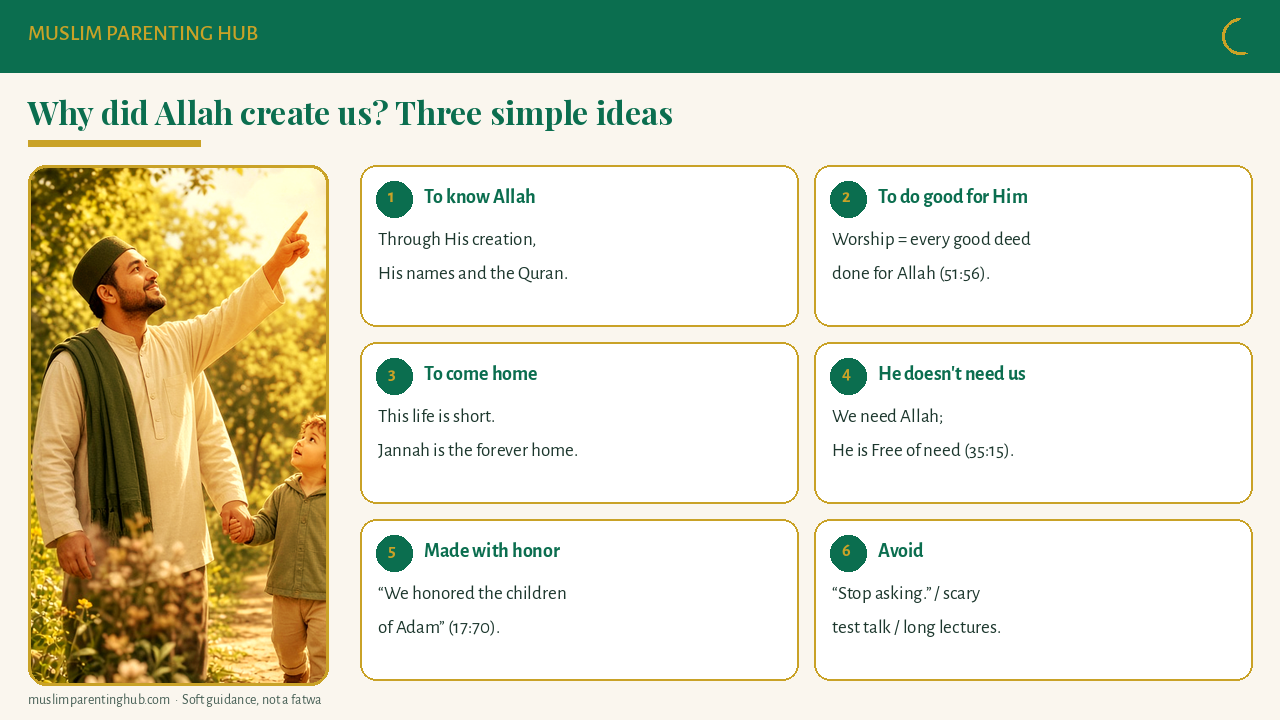
Young children remember pictures better than sentences. Many families use three simple ideas, one for each finger:
- To know Allah. We can know Him through His creation (the moon, our hands, rain), through His names like Ar-Rahman, and through the Quran. Our guide to names of Allah for kids has ten easy names to start with.
- To do good for Allah. “Worship” is bigger than salah. Helping a sibling, saying Bismillah before eating and telling the truth all count when we do them for Allah.
- To come home to Jannah. This life is short, like a school day. Jannah is the forever home Allah wants us to reach.
“So every day is a chance to know Allah a little more and do one more good thing for Him.”
Scripts by Age
Ages 4–6: Made With Love
Little ones mostly want to know they were wanted.
“Allah made you because He wanted you. He gave you eyes to see His moon and hands to help people. When you say ‘Alhamdulillah,’ you are doing the thing Allah made you for.”
Keep it to two or three sentences, then let them ask more if they want to.
Ages 7–9: Worship Is Bigger Than You Think
Kids this age often think “worship” means praying all day, which sounds boring.
“Worship means doing anything good for Allah. Salah is the most important part. But when you share your snack, do your homework honestly or help Dad carry groceries and you do it for Allah, that is worship too. Allah made us to fill our day with those things.”
You can connect this to the five daily prayers: five short visits with Allah spread through the day. Our five daily prayers for kids guide explains each one simply.
Ages 10–12: A Test and a Trust
Older kids can handle the idea of a test, as long as you keep it hopeful.
“Allah says He created life to see who does the best deeds (67:2). It’s like a test where Allah gives you the answers in the Quran, sends you help, forgives your mistakes when you say sorry, and rewards even your intention. He wants you to pass.”
You can also mention the trust (khilafah) of looking after the earth (Quran 2:30): caring for animals, not wasting water, and being fair to people are part of why we are here.
“But I Didn’t Ask to Be Born”
Some kids, especially after a hard day, say this with real frustration. Don’t panic and don’t scold.
“That sounds like a big feeling. Do you want to tell me what happened today?”
Deal with the feeling first. Later, when they are calm:
“You’re right, you didn’t ask. Allah gave you life as a gift, the way I gave you a gift on your birthday without you asking. He also gave you people who love you, and a way to Jannah. I’m really glad you’re here.”
If “I wish I wasn’t born” comes up often, or with talk of hurting themselves, treat it as a feelings and safety issue first. Talk to your pediatrician or a school counselor. Faith answers are not a replacement for that care.
What Not to Say
- “Allah made you to test you, so you’d better not fail.” True words, scary framing. Lead with mercy and love.
- “Stop asking questions like that.” This teaches kids that faith can’t handle questions. It can.
- “Allah needed people to worship Him.” Allah needs nothing (35:15). We are the ones who benefit.
- “Because I said so” or “Just because.” Kids deserve a real answer, even a short one.
- Long lectures. Answer in a minute, then offer: “Want to hear more another day?”
Avoid weak or made-up sayings you may have heard. The Quran verses above are clear and enough.
Make It Concrete: Small Moments That Teach Purpose
Children learn purpose by living it, not just hearing it. Try these during an ordinary week:
- The “for Allah” whisper. Before a chore or kind act, whisper together, “This is for Allah.” It turns tidying the shoe rack into worship.
- Wonder walks. On a fall evening, point out leaves, geese and the early sunset. “Who made all this? Why do you think He shows it to us?” Our where is Allah activities for kids list has more hands-on ideas.
- A gratitude minute at dinner. Each person names one gift from Allah. Knowing Allah through His gifts is part of why we were made. Do it for two weeks and it becomes a habit.
- Connect salah to purpose. When the adhan plays, say, “Time for the most important thing we were made for.”
- Answer follow-up questions honestly. “Who made Allah?” often comes next. Our guide to who made Allah? calm answers for kids is ready when it does.
The Five-Day “Made on Purpose” Plan
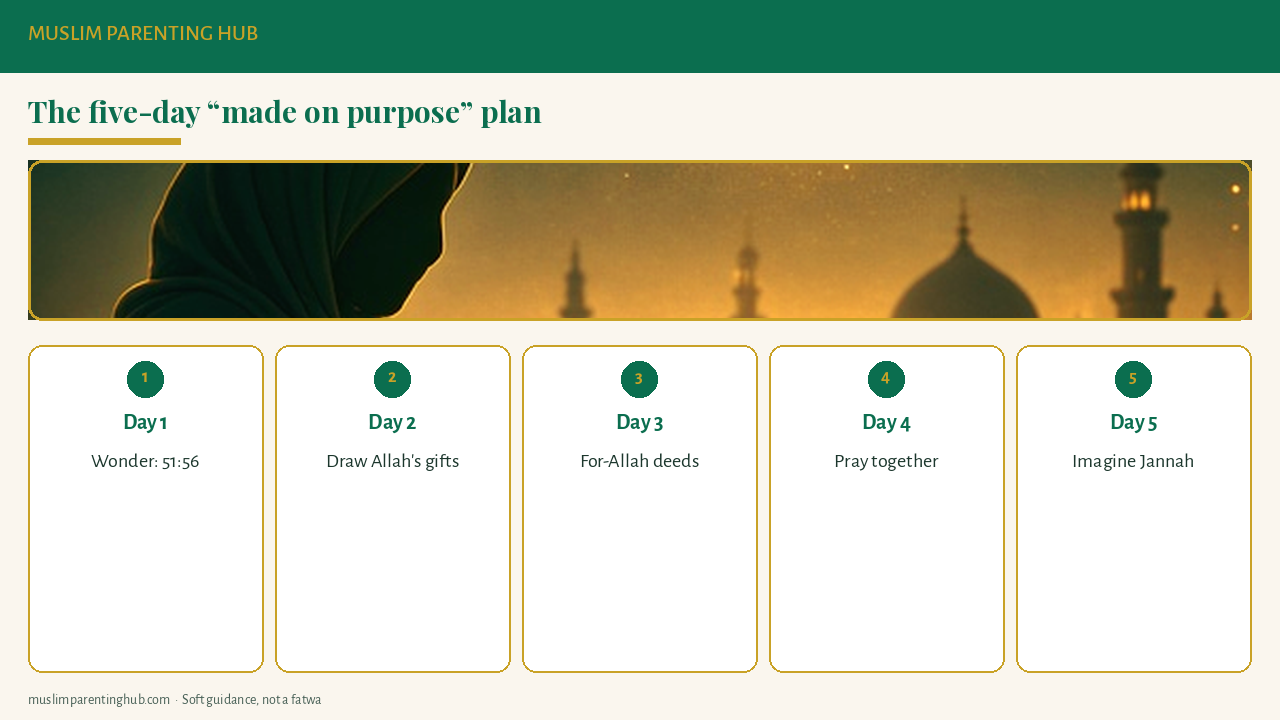
Use this plan for one school week. Each day takes about ten minutes, usually after Maghrib or at bedtime.
- Day 1: Wonder. Read Quran 51:56 in English together. Ask: “What do you think ‘worship’ means?” Accept every answer, then share the big meaning.
- Day 2: Gifts. Each child draws three gifts from Allah (their eyes, family, rain). Say Alhamdulillah for each.
- Day 3: Good deeds. Make a “for Allah” list of five small good deeds for tomorrow. Tick them off after school.
- Day 4: Salah. Pray one prayer together and talk afterward: “How did it feel to stop and talk to Allah?”
- Day 5: Jannah. Share that Jannah has “what no eye has seen and no ear has heard” (Bukhari, Muslim). Let kids imagine and draw it. End with a dua: “O Allah, help us be the people You made us to be.”
Keep it light. If a day doesn’t happen, just continue the next evening.
When Your Child Is Really Struggling
Sometimes “Why did Allah make us?” is really “Why is life hard?” This can follow a move, a family illness, or the death of a grandparent. If loss is behind the question, our gentle guide on how to explain death to a child in Islam can help you hold both feelings and faith.
Older kids who hear doubts from classmates or online may ask whether Allah is even real. That is a different conversation, and our guide to is Allah real? honest answers for kids walks through it.
FAQ
How do I explain why Allah created us to a child?
Keep it short and loving: “Allah made you on purpose, because He wanted you. He made you to know Him, love Him and do good things for Him, and He wants you in Jannah.” This is based on Quran 51:56. Then let your child ask more.
What does “worship” mean for kids?
Worship (ibadah) means anything good we do for Allah. Salah is the most important part, but sharing, telling the truth, helping at home and saying Bismillah all count when done for Allah. This helps kids see worship as their whole day, not only prayer time.
Does Allah need us to worship Him?
No. Allah needs nothing. The Quran says we are the ones in need of Allah, and He is Free of all needs (35:15). Worship benefits us: it brings us peace, good character and the way to Jannah.
What do I say if my child says “I didn’t ask to be born”?
First ask about the feeling and what happened. Later, calmly say that life is a gift Allah gave without being asked, like a birthday present, along with people who love them. If it comes up often or with talk of self-harm, speak to a pediatrician or counselor.
At what age can kids understand the purpose of life in Islam?
Kids aged 4–6 can understand “Allah made you because He wanted you.” Ages 7–9 can learn that worship includes every good deed. Ages 10–12 can understand life as a hopeful test (Quran 67:2) and caring for the earth as a trust.
Is it okay for my child to ask big questions about Allah?
Yes. Questions show your child is thinking and believes Allah matters. Answer calmly and briefly, say “I’ll find out” when you don’t know, and never shame a question. Children who feel safe asking usually keep their faith closer.
Related guides
- Where is Allah? Answers for kids’ questions
- Who made Allah? Calm answers for kids
- Is Allah real? Honest answers for kids
- Names of Allah for kids: where to start
- Does Allah love me? Gentle answers for kids
Closing
“Why did Allah create us?” is a question many adults never stop to ask. Your child asked it early, which is a gift. Keep your answer the same each time: Allah made you on purpose, with love, to know Him and do good, and He wants you home in Jannah. Over the years, that short sentence grows into a life.
Quick steps
Five-day “made on purpose” plan for kids. Ten minutes a day for one school week to help kids understand why Allah created us.
- Day 1 — Wonder — Read Quran 51:56 in English together and ask what your child thinks “worship” means, then share the big meaning.
- Day 2 — Gifts — Each child draws three gifts from Allah and says Alhamdulillah for each.
- Day 3 — Good deeds — Make a “for Allah” list of five small good deeds for tomorrow and tick them off after school.
- Day 4 — Salah — Pray one prayer together and talk afterward about how it felt to stop and talk to Allah.
- Day 5 — Jannah — Share the hadith that Jannah has what no eye has seen, let kids draw it and end with a dua.
Related articles
Where Is Allah? Gentle Answers Kids Ages 4–8 Can Understand
Where is Allah? Simple, love-based answers for ages 4–8—scripts for “Can He see me?” and “Who made Allah?”, what to avoid, and when you don’t know.
Read guide →
Who Made Allah? Calm Answers for Kids’ Biggest Question
Your child asked “Who made Allah?” Here are calm, age-fit answers, a simple maker-chain game, Surah Al-Ikhlas meanings, and scripts for school questions.
Read guide →
Is Allah Real? How to Answer Your Child’s Honest Question (Ages 4–12)
Your child asked, “Is Allah real? How do we know?” Calm, age-fit answers, signs-in-nature activities, Quran lines, and scripts for school doubts.
Read guide →
Names of Allah for Kids: 10 Beautiful Names to Start With (and How to Teach Them)
Start the 99 Names of Allah with kids: 10 easy names with simple meanings, everyday moments to use them, a name-of-the-week plan and crafts for ages 3–10.
Read guide →