
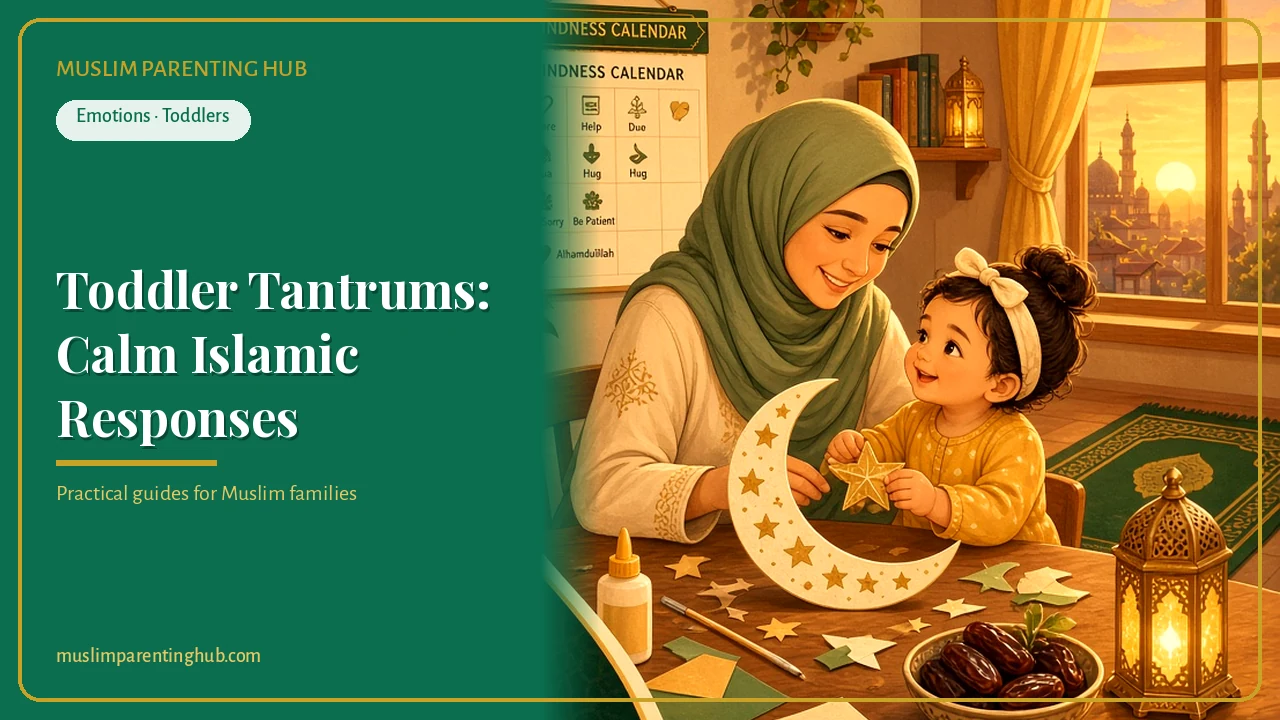
Toddler Tantrums in a Muslim Home: Calm Islamic Responses That Actually Help
The checkout line at Target. Your two-year-old wanted the candy, you said no, and now they’re flat on the floor, screaming like the world is ending. People are looking. Your face is hot. A voice in your head asks, “What kind of Muslim parent can’t control their child?”
Here’s the truth: tantrums are normal. Most children between about 18 months and 4 years have them, often several times a week. They don’t mean your child is “bad,” and they don’t mean you’ve failed. A toddler’s brain simply can’t yet manage big feelings like frustration, disappointment, and tiredness. Their emotions are huge; their words and self-control are tiny.
Islam gives parents something powerful for these moments—not a magic phrase that stops crying, but a way to stay calm, gentle, and firm ourselves. This guide gives you a 6-step in-the-moment response, scripts for the most common meltdown moments, Sunnah tools for your own anger, and ways to prevent the next tantrum.
This is gentle parenting guidance, not a fatwa. If you’re worried about your child’s development or behavior, talk to your pediatrician.
First, Your Heart: The Sunnah for the Parent
Before we talk about the toddler, let’s talk about you. Tantrums are hard because they trigger our big feelings—embarrassment, anger, exhaustion.
The Prophet ﷺ gave us clear tools:
- “The strong person is not the one who wrestles others down, but the one who controls himself when angry” (Bukhari, Muslim). Staying calm during a tantrum is real strength.
- Seek refuge in Allah. When two men were arguing angrily, the Prophet ﷺ said that if one of them said, “A’udhu billahi min ash-shaytan ir-rajim,” his anger would leave him (Bukhari, Muslim).
- Change your position. He advised that if you’re angry while standing, sit down (Abu Dawud). Kneeling to your toddler’s level does double duty: it calms you and connects you.
- Silence. He also taught that when one of us is angry, we should be quiet (Ahmad). Fewer words, less fuel.
- Gentleness. “Allah is Gentle and loves gentleness in all matters” (Bukhari, Muslim), and “gentleness is not in anything except that it beautifies it” (Muslim).
Anas ibn Malik served the Prophet ﷺ as a boy for ten years and said he never once told him “uff,” or asked “why did you do that?” (Bukhari, Muslim). That’s the model: patient, steady, kind.
Your calm is the most important tool in the room. Your toddler borrows it.
The 6-Step Calm Response (In the Moment)
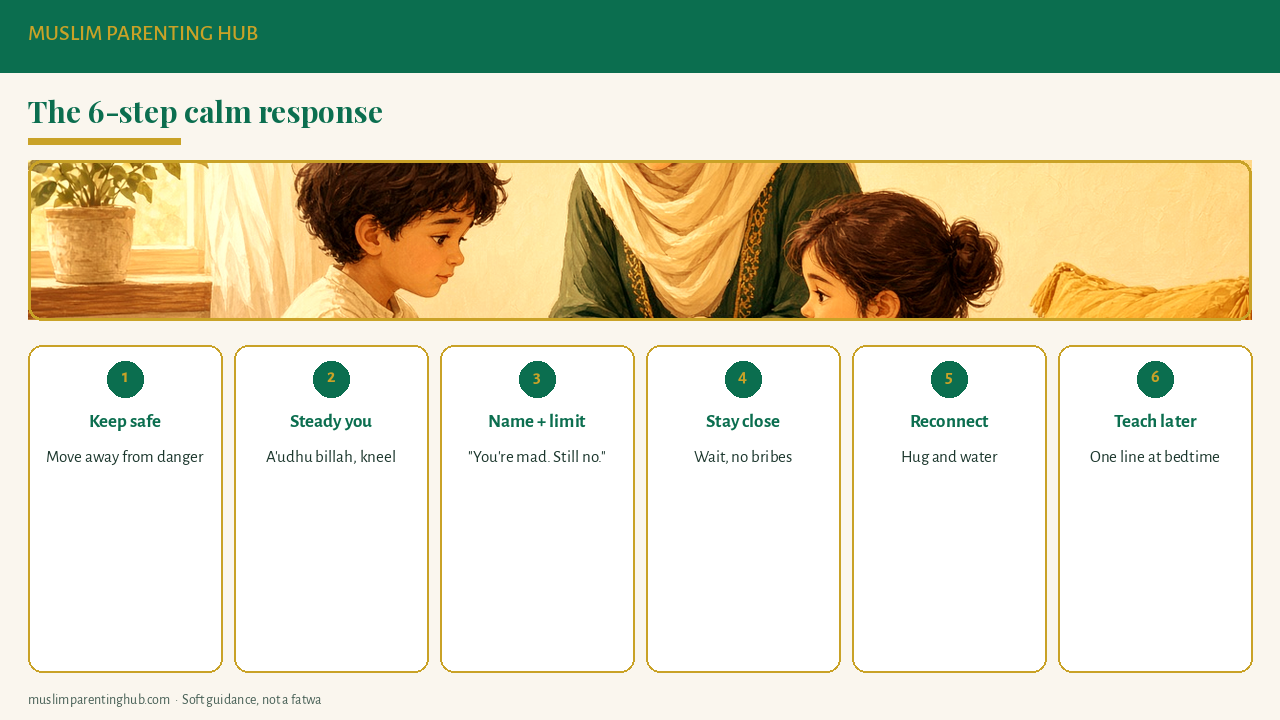
When the meltdown starts, run through these steps. They work at home, in the car, and in the cereal aisle.
Step 1 — Keep everyone safe
Move your child away from the street, stairs, or shelves. If they’re hitting or throwing, gently hold their hands or move them to a safe spot. Safety first; lessons later.
Step 2 — Steady yourself
Whisper “A’udhu billahi min ash-shaytan ir-rajim.” Take one slow breath. Kneel or sit down. Lower your voice instead of raising it.
Step 3 — Name the feeling, hold the limit
Use few words: “You’re so mad. You wanted the candy. The answer is still no.” You’re showing you understand the feeling and that the boundary stays. Don’t give in to stop the screaming—that teaches screaming works.
Step 4 — Stay close and wait
Most tantrums pass in a few minutes if they’re not fed by arguing or bribes. Stay nearby. Some toddlers want a hug; others need space. Try: “I’m right here when you’re ready for a hug.”
Step 5 — Reconnect
When the storm passes, reconnect warmly: a hug, a sip of water, “That was really hard. You calmed down.” No lecture yet.
Step 6 — Teach later, briefly
Hours later, or at bedtime, a short reflection: “Remember when you were mad at the store? Next time you can say, ‘I’m mad!’ and squeeze my hand.” Older preschoolers can learn a simple calm-down habit: sit, breathe, say “A’udhu billah.”
Scripts for the Most Common Tantrum Moments
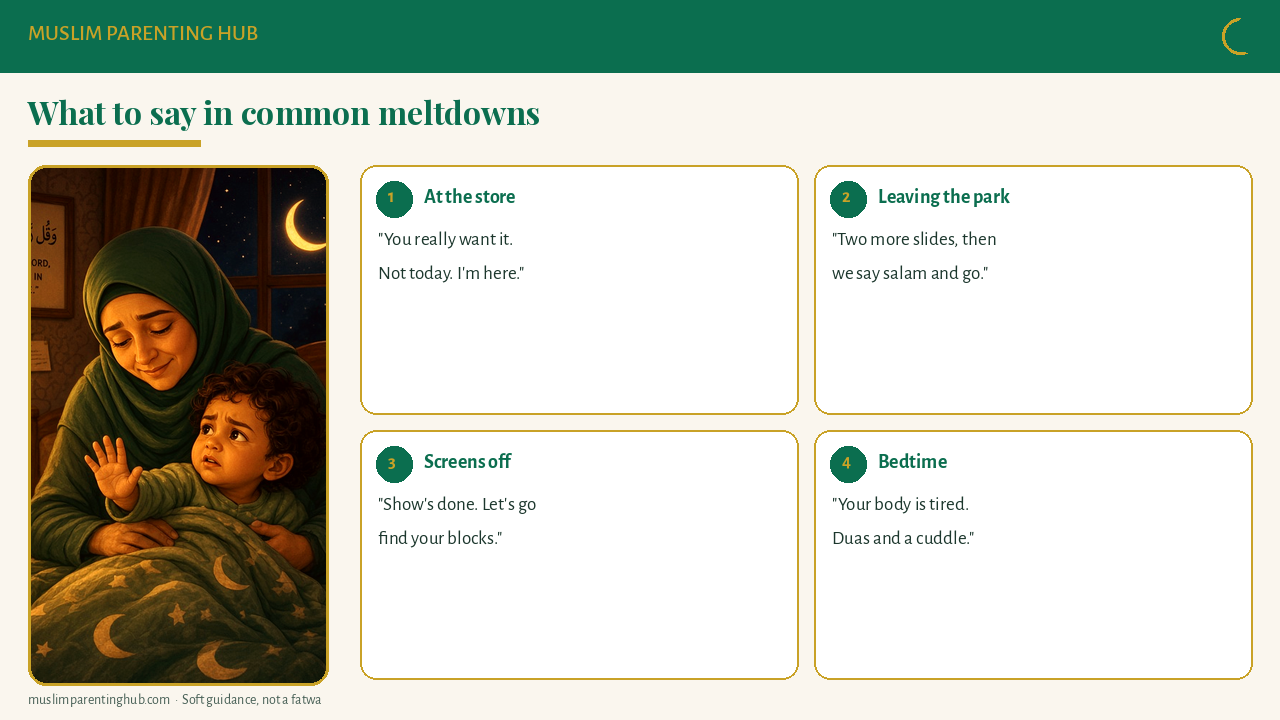
The store (“I want it!”)
“You really want that. It looks so yummy. We’re not buying it today. You can be mad. I’ll stay with you.”
Prevention: Before you go in, say, “We’re buying milk, bread and apples. No treats today. You can help find the apples.”
Leaving the park or a playdate
“It’s hard to stop playing. Two more slides, then we say salam and go.”
Give a warning, count down, then follow through calmly—carry them if needed.
Getting into the car seat
“The car seat keeps you safe. You can climb in by yourself, or I’ll help you. You choose.”
Offering a small choice gives back a little control.
Screens off
“The show is finished. You’re upset. Let’s go find your blocks.”
Turn it off, then offer something to move toward, not just something taken away.
Bedtime
“Your body is tired, and that makes everything feel bigger. It’s time for duas and a cuddle.”
Overtired toddlers melt down more. If bedtime is a nightly battle, our guide to calm Sunnah-based fixes when your toddler fights bedtime can help reset the routine.
Siblings
“You’re angry he took your truck. I won’t let you hit. I’ll help you get a turn.”
If tantrums often involve a brother or sister, see our fairness scripts for sibling jealousy.
At the masjid
“We need quiet voices here. Let’s go outside for a little break.”
Step out early, calm down, and try again—or go home and try another day. Our home practice plan for a toddler’s first masjid visits makes masjid trips smoother.
What Not to Do (Even When You’re Tempted)
Don’t use Allah as a threat
“Allah will be angry with you!” or “Allah doesn’t love kids who scream” might feel like it works, but it teaches a toddler to fear Allah instead of love Him. Keep Allah connected to comfort and help. Our guide on how to talk about Allah with toddlers offers simple, loving phrases for these early years.
Don’t hit or shame
Hitting, yelling, and “You’re so bad!” may stop the behavior for a moment, but they teach children that big people handle feelings by hurting. Keep the focus on the behavior, never the child’s worth.
Don’t negotiate mid-tantrum
“If you stop crying, I’ll buy you the candy” teaches that tantrums get results. Decide your limits before, and calmly keep them.
Don’t lecture
A screaming toddler can’t hear a speech about patience. Save teaching for when they’re calm.
Don’t compare
“Your cousin never acts like this” hurts and doesn’t help. Every child develops differently.
Preventing the Next Tantrum
You can’t prevent every tantrum, but you can reduce them a lot by watching the usual triggers: hungry, tired, overstimulated, bored, or not in control.
- Protect sleep and naps. A well-rested toddler is a calmer toddler.
- Carry snacks. Many “behavior problems” are really hunger.
- Give warnings before transitions. “Five more minutes, then shoes on.”
- Offer small choices. “Red cup or blue cup?” “Walk or hop to the car?”
- Build predictable routines. Toddlers feel safe when they know what comes next—wake up, breakfast, play, Dhuhr, nap, and so on.
- Name feelings in calm times. Read books about feelings. Say, “You look happy!” “Are you frustrated?”
- Say yes when you can. Save your firm “no” for things that matter.
- Don’t push too many big skills at once. Starting potty training, a new sibling, and a new daycare in the same month is a lot. If toilet training is causing daily battles, our guide to what to do when Islamic potty training stalls explains how to step back without shame.
Teaching Little Ones Islamic Calm-Down Habits
From about age 3, you can begin to build simple faith-based calm-down habits. Practice them when everyone is calm, like a game:
- “Sit like a mountain.” Sit down when angry—just like the Sunnah.
- “Smell the flower, blow the candle.” Slow breaths in and out.
- “A’udhu billah.” Say it softly together.
- Ask for help. “Ya Allah, help me feel calm.”
- Hug or squeeze. A big hug or squeezing a soft toy.
When your child uses even one of these on their own, celebrate: “You were angry and you sat down and said A’udhu billah. That is so strong! MashaAllah!”
When to Get Extra Help
Talk to your pediatrician if tantrums:
- happen many times a day, every day, past about age 4,
- regularly involve hurting themselves or others,
- come with big delays in speech or other skills,
- or leave you feeling you can’t cope.
Seeking help is not a lack of faith or tawakkul. It’s taking the means Allah provided.
And if you lost your temper today—shouted, or said something you regret—you’re human. Say Astaghfirullah, apologize to your child (“I yelled. That wasn’t okay. I’m sorry.”), and try again tomorrow. Children learn as much from a parent who repairs as from a parent who never slips.
FAQ
Are tantrums normal for Muslim toddlers?
Yes. Tantrums are a normal part of development for most children from about 18 months to 4 years. They happen because toddlers have big feelings and few words or self-control skills yet, not because of weak faith or bad parenting.
What does Islam say about handling anger?
The Prophet ﷺ taught that the strong person controls himself when angry, and advised seeking refuge in Allah from Shaytan, sitting down, and staying quiet. Parents can model these Sunnah tools during a toddler’s tantrum.
Should I ignore my toddler’s tantrum?
Don’t give in to the demand or argue, but don’t abandon your child either. Keep them safe, stay nearby and calm, name the feeling, and reconnect once they settle.
Is it okay to say “Allah is angry with you” to stop a tantrum?
It’s better not to. Using Allah as a threat for ordinary toddler behavior can make children fear rather than love Allah. Use your own calm authority for limits and keep talk about Allah warm and comforting.
How can I teach my toddler to calm down the Islamic way?
During calm times, practice sitting down, slow breathing, saying “A’udhu billah,” and a short dua like “Ya Allah, help me feel calm.” Praise your child warmly when they use one on their own.
When should I worry about tantrums?
Talk to your pediatrician if tantrums are very frequent past about age 4, regularly involve hurting themselves or others, or come with developmental delays, or if you feel unable to cope.
Related guides
- When your Muslim toddler fights bedtime
- How to talk about Allah with toddlers
- Sibling jealousy in a Muslim home
- Teach kids to apologize with heart
Closing: Calm Is Contagious
Your toddler won’t remember the candy at Target. They’ll remember—deep down—that when their feelings were too big, a parent stayed close, stayed kind, and didn’t let go of the limits. That’s what rahma looks like at two years old. Next time the storm hits, kneel down, whisper A’udhu billah, breathe, and remind yourself: this is a phase, and I’m teaching my child how a believer handles big feelings.
Quick steps
6-step calm response to a toddler tantrum. A calm, Sunnah-informed way to respond in the moment when a toddler melts down at home, in the car, or in a store.
- Keep everyone safe — Move your child away from streets, stairs, or shelves, and gently hold their hands or move them if they are hitting or throwing.
- Steady yourself — Whisper A'udhu billahi min ash-shaytan ir-rajim, take one slow breath, kneel or sit down, and lower your voice.
- Name the feeling, hold the limit — Use few words: "You're so mad. You wanted the candy. The answer is still no." Don't give in to stop the screaming.
- Stay close and wait — Stay nearby without arguing or bribing; offer a hug when they are ready.
- Reconnect — When the storm passes, give a hug and a sip of water and say, "That was really hard. You calmed down." No lecture yet.
- Teach later, briefly — Hours later or at bedtime, reflect in one or two sentences and practice a calm-down habit like sitting, breathing, and saying A'udhu billah.
Related articles

Sibling Jealousy in a Muslim Home: Fairness, Scripts & What Not to Say
Practical Islamic parenting scripts for sibling jealousy—fairness vs sameness, what not to say, conflict coaching, and age tips. Calm tools for Muslim homes.
Read guide →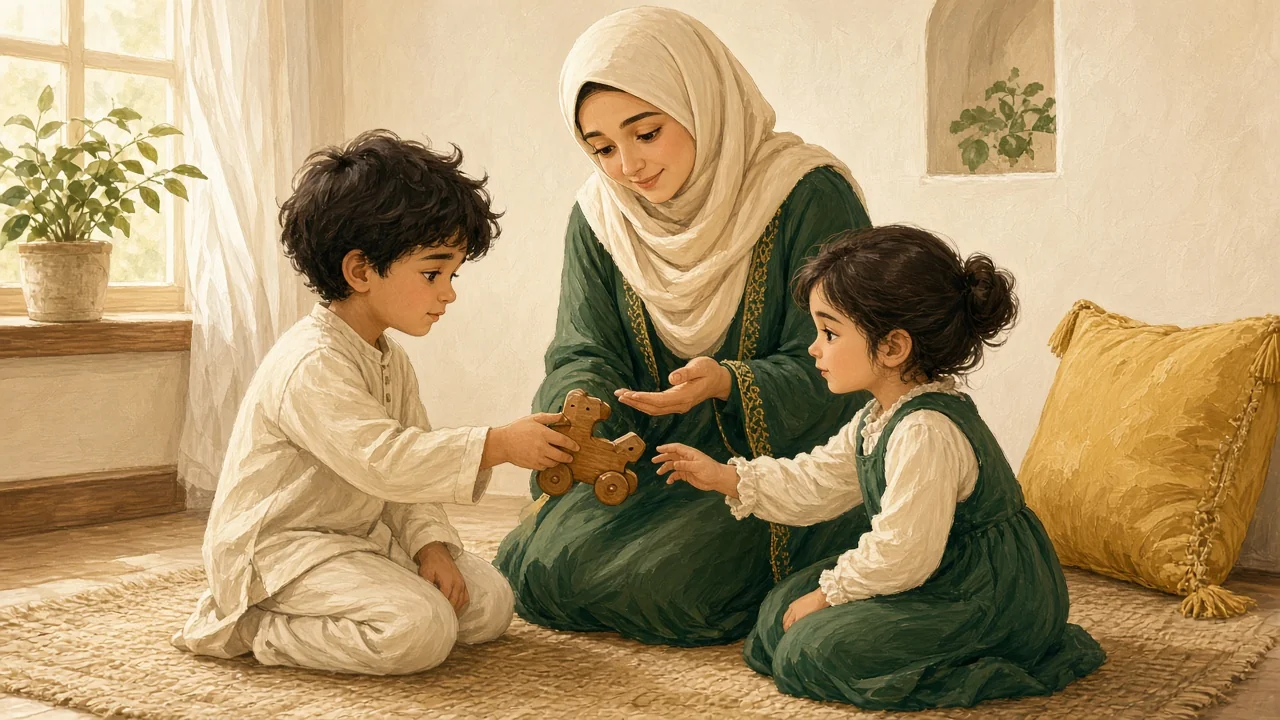
Teach Kids to Apologize with Heart: Islamic Repair Scripts (Plus Soft Istighfar)
Teach kids to apologize with Islamic repair scripts—pause, name the hurt, make it right—plus soft istighfar without shame. Age bands, what not to force, sibling tips.
Read guide →
When Your Muslim Toddler Fights Bedtime: Calm Sunnah-Based Fixes
Calm Sunnah-based fixes when your Muslim toddler fights bedtime—stalling, fear, separation, dua, boundaries, and age tips. Soft routines that actually stick.
Read guide →
How to Talk About Allah With Toddlers: Simple Words and a 7-Day Plan
What to say when your toddler asks “Who made the moon?” Loving phrases about Allah for ages 0–3, bedtime lines and a 7-day plan—no fear, no lectures.
Read guide →