
Should Muslim Kids Invite the Whole Class? Birthday Invitations Without Leaving Anyone Out
Your daughter is turning seven, and she has a list. It has four names on it. Her best friend from the bus, two girls from her table, and a cousin. Then she says, “But I don’t want Emma to come. Emma is mean sometimes.” And you suddenly remember how it felt, years ago, to watch party invitations get handed out in class and not get one.
Birthday invitations are one of the first places kids learn about inclusion, exclusion, and how their choices make others feel. For Muslim families, it’s also a place where faith meets everyday American school life: different views on birthdays, food concerns, modesty, and how to be kind when you can’t (or don’t want to) include everyone.
This guide walks through the big question (should your child invite the whole class?), the school rules you need to know, an Islamic lens on not leaving people out, and practical options that fit different families and budgets. If your child has been on the other side and felt left out, our guide to scripts for when your Muslim child is left out of birthday parties is a good companion read.
First, a Note on Birthdays in Muslim Families
Muslim families don’t all approach birthdays the same way. Some scholars consider birthday celebrations an imitation of other traditions and advise against them. Others see a simple gathering as a permissible cultural custom, as long as nothing haram is involved. Many families land somewhere in between: no big party, but a special dinner or a small get-together.
This article doesn’t try to settle that question. Follow your family’s understanding and the guidance of a scholar you trust. If you don’t hold birthday parties, much of this guide still applies, because your child will be invited to other kids’ parties, and the lessons about including others matter year-round. (We’ll also cover alternatives below.)
The School Rule Most Parents Don’t Know About
Many US elementary schools have a simple policy: if invitations are handed out at school, every child in the class must get one. Some schools allow “all the girls” or “all the boys” instead. Others don’t allow party invitations in backpacks or cubbies at all.
Before you print anything, check: - Your school’s handbook or the teacher’s beginning-of-year letter - Whether the class has a parent group chat or email list - If there are food rules for any treats brought in (many schools now ban homemade food or require store-bought with labels)
If your child wants a small party, that’s usually fine, but invitations should go directly to parents by text or email, not through school. And kids should be taught not to talk about the party at school. That’s where the real hurt happens.
The Islamic Lens: Hearts Matter
Islam places huge weight on not hurting other people’s hearts, even unintentionally.
“Love for your brother what you love for yourself.” The Prophet ﷺ said none of us truly believes until we love for our brother what we love for ourselves (Bukhari and Muslim). Ask your child: “How would you feel if everyone at your table got an invitation except you?”
Don’t leave someone out of the conversation. The Prophet ﷺ said that when three people are together, two should not talk privately and leave the third out, because it will grieve him (Bukhari and Muslim). Scholars explain the reason is to protect feelings. A party talked about in front of uninvited classmates works the same way: it makes someone feel small.
Give gifts, grow love. The Prophet ﷺ said, “Give gifts to one another, and you will love one another” (Al-Adab al-Mufrad). Kindness, generosity, and hospitality are part of our faith, and a gathering can be a chance to practice them.
Hosting is an honor. Generous hosting is part of Muslim character. Our guide to guest manners and hosting at home has simple ways kids can welcome friends.
None of this means your child must invite every classmate to every event. It means we choose in a way that protects feelings, and we stay discreet when we can’t include everyone.
Whole Class, Small Group, or No Party? Your Options
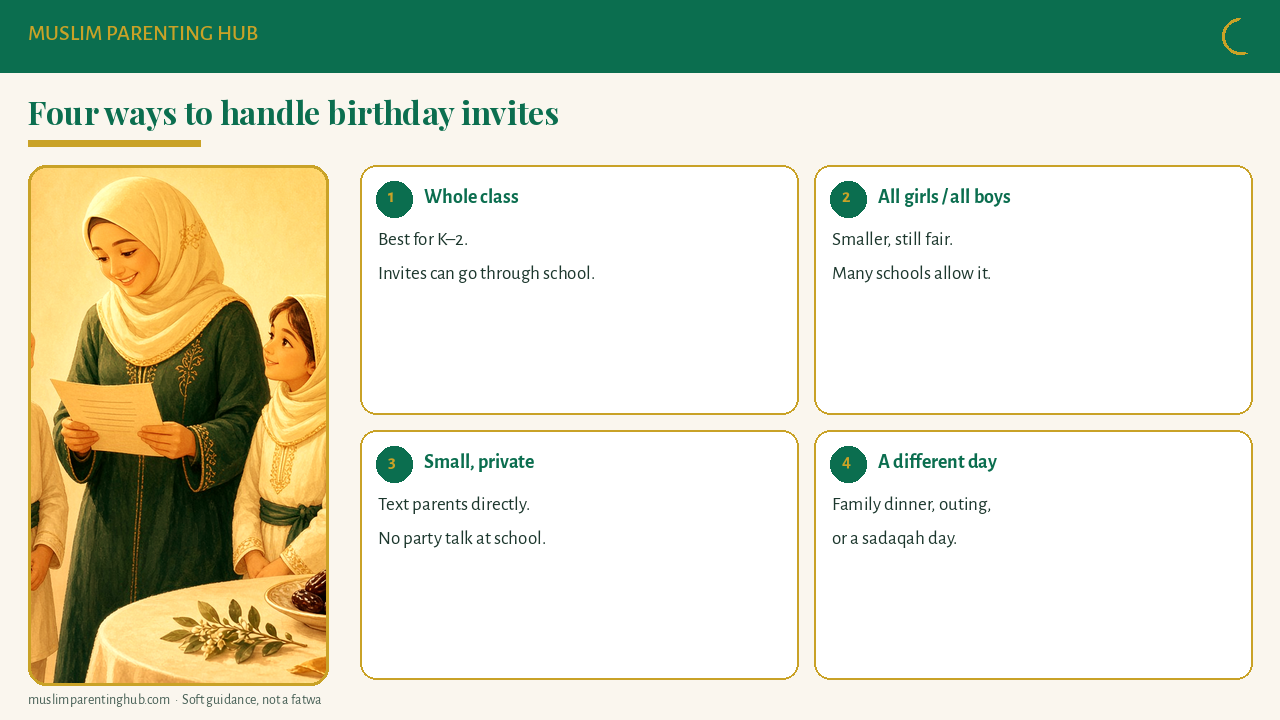
Option 1: Invite the whole class
Best for: Kindergarten through about second grade, when friendships are still fluid and most kids would feel hurt to be left out.
Pros: No one is excluded. Easy to send invitations through school. Your child gets a big, joyful day.
Cons: Cost and space. Twenty-five kids is a lot. Some families won’t come because of their own rules, so expect maybe half to show.
Make it work: Choose a park pavilion, a community center room, or a backyard with simple games. Keep food easy: cheese or veggie pizza (or halal pepperoni from a halal pizzeria), fruit, juice boxes, and cupcakes with gelatin-free frosting and sprinkles.
Option 2: Invite all the girls or all the boys
Best for: Families who prefer gender-separated gatherings, or classes where the child mainly plays with one group.
Pros: Fewer kids, but the “everyone in my group got one” fairness stays. Many schools explicitly allow this.
Cons: Some kids in the other group may still feel left out if it’s talked about.
Option 3: A small party, invited privately
Best for: Older kids (third grade and up) who have a few close friends, or families with limited space or budget.
Pros: Simple, cheap, and lets your child spend real time with friends.
Cons: Requires discretion. If the party gets talked about at school, uninvited kids can feel hurt.
Make it work: Text or email parents directly. Teach your child: “We don’t talk about the party at school, because others might feel sad.” That’s not secrecy; that’s adab.
Option 4: No party, but a different celebration
Best for: Families who don’t celebrate birthdays, or who prefer something quieter.
Ideas: - A family dinner with a favorite meal and a “what we love about you” circle - A day out: zoo, bowling, apple picking - A “sadaqah day”: your child chooses a charity, packs care bags, or donates toys (our sadaqah habits age chart has ideas by age) - A “thank-you day” where your child makes cards for teachers or neighbors
How to Talk to Your Child About Who to Invite
Children often build their invite list based on who was nice to them yesterday. Help them think a little bigger.
Ask open questions: - “Who do you play with most at recess?” - “Is there anyone who’d feel sad if they found out?” - “If you invite the whole table except one person, how might that person feel?”
About the “mean” kid: If your child doesn’t want to invite someone who’s been unkind, take it seriously. Ask what happened. If it’s real bullying, you don’t have to invite that child, but you might choose a smaller private party instead of a whole-class event. If it’s an ordinary kid-conflict, you can say, “Sometimes inviting someone helps fix a friendship. The Prophet ﷺ was kind even to people who were unkind to him.”
About the quiet kid: Every class has a child who rarely gets invited anywhere. Gently ask, “Is there anyone in your class who doesn’t get invited much?” Including that child can be one of the most meaningful good deeds of the year. Our guide on helping your Muslim child make friends at school has scripts for reaching out.
Hosting a Halal-Friendly Party Non-Muslim Families Will Love
If you do host, a few practical tips help everyone feel comfortable.
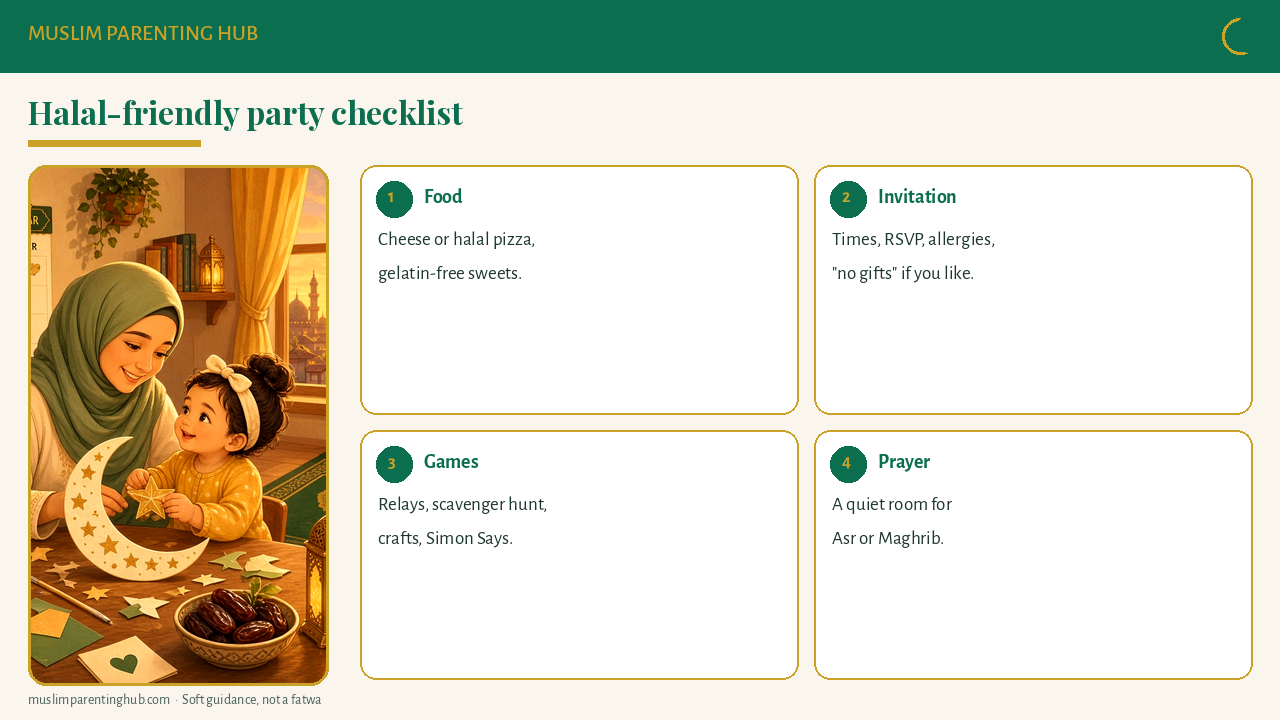
Food: - Choose cheese, veggie, or halal meat pizza; many cities have halal pizzerias. - Check marshmallows, gummy candy, and some frostings for pork gelatin. - Ask on the invitation about allergies. - Serve water and juice boxes.
On the invitation: - Keep it short: date, time, place, RSVP. - If you prefer, add: “No gifts please; your presence is the gift!” or suggest a book swap. - Give an end time so parents can plan.
Games: - Relay races, scavenger hunts, freeze dance, craft stations, sidewalk chalk - If your family avoids music, use games that don’t need it, such as Simon Says, musical chairs with clapping, treasure hunts
Modesty and mixing: - For older kids, many families prefer all-girls or all-boys parties. - Parents can stay or drop off; say which on the invitation.
Prayer time: If the party runs over Asr or Maghrib, find a quiet room and pray. Some non-Muslim parents will be curious; your child can explain simply. Our guide to kind answers kids can give classmates about Islam has easy wording.
When Your Child Is a Guest
Inclusion goes both ways. When your child gets invited:
- RSVP promptly. Even if you can’t come, a kind “Thank you so much for inviting her; we can’t make it, but we hope she has a wonderful birthday” means a lot.
- If you can’t attend because of food, music, or timing, consider dropping off a small gift or card. It shows the friendship matters.
- If you attend, remind your child to thank the host and the birthday child.
- For food concerns, feed your child beforehand and send along a snack, or ask the host if pizza is cheese.
Teaching the “Don’t Talk About It” Rule
The biggest hurt isn’t usually the invitation; it’s the talk. Teach your child three simple rules:
- No party talk at school unless the whole class is invited.
- No handing out invitations at school unless everyone gets one.
- No “you’re not invited.” Ever. Even if asked directly, they can say: “It’s a small family thing.”
Role-play it at home: “What do you say if someone asks, ‘Am I coming to your party?’” Practicing helps kids respond kindly in the moment.
When Someone in the Class Is Always Left Out
Sometimes parents notice a pattern: one child is never invited anywhere. That child might be new, shy, have special needs, or come from a different background. Muslim kids often know this feeling well.
You can quietly help by: - Inviting that child to your next gathering, even a simple park playdate - Encouraging your child to sit with them at lunch - Doing a rahma activity focused on including others
Small acts of inclusion can change a child’s whole school year.
The Bigger Lesson
Birthday invitations look small, but they teach kids a big lesson: our choices touch other people’s hearts. Whether you throw a whole-class party, a small gathering, or skip birthdays entirely, you can raise a child who thinks, “Who might feel left out?” before acting. That’s the kind of heart Islam asks us to nurture.
FAQ
Do Muslim kids have to invite the whole class to a birthday party?
No. But if invitations go out at school, many US schools require including everyone, or all boys or all girls. For smaller parties, invite privately and avoid talking about it at school.
Is it okay for a Muslim child to have a birthday party?
Scholars differ. Some advise against birthday celebrations, while others allow a simple gathering as a custom without anything haram. Follow your family’s understanding and a trusted scholar.
How do I host a halal-friendly party for non-Muslim classmates?
Serve cheese, veggie, or halal pizza, check sweets for pork gelatin, choose simple games, add clear times on the invitation, and set aside a quiet spot for prayer.
What should my child say if a classmate asks, “Am I invited?”
Teach a kind, honest line like “It’s a small family party this year,” and never “You’re not invited.” Practice it at home so it comes out gently.
What if my child doesn’t want to invite a classmate who is unkind?
Take it seriously and ask what happened. For real bullying, don’t force it; choose a small private party. For ordinary conflicts, an invitation can help repair the friendship.
Related guides
Related articles
Guest Manners for Muslim Kids: Hosting at Home with Islamic Adab
Teach Muslim kids guest manners for hosting at home—shoes, greetings, serving, privacy, and soft scripts. Islamic adab parents can practice tonight.
Read guide →
Helping Your Muslim Child Make Friends at School: Scripts, Playdates and Good Companions
Is your Muslim child lonely at school? Friendship scripts, halal playdate ideas, what to say when "no one plays with me," and the Sunnah of good friends.
Read guide →
10 Rahma Activities to Teach Muslim Kids Kindness This Month
Teach Muslim kids rahma with 10 kindness activities—kindness jar, neighbor drops, Prophet ﷺ mercy stories, age charts, and tonight scripts. Soft, practical monthly plan.
Read guide →
When Your Muslim Child Is Left Out of Birthday Parties: Scripts That Protect Their Heart
Soft scripts when Muslim kids are left out of birthday parties—validate feelings, protect identity without shaming others, and build warm family alternatives.
Read guide →