
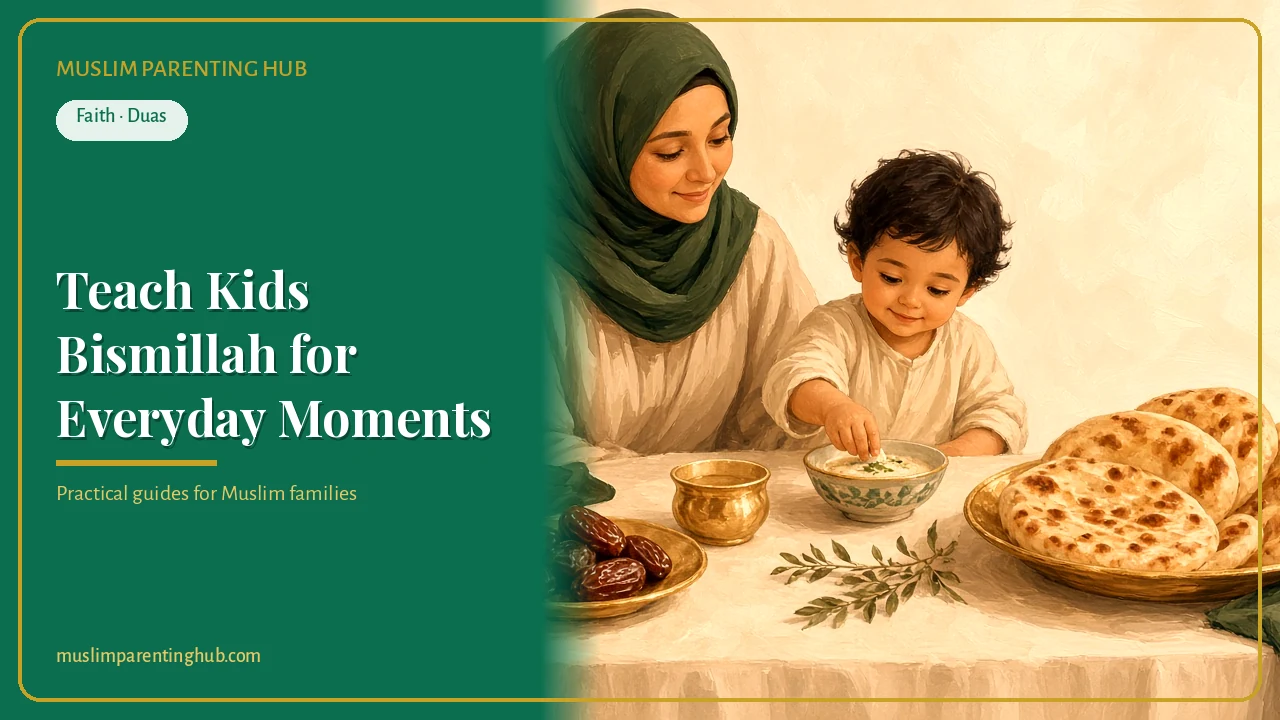
Teach Kids to Say Bismillah Across Everyday US Moments: A Habit Plan
Bismillah—“In the name of Allah”—is one of the first phrases many Muslim kids hear. Then life gets busy: cereal bowls, school shoes, Chromebook logins, carpool lanes. The phrase that should travel through the day gets stuck at the dinner mat.
This habit plan helps US Muslim families weave Bismillah into ordinary moments without nagging. It supports deeper dua skills from duas for kids to learn and pairs naturally with Islamic table manners.
Soft guidance for homes—not a fatwa.
Why Everyday Bismillah Matters
Saying Bismillah trains kids to:
- Begin actions with remembrance, not autopilot
- Slow down for one breath before food, doors, and tasks
- Connect small moments to Allah without needing a long formal dua every time
- Build a bridge into longer duas as they grow
It is short enough for toddlers and meaningful enough for teens—if we keep it warm.
The Core Habit Loop
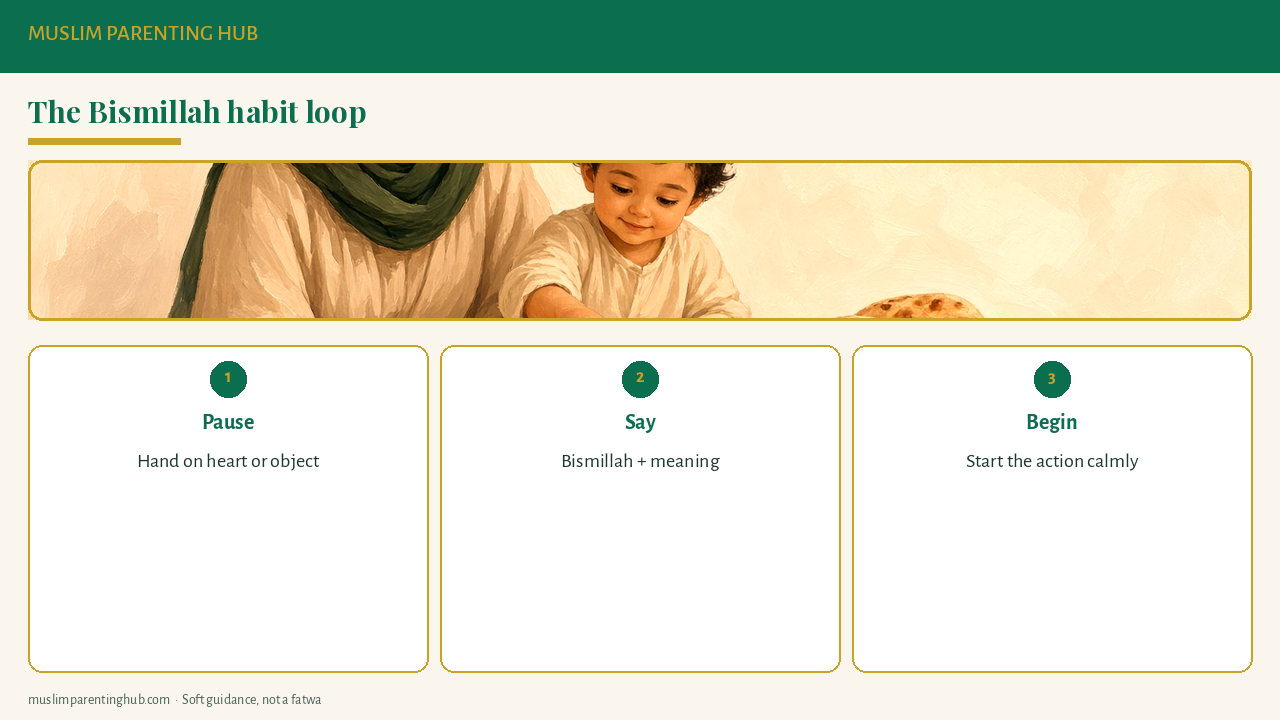
- Pause (hand on heart or on the object: spoon, door handle, backpack zipper).
- Say “Bismillah” (Arabic; add “in Allah’s name” for meaning with little ones).
- Begin the action calmly.
Model it yourself out loud for a week before you expect echoes.
Everyday US Moments to Attach Bismillah
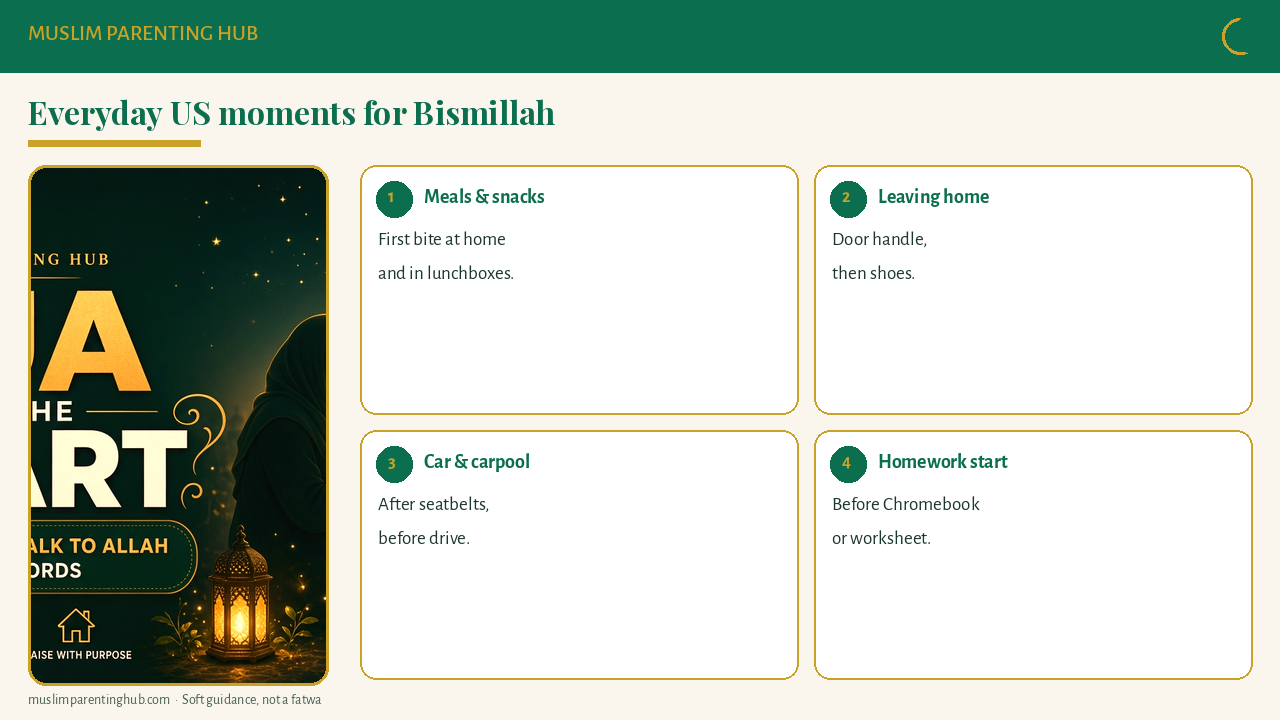
Food & drink: First bite, snack pack at school, water bottle before soccer.
Leaving the house: Hand on the door, then Bismillah, then shoes outside if that is your rhythm.
Car & carpool: Before shifting into drive—pair with your car travel dua routine on longer trips; Bismillah alone is fine for short school runs.
Homework & Chromebook: Before opening the laptop or worksheet.
Brushing teeth / bathroom entry: Keep bathroom-specific duas as you teach them; Bismillah can start many permissible acts.
Sports practice: Before tying cleats or starting a drill.
Helping at home: Before starting a chore.
Pick three anchors for the first two weeks—not fifteen. Success loves a short list.
A 7-Day Habit Plan
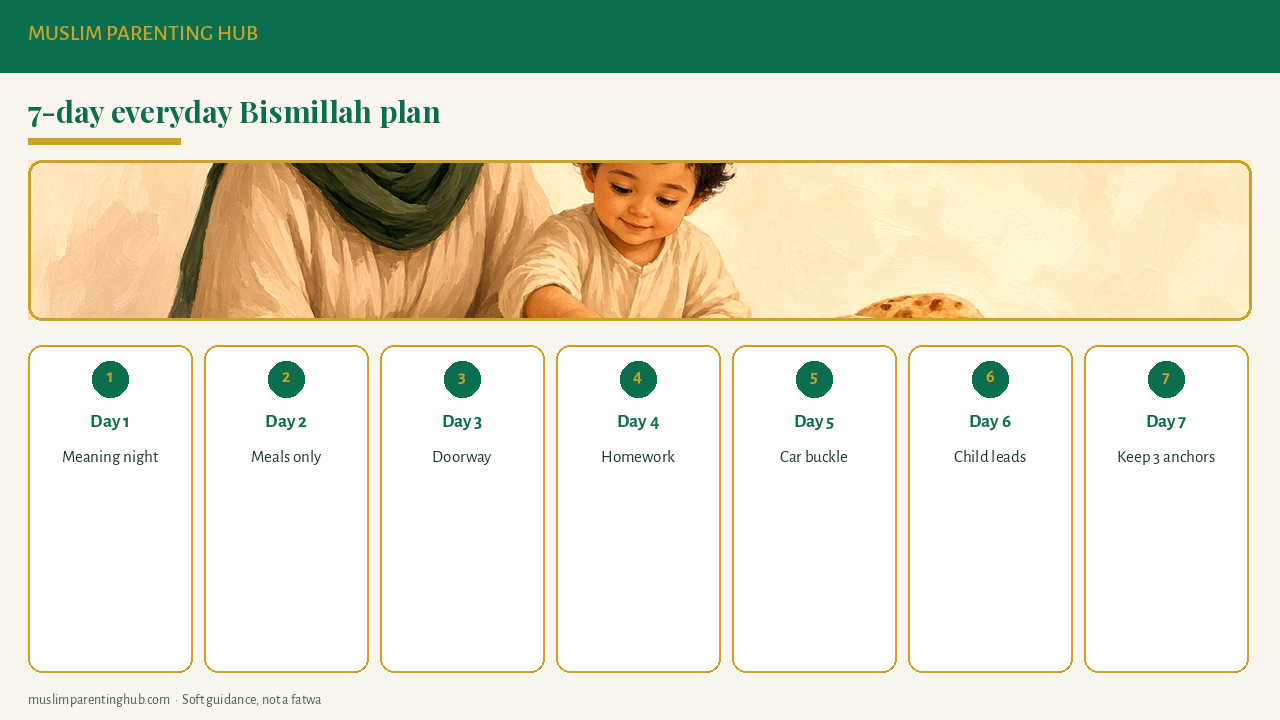
Day 1 — Meaning night. Explain: “We say Bismillah to begin with Allah’s name. It invites barakah—goodness—into ordinary things.” Two minutes max.
Day 2 — Meal only. Every sit-down meal, you say it first; invite echo. Tie to table manners without adding new rules yet.
Day 3 — Doorway. Practice leaving for school or errands with door-handle Bismillah. Smile when they remember; soft prompt when they forget—no restarting the whole exit lecture.
Day 4 — Homework start. Sticky note on the desk: “Bismillah → then begin.” One prompt, then quiet.
Day 5 — Car buckle. After seatbelts, before radio: Bismillah together. On longer drives, add the travel dua you already use.
Day 6 — Child leads once. Let them start dinner Bismillah for the family.
Day 7 — Review & choose anchors. Keep the three that stuck. Retire the ones that caused friction.
Age Bands
Toddlers (2–3): Echo “Bismillah!” as a happy sound before bites. Celebrate attempts.
Preschool (4–5): Door + meals. Meaning in simple English once a day.
Ages 6–9: Add homework and sports. Let them remind younger siblings kindly—not bossily.
Ages 10+: Discuss sincerity vs mumbling. Invite occasional longer own-words dua after Bismillah when something feels big (tests, doctor visits). Morning protection habits can sit beside this; see morning protection dua.
Scripts That Avoid Nagging
Forgetful morning:
“Hand on the door—Bismillah—then we go. I’ll race you to remember.”
Mid-bite reminder (gentle):
“Oops—let’s pause for Bismillah, then keep enjoying.”
Teen eye-roll:
“I’m not policing you. It’s a one-second reset I use too. Try it on the next assignment start.”
Public school lunch:
Soft whisper or silent intention if they feel shy; loud performance is not required in the cafeteria.
Linking Bismillah to Wider Dua Life
Bismillah is a doorway, not the whole house. Once it sticks, kids find it easier to learn short morning phrases, travel duas, and own-words asks. Keep teaching from the heart: gratitude, help, and talking to Allah in their own language when Arabic is still growing.
Common Mistakes
- Turning every forgotten Bismillah into a scolding
- Stacking too many anchors at once
- Skipping meaning forever (kids then treat it like a magic word without heart)
- Using Bismillah as a bribe tool (“Say it or no snack”) in a way that breeds resentment
- Correcting pronunciation harshly in front of guests
Special Moments: Tests, Games, Doctor Visits
Before a spelling test or medical appointment, Bismillah plus one own-words line works well:
“Bismillah. Ya Allah, help me do my best and stay calm.”
Keep it short enough that anxious kids do not feel another performance demand.
Family Culture Tips for US Homes
- Put a small, beautiful “Bismillah” art print near the kitchen—not as decoration only, but as a cue.
- Let kids hear parents say it when starting emails, cooking, or driving.
- In mixed-faith gatherings, you can still say it quietly for your own plate without making a scene.
- During busy sports seasons, protect at least mealtime Bismillah so the habit does not vanish until summer.
Snack Boxes and Water Bottles
US school days run on snacks. Pack a tiny cue card in the lunchbox for early readers, or agree on a hand squeeze code for pre-readers: squeeze means “Bismillah together in our hearts,” then eat. Keep it light so food stays joyful.
Sports Bags and Locker Rooms
Before practice, one Bismillah while zipping the bag sets intention without coaching from the sidelines mid-game. Teens may prefer silent starts; respect privacy while keeping home modeling strong.
Cooking Together
Invite kids to say Bismillah when cracking eggs or turning on the stove (with safety). Shared cooking makes the phrase communal, not a rule aimed only at children.
Forgetting Without Guilt Spirals
Everyone forgets. The sunnah spirit includes remembering Allah often—not perfection tracking. A mid-action “Bismillah” when they recall mid-bite is better than shame. Smile, reset, continue.
Connecting Bismillah to After-School Reset
The first glass of water after school, the first bite of snack, opening the homework folder—each can carry Bismillah. If afternoons are chaotic, attach the phrase to whichever moment already exists rather than inventing a new ceremony. Habits stick to anchors that already survive real life.
Travel Days and Hotel Breakfasts
Vacations disrupt cues. Pack the same verbal routine: door of the hotel room, first bite at the breakfast buffet, buckling in the rental car. Familiar phrases make unfamiliar places feel held by Allah’s name.
Siblings Teaching Siblings
Older kids love to coach—sometimes too sharply. Give them a soft script: “Want to say Bismillah with me?” not “You forgot again!” Praise gentle teaching. Correct bossiness privately.
Measuring Success Softly
For two weeks, notice only: Did anyone in the house say Bismillah without a prompt at least once a day? If yes, the culture is growing. Per-child scoreboards usually create pressure; family atmosphere metrics work better.
Rainy-Day Indoor Practice Games
- Doorway relay: kids race (safely) to touch the door, say Bismillah, and return.
- Snack pause: freeze mid-reach until someone leads Bismillah, then eat.
- Homework lamp on: light does not turn on until Bismillah (parent controls the lamp—keep it playful).
Games should stay optional and joyful. End them the moment they become control battles.
Keeping Arabic Pronunciation Soft
Model clear Bismillah without mocking cute mispronunciations. Offer a smiling re-model later: “We say it like this—want to try with me?” Shame freezes mouths; affection opens them.
A One-Week Family Challenge (Optional)
Only after the gentle 7-day plan: choose one shared anchor (dinner) and aim for seven night leads rotated among family members. No punishments for misses. Celebrate completion with a favorite dessert and a collective Alhamdulillah—not with prizes that buy the deen.
If you remember one parenting move, make it this: say Bismillah yourself where they can hear you—especially on ordinary Tuesdays. Kids inherit what we repeat more than what we lecture.
Barakah is not a productivity hack; it is seeking Allah’s help in the ordinary. Bismillah keeps that seeking close enough for a child to reach every single day.
Begin tonight with one meal. Say it first. Invite their echo. Tomorrow add the door. That is enough to start a lifetime of remembrance in a busy US Muslim home.
FAQ
At what age should kids say Bismillah alone?
Many start echoing as toddlers and say it more independently by preschool. Focus on warmth over deadlines.
What if my child refuses?
Check for pressure overload. Return to modeling only for a week. Invite, do not force.
Is English meaning enough without Arabic?
Teach both when you can. Meaning keeps the heart awake; Arabic connects them to the ummah’s shared phrase. Start with whatever they can manage.
Should they say Bismillah before every bite?
Beginning the meal is the common family habit. Constant mid-meal interruptions can feel heavy—use gentle resets if they forgot at the start.
How does this relate to longer duas?
Bismillah is a frequent micro-dua habit. Longer memorized duas and own-words dua grow alongside it, not instead of it.
What about saying it at public school?
Quietly is fine. Faith can be sincere without being loud. Follow school rules and your child’s comfort.
Closing: One Breath, Then Begin
Everyday Bismillah is how Muslim kids carry remembrance into cereal bowls, car lanes, and homework tabs. Choose three anchors. Model for a week. Celebrate echoes. Keep meaning alive.
In the name of Allah—then begin. That is a whole upbringing in one soft phrase.
Weekend Reinforcements
Use slower Saturday breakfasts to let kids lead Bismillah without the weekday rush. On Sundays, preview the school-week anchors: door, lunchbox first bite, homework start. A two-minute preview beats Monday morning battles.
If your weekend mornings already follow a gentle family rhythm, tuck Bismillah into the first shared meal so the phrase feels like part of rest, not only part of hustle.
When Relatives Critique Your Soft Approach
Some relatives learned faith through sharp correction. Thank them for caring, then hold your line: “We’re building love for the phrase. Scolding makes them shut down.” Consistency between parents matters more than winning the extended-family debate at the dinner table.
Quick steps
7-day everyday Bismillah habit plan for kids. A gentle week attaching Bismillah to meals, doorways, homework, and car rides.
- Day 1 — Meaning night — Explain Bismillah as beginning with Allah's name in under two minutes.
- Day 2 — Meal only — Model Bismillah at every sit-down meal and invite an echo.
- Day 3 — Doorway — Practice door-handle Bismillah when leaving the house.
- Day 4 — Homework start — Use a sticky-note cue before worksheets or Chromebooks.
- Day 5 — Car buckle — Say Bismillah after seatbelts before short school runs.
- Day 6 — Child leads — Let the child start dinner Bismillah for the family.
- Day 7 — Review anchors — Keep the three anchors that stuck and retire friction points.
Related articles
A 5-Minute Morning Protection Dua Routine Muslim Kids Can Grow Into
A gentle 5-minute morning protection dua routine for Muslim kids—wake-up words, short adhkar by age, and scripts that grow with toddlers to school-age.
Read guide →
Duas for Kids to Learn: 10 Easy Duas + How to Make Dua From the Heart
10 easy duas for kids to learn, with meanings, plus a simple way to help children make dua from the heart in their own words. Scripts for tonight.
Read guide →
Islamic Table Manners for Toddlers: A 7-Day Bismillah & Right-Hand Plan
Teach Islamic table manners for toddlers with a 7-day Bismillah and right-hand plan—meal scripts, age tips, guest/restaurant edge cases, and a gentle sticker chart.
Read guide →
The Car Dua Routine Muslim Kids Actually Remember (School Run to Road Trip)
Build a car travel dua routine Muslim kids remember—ignition trigger, call-and-response, school-run vs road-trip versions, and printable card placement tips. Soft and practical.
Read guide →