Why Didn’t Allah Answer My Dua? Gentle Answers for Kids (Ages 4–12)
It usually comes out at a tender moment. Your child prayed every night for the class hamster to come home with them, or for Grandpa to get better, or for it to snow on Halloween. It didn’t happen. And now, with a wobbly voice: “Why didn’t Allah answer my dua? Doesn’t He hear me?”
That question is not a crisis of faith. It is a sign your child really believes Allah is listening, which is exactly what you have been teaching. What they need now is a calm, honest answer that keeps them making dua instead of giving up on it.
This guide gives US Muslim parents a short answer to say first, the three ways Allah answers every dua (from a hadith kids can understand), scripts for different ages, and a simple five-day plan that turns disappointment into trust. It is gentle home guidance, not a fatwa. If your child’s teacher or imam uses particular wording, follow that trusted wording.
If your child has also been asking where Allah is, our main guide to where is Allah answers for kids pairs well with this one. “Where is Allah?” and “Does Allah hear me?” often arrive in the same week.
The Short Answer (Say This First)
“Allah heard every word, even the ones you only said in your heart. Allah always answers dua, but not always with a ‘yes, right now.’ Sometimes He says ‘yes.’ Sometimes He says ‘wait, something better is coming.’ And sometimes He keeps you safe from something you couldn’t see. Every dua you make is saved for you, and none of them are wasted.”
That answer rests on four true points:
- Allah hears everything. “And when My servants ask you about Me, indeed I am near. I respond to the call of the caller when he calls upon Me” (Quran 2:186).
- Every dua gets one of three answers. The Prophet ﷺ said that whenever a Muslim makes a dua that has no sin in it, Allah gives one of three things: He answers it soon, He saves it for the person in the Hereafter, or He turns away a harm of the same size (Ahmad).
- Allah knows what is best. “Perhaps you dislike something and it is good for you, and perhaps you love something and it is bad for you. Allah knows, and you do not know” (Quran 2:216).
- Allah loves it when we keep asking. The Prophet ﷺ taught that a dua is answered as long as the person does not become impatient and say, “I prayed and prayed, and it wasn’t answered” (Bukhari, Muslim).
Say it slowly, with a hand on their back. The words matter, but your calm face tells them the question is safe to ask.
The Three Ways Allah Answers (A Picture Kids Remember)
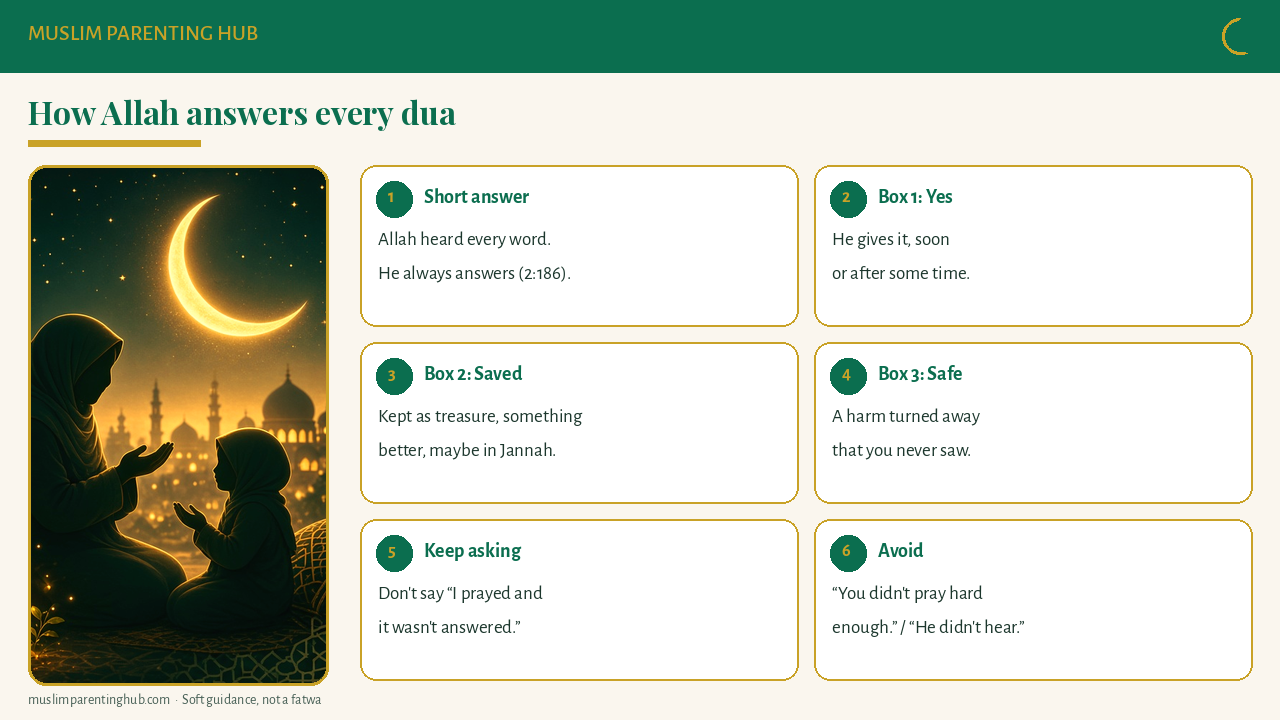
Young children understand ideas better when they can picture them. Many families use the idea of three “answer boxes”:
- The “Yes” box. You asked, and it happened. Maybe soon, maybe after some time. Like when you asked Allah to help you on your spelling test and you remembered every word.
- The “Saved for later” box. Allah keeps your dua like treasure and gives you something better, maybe in this life, maybe in Jannah. You might not know about it until later.
- The “Safe” box. Allah used your dua to keep something bad away from you, something you never even saw. Like a shield.
“So there is no such thing as a lost dua. Every single one goes into one of these boxes.”
Avoid turning this into a lecture. Draw three boxes on a napkin, and let your child put a sticker or a star in each. Then move on to something cozy.
Scripts by Age
Ages 4–6: Allah Is Listening
Keep it short and concrete. Little ones mostly want to know that Allah heard them and still loves them.
“Allah heard you. Allah always hears you. Sometimes Allah says ‘not now’ because He has a better surprise. Shall we ask Him again tonight, together?”
If the dua was for something they can’t have (a puppy, a trip, a toy), add:
“Mama and Baba sometimes say ‘not now’ too, because we love you. Allah loves you even more than we do, and He knows everything.”
Our guide to does Allah love me? gentle answers for kids has more love-first phrases for this age.
Ages 7–9: The Hadith of Three Answers
This age loves rules and fairness. Give them the hadith directly:
“The Prophet ﷺ told us something amazing. He said every dua gets one of three answers: Allah gives it soon, or He saves it for you in Jannah, or He keeps away something bad that was coming. So your dua wasn’t ignored. It went into one of those three boxes. Which box do you think yours went into?”
Let them guess. There is no wrong answer here; the point is that they are thinking about Allah’s wisdom instead of feeling ignored.
Ages 10–12: Wisdom and Patience
Older kids may ask harder versions: “I prayed for Nani to get better and she didn’t. Why?” Be honest and gentle:
“That’s one of the hardest feelings. Our duas for Nani weren’t wasted. Allah heard every one. Sometimes Allah’s plan includes things that hurt us, and He promises reward and comfort for our patience. The Quran says Allah knows and we don’t know. We can still make dua for her now, and that dua reaches her.”
If the question comes after a death in the family, our guide on how to explain death to a child in Islam can help you with the next conversation.
What Not to Say
Some answers are tempting because they are quick, but they can make a child feel unseen or afraid:
- “You didn’t pray hard enough.” This turns dua into a performance and teaches kids that Allah’s answer is about their effort alone.
- “Allah was punishing you.” For a young child this creates fear and confusion. Keep the focus on Allah’s mercy and wisdom.
- “Maybe Allah didn’t hear you.” Never say this. Allah hears everything, even whispers and thoughts (Quran 20:7).
- “Stop asking for silly things.” Children are allowed to ask Allah for small things. The Prophet ﷺ encouraged asking Allah for everything, even the small things we need.
If you’re not sure about a detail, it’s okay to say, “That’s a great question. Let’s find out together.” That models honesty and trust at the same time.
Good Habits That Make Dua Feel Real
A child who believes Allah answers dua will keep asking. These small habits help:
- Make dua at the special times. Between the adhan and the iqamah, in sujood, on Friday afternoons, and when it rains. Kids love having “secret dua times.” Our guide to dua after the adhan for kids is a good place to start.
- Teach a few short, real duas. Short Quranic duas give kids words when they don’t have their own, like “Rabbi zidni ilma,” “My Lord, increase me in knowledge” (Quran 20:114). Our list of duas for kids to learn has easy ones with meanings.
- Make dua for others. The Prophet ﷺ said that when a Muslim makes dua for a brother in his absence, an angel says, “And for you the same” (Muslim). Kids love knowing that praying for a friend comes back to them.
- Notice the yeses out loud. When something they asked for happens, celebrate: “Remember you asked Allah for this? Alhamdulillah!”
- Use names of Allah. Al-Mujeeb means the One who answers. Al-Samee’ means the All-Hearing. Learn them together; see names of Allah for kids.
The Five-Day Dua Jar Plan
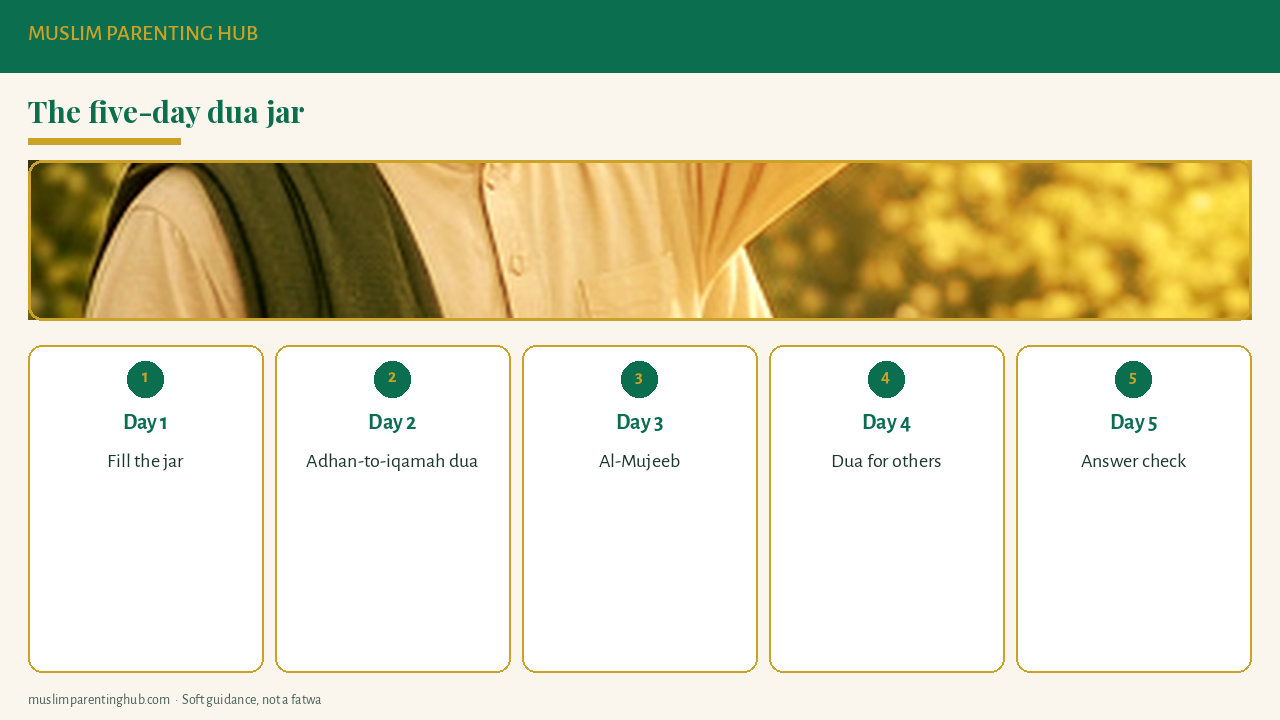
This simple plan helps kids see that Allah answers. You need a clean jar, small slips of paper and a pen.
- Day 1 — Fill the jar. Each family member writes or draws three duas and drops them in the jar. Big or small, all are welcome.
- Day 2 — Special time. Make the duas together between the adhan and iqamah of Maghrib. Teach that this is a time when duas are not turned back (Abu Dawud, Tirmidhi).
- Day 3 — Al-Mujeeb. Learn the name Al-Mujeeb, the One Who Answers. Write it on the jar lid.
- Day 4 — Dua for others. Add one dua for someone else: a sick neighbor, a sad friend, a grandparent far away.
- Day 5 — Answer check. Open the jar together. Sort the slips into the three boxes: “yes,” “saved for later” and “keep asking.” Say Alhamdulillah for every one.
Keep the jar going. Every Friday, pull out the slips and check again. Over months your child will see a pile of answered duas, and that memory is worth more than any explanation.
When the Dua Was Really Big
Sometimes the unanswered dua is heavy: a parent’s job, a sick grandparent, parents who are divorcing, a friend who moved away. In those moments:
- Name the feeling first. “You’re really sad, and you wanted this so much.” Feelings before explanations.
- Make dua together right then. Let your child say their own words. Hold their hands up with yours.
- Point to what Allah gave. “Allah gave us each other. He gave Nani to us for a long time.” Gratitude softens grief.
- Keep the door open. “You can talk to Allah about this any time, even when you’re angry or sad. He understands.”
If your child seems stuck in worry for weeks, our guide to duas for worried kids has calming duas and steps, and it’s always fine to speak with your pediatrician or a counselor.
FAQ
What do I say when my child asks why Allah didn’t answer their dua?
Say that Allah heard every word and always answers, but not always with “yes, right now.” Explain the three answers from the hadith: Allah gives it soon, saves it for later, or keeps a harm away. Then make dua together again.
Does Allah hear kids’ duas?
Yes. Allah hears every dua, from every person, in every language, even the ones said silently in the heart (Quran 2:186, 20:7). Children’s duas matter to Allah, so encourage them to ask for anything that is good.
What are the three ways Allah answers dua?
The Prophet ﷺ said Allah answers a Muslim’s dua in one of three ways: He grants it soon, He saves it as reward in the Hereafter, or He turns away a harm of the same size (Ahmad). No sincere dua is wasted.
Is it okay for kids to ask Allah for toys or small things?
Yes. Kids can ask Allah for anything good, big or small. It teaches them to turn to Allah first. Gently add duas for others and for good character too, so their dua list grows with them.
My child says “I prayed and nothing happened.” How do I keep them from giving up?
Acknowledge the feeling, then share the hadith that dua is answered as long as we don’t say “I prayed and it wasn’t answered” (Bukhari, Muslim). Start a dua jar so they can see answers over time.
What is the best time for kids to make dua?
Between the adhan and the iqamah, in sujood, during rain, on Friday, and in the last part of the night. For kids, the easiest are after the adhan and in sujood during salah. Make it a family habit at Maghrib.
Related guides
- Where is Allah? Answers for kids’ questions
- Does Allah love me? Gentle answers for kids
- Duas for kids to learn: 10 easy duas + dua from the heart
- Names of Allah for kids: where to start
- Does Allah see me everywhere? Gentle answers
Closing
“Why didn’t Allah answer my dua?” is a beautiful question, because it means your child expected an answer. Keep your reply the same every time: Allah heard you, Allah always answers, and none of your duas are wasted. A child who learns that early will keep raising their hands to Allah through every season of life.
Quick steps
Five-day dua jar plan for kids. A simple jar of written duas that helps children see how Allah answers over time.
- Day 1 — Fill the jar — Each family member writes or draws three duas and drops them in a jar.
- Day 2 — Special time — Make the duas together between the adhan and iqamah of Maghrib.
- Day 3 — Al-Mujeeb — Learn the name Al-Mujeeb, the One Who Answers, and write it on the lid.
- Day 4 — Dua for others — Add one dua for someone else, like a sick neighbor or a grandparent far away.
- Day 5 — Answer check — Open the jar and sort the slips into yes, saved for later and keep asking, saying Alhamdulillah for each.
Related articles

Where Is Allah? Gentle Answers Kids Ages 4–8 Can Understand
Where is Allah? Simple, love-based answers for ages 4–8—scripts for “Can He see me?” and “Who made Allah?”, what to avoid, and when you don’t know.
Read guide →
Does Allah Love Me? How to Answer Kids’ Tender Question (Ages 3–10)
“Does Allah love me, even when I’m bad?” Warm, true answers for Muslim kids: Al-Wadud, the mother hadith, scripts by age and a 5-day plan.
Read guide →
Names of Allah for Kids: 10 Beautiful Names to Start With (and How to Teach Them)
Teach kids the Names of Allah one at a time: 10 starter names with simple meanings, everyday moments, a name-of-the-week plan, and crafts for ages 3–10.
Read guide →
Duas for Kids to Learn: 10 Easy Duas + How to Make Dua From the Heart
10 easy duas for kids to learn, with meanings, plus a simple way to help children make dua from the heart in their own words. Scripts for tonight.
Read guide →