
How to Explain Death to a Child in Islam: Gentle Answers About Jannah, Grief and Dua
It usually comes out of nowhere. In the car, at bath time, or right before sleep: “Mama, are you going to die?” Or, “Where did Nana go?” Or, after a dead bird on the sidewalk, “Will that happen to me?”
Most parents freeze. We want to protect our children from sadness, and we worry about saying something that will make them afraid. But children ask about death because they are trying to understand the world—and Islam gives us a beautiful, honest, hopeful way to answer.
This guide walks you through simple words for each age, how to talk about returning to Allah and Jannah without fear, what to do when someone in the family dies, whether children should attend a janazah, how to help a grieving child, and the duas kids can make for people they love. It is soft guidance for parents, not a fatwa; for specific rulings, ask a scholar you trust.
Why Honest, Simple Words Matter
Children handle truth better than confusion. When adults use vague phrases, kids fill the gaps with their own (often scarier) imagination.
Avoid euphemisms like: - “Grandpa went to sleep.” (Children may become afraid to sleep.) - “We lost Auntie.” (Then why aren’t we looking for her?) - “Allah took him because He needed another angel.” (Inaccurate, and it can make Allah sound frightening.)
Use clear, gentle words instead:
“Grandpa died. His body stopped working, and it can’t work again. His soul went back to Allah, who made him and loves him.”
The word “died” can feel harsh to adults, but it is clear to children. Pair it with warmth and a hug.
The Islamic Big Picture, in Kid Words
Islam gives children a story with a beginning, middle, and hopeful end:
- Allah made us. Everyone and everything belongs to Allah.
- We live in this world for a while. We learn, love, pray, and do good.
- Everyone’s time in this world ends one day. This is called death. Allah decides when.
- Our soul returns to Allah. We say, “Inna lillahi wa inna ilayhi raji’un”—“We belong to Allah, and to Him we return” (Quran 2:156).
- Allah is the Most Merciful. We hope for Jannah, a place of peace and happiness with no more sadness or pain.
- We can be together again. We pray that Allah brings our family together in Jannah.
This frame helps children see death as part of Allah’s plan, not a random scary event. It also teaches them the words Muslims say at every loss—words they’ll carry all their lives.
If your child’s questions turn to “Where is Allah?” or “Can Allah see Grandpa?”, our guide to answering kids’ big questions about Allah has short, honest answers for ages 4–8.
What to Say by Age
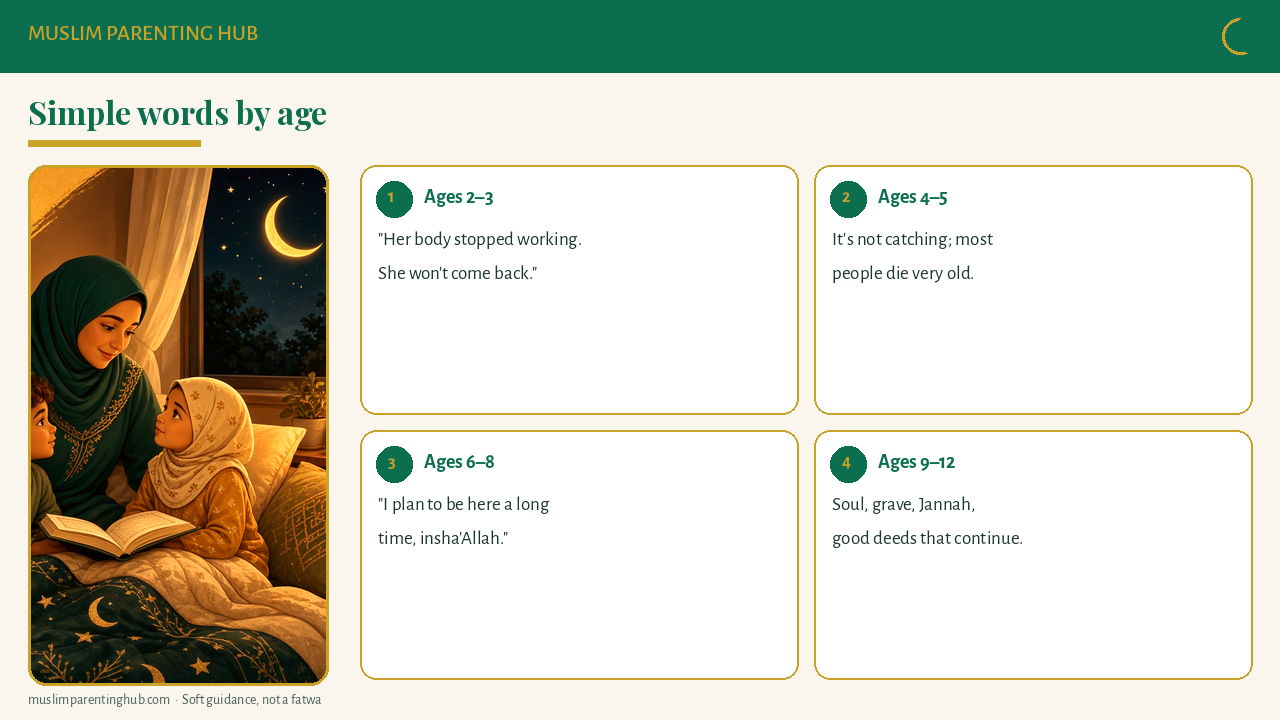
Toddlers (2–3)
Toddlers don’t understand permanence yet. Keep it very short and concrete:
“Kitty died. That means her body stopped working. She won’t come back. We feel sad, and that’s okay.”
Expect them to ask the same question many times. Repeat the same calm answer each time.
Preschoolers (4–5)
They may think death is reversible or contagious. Be clear and reassuring:
“When someone dies, they can’t come back to this life. You can’t catch it like a cold. Most people die when they are very, very old.”
Introduce the dua lightly: “When something sad happens, Muslims say ‘Inna lillahi wa inna ilayhi raji’un.’ Let’s say it together.”
Early elementary (6–8)
Now kids understand it’s permanent and might happen to people they love. They need safety more than details:
“I plan to be here to take care of you for a very long time, insha’Allah. And if anything ever happened, there are lots of people who love you and would take care of you.”
They’re ready for simple concepts like the soul, the grave as a resting place, and hope for Jannah.
Older kids (9–12)
They can handle deeper conversations: the Day of Judgment, good deeds that keep helping after death, why we pray janazah, and how grief works. Let them lead with questions.
When Kids Ask About the Angel of Death
Some children hear the phrase “angel of death” and become frightened. Keep it gentle:
“Allah gave one angel the job of bringing souls back to Him. For believers, it’s a gentle meeting. Angels only do what Allah tells them, and Allah is the Most Merciful.”
Children who already have a warm picture of angels handle this much better. If your child is anxious about angels in general, our guide on teaching kids about angels without scaring them starts with light, protection, and Allah’s care.
When Someone in the Family Dies
For many US Muslim families, the first close death is a grandparent—sometimes overseas, sometimes after a long illness, sometimes suddenly. A few calm steps help:
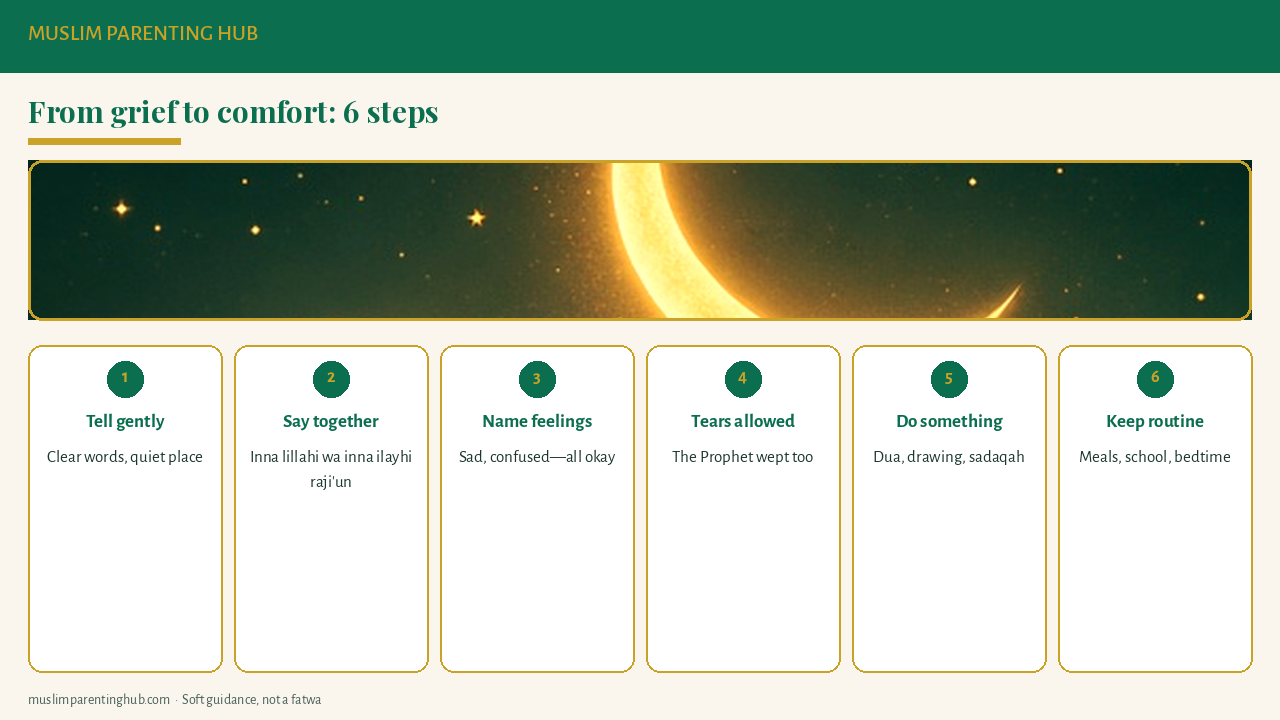
- Tell them yourself, soon, in a quiet place. Use the clear words above.
- Say the dua together. “Inna lillahi wa inna ilayhi raji’un.”
- Name the feelings. “I feel very sad. You might feel sad, confused, or even nothing right now. All of that is okay.”
- Show that tears are allowed. When the Prophet ﷺ’s young son Ibrahim died, he wept and said, “The eyes shed tears and the heart grieves, but we say only what pleases our Lord” (Bukhari). Crying is not weak faith.
- Give them something to do. Make dua, draw a picture, give sadaqah, or help prepare food for visitors.
- Keep routines steady. Meals, school, bedtime, and prayers give children a sense of safety.
Should children attend the janazah?
Families differ, and it depends on the child. Many school-age children find it comforting to be part of the community prayer, especially if they’re prepared: - Explain what they’ll see: rows of people, the body wrapped in white cloth, a short prayer without bowing or prostrating. - Assign a trusted adult to sit with them and step out if needed. - Younger children may do better staying with a caregiver and visiting the grave later.
Never force a frightened child. You can also make a short family dua at home at the same time.
Helping a Grieving Child (Weeks and Months Later)
Children grieve in bursts. They might cry at bedtime, then play happily ten minutes later. That’s normal.
Signs a child may need extra support: - Sleep problems or nightmares (our Islamic comfort scripts for scary dreams can help at bedtime) - Clinginess or fear of being apart from parents - New stomachaches or headaches - Anger, irritability, or school struggles - Worrying constantly that you will die too
Most of these ease with time, closeness, and routine. If they last for months or interfere with daily life, talk to your pediatrician or a counselor—ideally one who understands Muslim families.
Ways to remember someone lovingly: - Make a memory box with photos and small objects. - Tell stories at dinner: “Remember how Nana always gave you the first date in Ramadan?” - Make dua for them at Maghrib or bedtime. - Give sadaqah in their name.
Duas and Good Deeds Kids Can Do for Someone Who Died
This is one of the most comforting parts of Islam for children: they can still help the person they love.
The Prophet ﷺ said that when a person dies, their deeds end except for three: ongoing charity, beneficial knowledge, and a righteous child who prays for them (Muslim). Children love knowing that their duas are a gift.
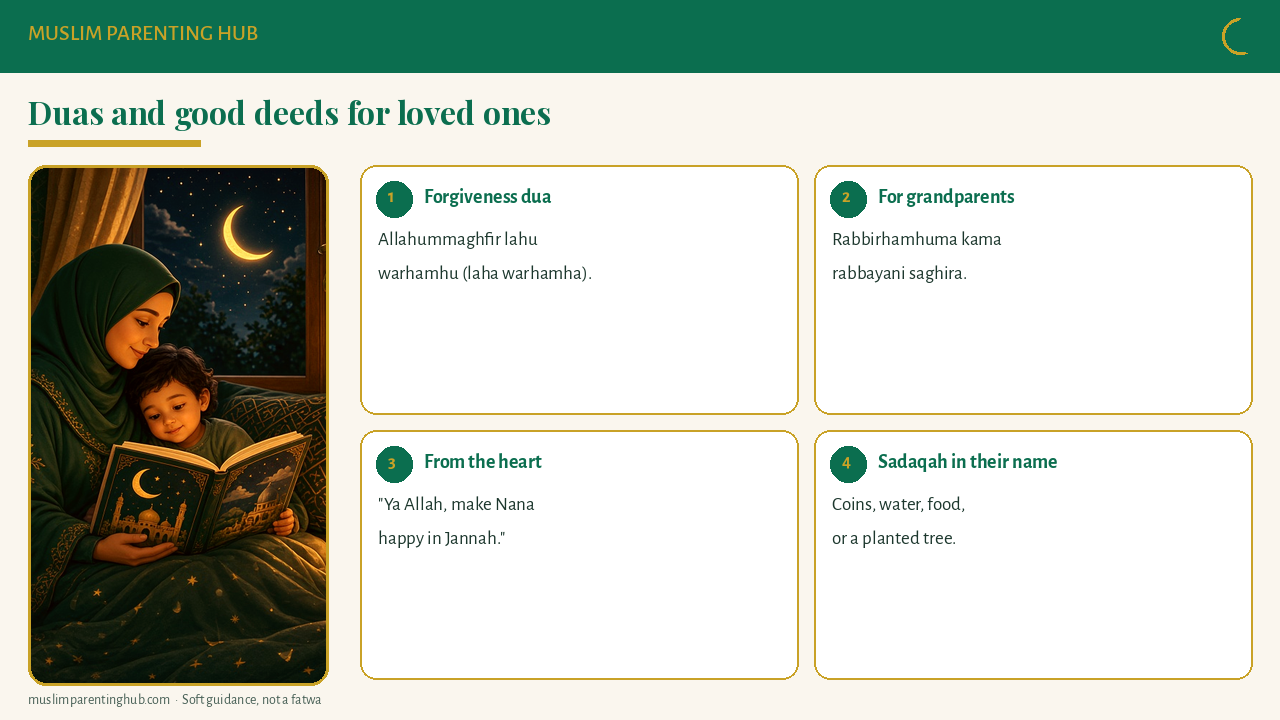
Simple duas children can learn: - “Allahummaghfir lahu warhamhu” — “O Allah, forgive him and have mercy on him.” (Use laha warhamha for a woman.) - “Rabbirhamhuma kama rabbayani saghira” — “My Lord, have mercy on them as they raised me when I was small” (Quran 17:24), for parents and grandparents. - A dua from the heart in their own words: “Ya Allah, please make Nana happy in Jannah.”
That last one matters as much as any Arabic phrase. Our guide to helping kids make dua from the heart shows how to make personal dua feel natural.
Good deeds in someone’s name: - Put coins in a sadaqah jar for Grandpa. - Donate water or food in their name. - Plant a tree or flowers (benefits continue as others enjoy them). - Learn a short surah and dedicate the effort with dua.
When the Question Is “Will You Die?”
This is the question that breaks parents’ hearts. Honest and reassuring works best:
“Everyone dies one day, but I plan to live a long time, insha’Allah, and take care of you until you’re grown. Allah is always taking care of you too, and so many people love you.”
Then move to something concrete: a hug, a bedtime dua, or a plan for tomorrow. Children need the answer and the feeling of safety.
If your child asks, “Will I die?”:
“Most people die when they are very, very old. You are young and healthy. Let’s take good care of our bodies, and let’s make dua for a long, happy life.”
When a Pet Dies
A pet’s death is often a child’s first loss. Treat it gently: - Let your child say goodbye. - Bury a small pet together if you can. - Talk about how the pet was a gift from Allah and how your child cared for it with rahma. - Avoid promising specific things about the pet’s afterlife; you can say, “Allah is Most Merciful, and He knows how much you loved her.”
What Not to Say
- “Don’t cry.” (Tears are a mercy.)
- “Be strong for your mom.” (A child shouldn’t carry adult grief.)
- “If you’re bad, you’ll go to the hellfire when you die.” (Fear-based messages backfire.)
- “Allah was angry with him.” (We don’t know, and it teaches fear of Allah instead of love.)
- “He’s watching you from the sky.” (Not accurate, and it can feel unsettling.)
Stay with what Islam clearly teaches: we belong to Allah, we return to Him, He is Most Merciful, and we make dua.
FAQ
How do I explain death to a young child in Islam?
Use clear, simple words: the person’s body stopped working, they can’t come back to this life, and their soul returned to Allah. Teach “Inna lillahi wa inna ilayhi raji’un” and keep the tone calm and loving.
Is it okay for my child to see me cry?
Yes. The Prophet ﷺ wept when his young son died and said the eyes shed tears and the heart grieves. Showing healthy grief teaches children that sadness and faith go together.
Should children go to a janazah?
Families differ. Many school-age children are comforted by joining, if prepared beforehand and accompanied by a trusted adult. Younger or very anxious children may do better staying home and making dua with a caregiver.
What dua can kids say for someone who died?
“Allahummaghfir lahu warhamhu” (O Allah, forgive him and have mercy on him), or “laha warhamha” for a woman, plus personal duas in their own words. Kids can also give sadaqah in the person’s name.
My child is afraid I will die. What should I say?
Be honest and reassuring: everyone dies one day, but you plan to live a long time, insha’Allah, and many people love them. Follow with closeness—a hug and a bedtime dua.
When should I get professional help for a grieving child?
If sleep problems, fear, anger, or school struggles last for months or get worse, speak with your pediatrician or a counselor who understands Muslim families.
Related guides
- Teach kids about angels without scaring them
- “Where is Allah?” Answering kids’ big questions
- Scary dreams and nighttime fear: comfort scripts
- Teach kids to make dua from the heart
Closing: We Belong to Allah
Death is the one conversation every parent eventually has. You don’t need perfect words—you need honest ones, a calm voice, and open arms. When you teach your child to say “Inna lillahi wa inna ilayhi raji’un,” to cry without shame, and to keep loving people through dua, you give them a faith that holds them on the hardest days. Tonight, if they ask, take a breath, sit close, and answer gently. Allah is with you both.
Related articles
"Where Is Allah?" How to Answer Kids' Big Questions About Allah (Ages 4-8)
Gentle, love-based answers for ages 4–8: Where is Allah? Can He see me? Who made Allah?—plus scripts, what to avoid, and when you don't know.
Read guide →
How to Teach Children About Angels in Islam Without Scaring Them
Age-appropriate ways to teach children about angels in Islam—Kiraman Katibin, bedtime protection, gentle scripts, and activities for ages 4–8. Soft, calm faith.
Read guide →
Duas for Kids to Learn: 10 Easy Duas + How to Make Dua From the Heart
10 easy duas for kids to learn, with meanings, plus a simple way to help children make dua from the heart in their own words. Scripts for tonight.
Read guide →
Scary Dreams and Nighttime Fear: Islamic Comfort Scripts for Muslim Kids
Comfort Muslim kids after scary dreams with soft Islamic scripts, short dua, night lights, and parent calm—without fear-based stories. Practical tonight.
Read guide →