Does Allah Love Me? How to Answer Kids’ Tender Question (Ages 3–10)
Sometimes it comes out quietly after a hard day. Your child has been told off, or had a fight with a sibling, or made a mistake at school. Then, at bedtime: “Does Allah still love me?”
Other times it’s pure curiosity: “How much does Allah love us? More than you love me?”
Both versions of the question deserve a warm, confident answer. How a child pictures Allah in these early years shapes how they will pray, make dua and turn back to Him for the rest of their life. This guide gives US Muslim parents a short answer to say first, scripts by age, the Quran and hadith behind them, and a five-day plan that turns the answer into a feeling. It is gentle home guidance, not a fatwa. If your child’s teacher or imam uses particular wording, follow that trusted wording.
If your child has been asking where Allah is, our main guide to where is Allah answers for kids pairs well with this one. Love is usually the next question.
The Short Answer (Say This First)
“Yes. Allah loves you very, very much. Allah made you, He gives you everything you have, and His love is bigger than Mama’s and Baba’s love put together. When we do good things, Allah is pleased. When we make mistakes and say sorry, Allah loves that too.”
That answer has four true parts:
- Allah is Al-Wadud, the Most Loving. “And He is the Forgiving, the Most Loving” (Quran 85:14).
- Everything good is a gift from Him. Our eyes, our food, our family and our home all come from Allah (Quran 16:18).
- His mercy is greater than a mother’s. The Prophet ﷺ saw a mother hug her baby tightly and said that Allah is more merciful to His servants than this mother is to her child (Bukhari, Muslim).
- Saying sorry brings us closer. “Indeed, Allah loves those who turn back to Him often” (Quran 2:222).
Say it with a hug. Children read your body before they process your words. A calm, smiling answer tells them the question is safe.
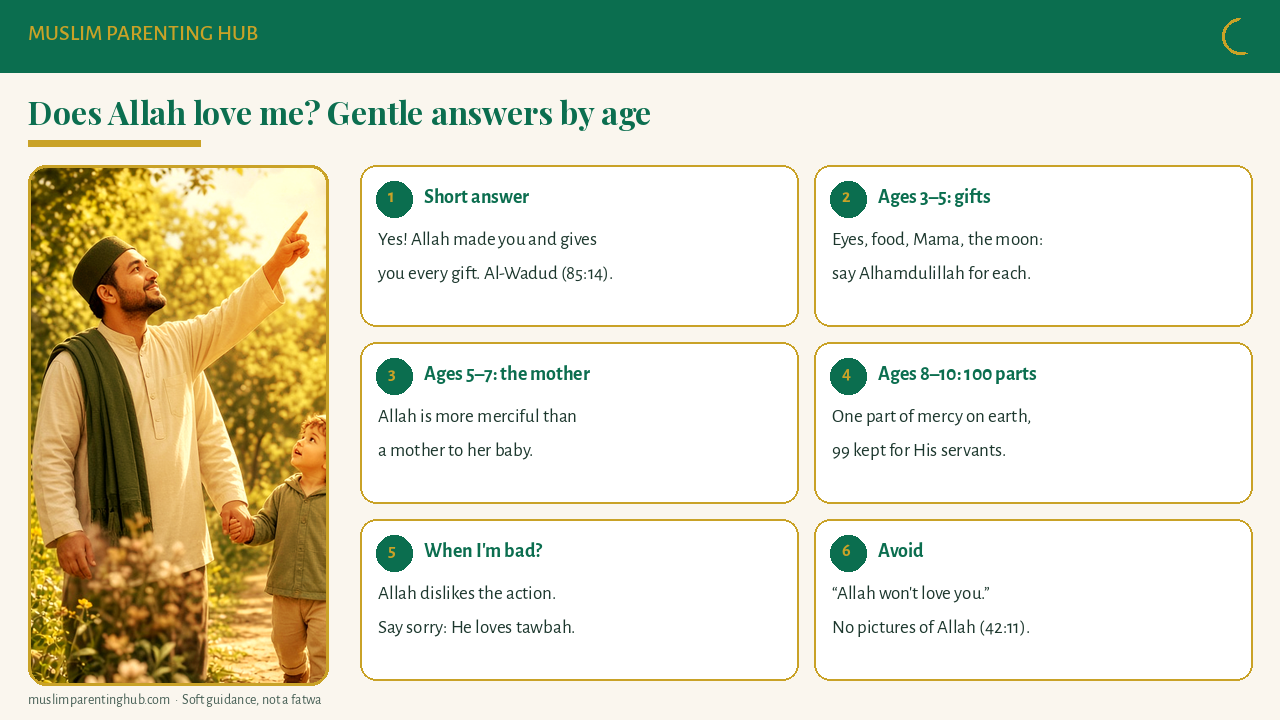
Scripts by Age
Ages 3–5: Love and Gifts
“Allah loves you! Who gave you your eyes to see the moon? Allah. Who gave you your yummy dinner? Allah. Who gave you Mama? Allah. He gives you so many gifts because He loves you.”
Make it a little game: each of you names one gift from Allah and says “Alhamdulillah.” Keep it to two minutes.
Ages 5–7: The Mother Story
“One day the Prophet ﷺ saw a mother who had lost her baby. When she found him, she held him so tight and fed him. The Prophet ﷺ asked, ‘Would this mother ever throw her baby in a fire?’ The people said, ‘Never!’ He said, ‘Allah is more merciful to His servants than this mother is to her child.’”
Then hug your child and say, “I love you this much, and Allah’s mercy is even bigger.”
Ages 8–10: The 100 Parts of Mercy
“The Prophet ﷺ told us Allah made mercy in one hundred parts. He sent just one part down to the whole world. Every mama animal that protects her baby, every kind word, every hug, all of it comes from that one part. Allah kept ninety-nine parts for the Day of Judgment for His servants” (Bukhari, Muslim).
Older children can also hear the hadith qudsi: “If My servant comes near to Me by a hand-span, I come near to him by an arm’s length; and if he comes to Me walking, I come to him running” (Bukhari). Ask: “What does that tell you about how much Allah wants us close?”
“Does Allah Still Love Me When I’m Bad?”
This is the version that matters most, and it’s where many of us, without meaning to, give the wrong message. Phrases like “Allah won’t love you if you do that” can feel useful in the moment, but they teach a child that Allah’s love is something to lose, and fear grows where trust should be.
A truer and gentler answer separates the child from the action:
“Allah doesn’t love bad actions, like hitting or lying. But He never stops caring for you. That’s why He gave us a special door called tawbah. When we say ‘Astaghfirullah’ and try to fix it, Allah forgives, and He loves people who come back to Him.”
Back it up with the verse many scholars call one of the most hopeful in the Quran: “Do not despair of the mercy of Allah. Indeed, Allah forgives all sins” (Quran 39:53).
Then show it in action. If your child has just hit a sibling, walk them through a short repair: say sorry, fix what can be fixed, and say “Astaghfirullah” together. Our guide on teaching kids to apologize with istighfar has scripts for each step. After a child lies, the same pattern works: calm truth, repair, and a reminder that Allah loves the one who comes back.
Five Things Allah Loves (Kid-Size)
The Quran tells us the kinds of people Allah loves. Turning these into simple “Allah loves…” sentences gives kids something to aim for without making love feel conditional:
| Quran says | Kid-size version |
|---|---|
| Allah loves those who do good (2:195) | “Allah loves it when you help.” |
| Allah loves those who turn back to Him and those who keep clean (2:222) | “Allah loves it when you say sorry and when you wash up.” |
| Allah loves the patient (3:146) | “Allah loves it when you wait nicely.” |
| Allah loves those who trust Him (3:159) | “Allah loves it when you make dua and trust Him.” |
| Allah loves those who are fair (49:9) | “Allah loves it when you share fairly.” |
Keep the tone celebratory. “Allah loves it when…” is an invitation, not a test.
A Five-Day Plan to Make It a Feeling
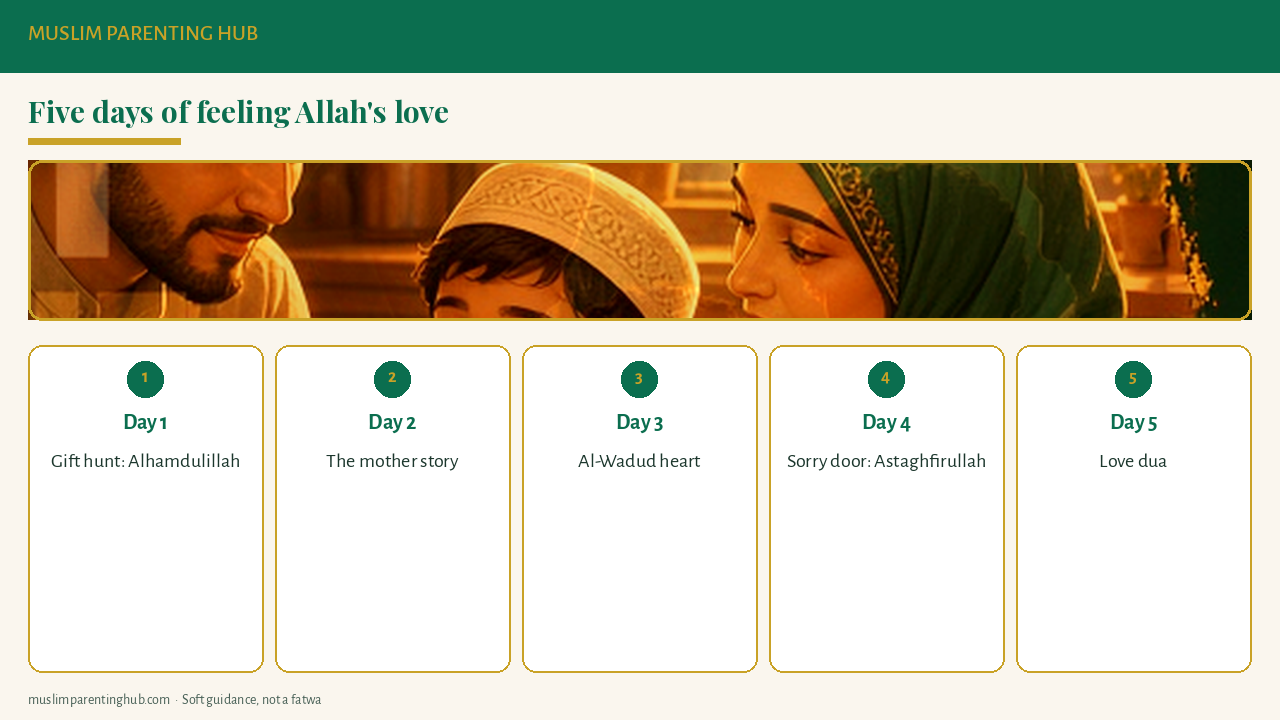
Words land best when they’re lived. Try one small activity a day:
- Day 1 — Gift hunt. Walk around the house and name ten gifts from Allah. Say “Alhamdulillah” at each one. For more gratitude games, try the 14-day shukr plan for kids.
- Day 2 — The mother story. Tell the hadith at bedtime and hug for ten seconds.
- Day 3 — Al-Wadud. Learn the name Al-Wadud, the Most Loving. Draw a heart and write the name inside (no pictures of Allah, ever).
- Day 4 — Sorry door. Practice “Astaghfirullah” together after a small mistake, and remind your child that Allah loves those who come back.
- Day 5 — Love dua. Teach a short dua: “Allahumma inni as’aluka hubbak,” “O Allah, I ask You for Your love” (Tirmidhi). Say it together after Maghrib or at bedtime.
If you’re just beginning to learn Allah’s names together, our guide on names of Allah for kids suggests which names to start with.
Questions Kids Ask Next
“Does Allah love me more than you do?” “Yes. My love comes from the tiny bit of mercy Allah put in my heart. His love and mercy are so much bigger.”
“Does Allah love everyone?” “Allah is kind to every creature. He gives food and air to everyone. He has a special love for people who believe, do good and say sorry.”
“Can Allah see that I love Him?” “Yes. Allah knows what is in your heart, even when you don’t say it.” (Pair this with our guide does Allah see me everywhere?)
“How do I show Allah I love Him?” “Pray, make dua, be kind, say Alhamdulillah, and follow what the Prophet ﷺ taught us. Allah says, ‘If you love Allah, follow me, and Allah will love you’” (Quran 3:31).
What to Avoid
- Love as a threat. “Allah won’t love you” turns Allah into a punishment tool. Use “That makes Allah unhappy, let’s fix it” instead.
- Only talking about fire. Jahannam is real, but young children need years of mercy, gifts and love first.
- Pictures of Allah. Nothing is like Him (Quran 42:11). Point to what He made, never an image of Him.
- Long lectures. One warm sentence and a hug beat a ten-minute talk.
- Ignoring the feeling. If the question comes after a hard day, name the feeling first: “You had a rough day. Let’s talk about it.”
FAQ
What should I say when my child asks “Does Allah love me?”
Say yes, calmly and warmly: Allah made you, gives you every gift you have, and His love and mercy are bigger than a parent’s. Add that Allah loves it when we do good and when we say sorry after a mistake.
Does Allah love children who misbehave?
Allah dislikes wrong actions, not the child’s worth. Teach that when we make mistakes and say “Astaghfirullah” and fix things, Allah forgives, and the Quran says He loves those who turn back to Him often (2:222).
Which name of Allah teaches kids about His love?
Al-Wadud, the Most Loving (Quran 85:14), along with Ar-Rahman and Ar-Raheem, the Most Merciful. Start with these before harder names, and connect each one to a gift your child can see.
Is there a hadith about Allah’s love that kids can understand?
Yes. The Prophet ﷺ saw a mother hugging her baby and said Allah is more merciful to His servants than this mother is to her child (Bukhari, Muslim). It is short, visual and easy for ages 5 and up.
Is it okay to say “Allah won’t love you if you do that”?
It’s better not to. It teaches that Allah’s love is easily lost and can make kids afraid of Him. Say “That action makes Allah unhappy, so let’s fix it and say Astaghfirullah” instead.
What dua can kids say to ask for Allah’s love?
“Allahumma inni as’aluka hubbak,” meaning “O Allah, I ask You for Your love” (Tirmidhi). Teach it in two small parts and say it together after Maghrib or at bedtime.
Related guides
- Where is Allah? Answers for kids’ questions
- Why can’t we see Allah? Gentle answers for kids
- How to talk about Allah with toddlers
- Names of Allah for kids: where to start
Closing
“Does Allah love me?” is a question you want your child to keep asking, because it means they care about their relationship with Him. Answer it the same way every time: yes, more than you can imagine, and when you slip, the door back is always open. A child who grows up sure of Allah’s love will keep running back to Him.
Quick steps
Five-day plan to help kids feel Allah’s love. One small activity a day that turns “Allah loves you” into a feeling.
- Day 1 — Gift hunt — Name ten gifts from Allah around the house and say Alhamdulillah at each one.
- Day 2 — The mother story — Tell the hadith of the mother and her baby at bedtime and hug for ten seconds.
- Day 3 — Al-Wadud — Learn the name Al-Wadud, the Most Loving, and write it inside a heart.
- Day 4 — Sorry door — After a small mistake, say Astaghfirullah together and remember Allah loves those who come back.
- Day 5 — Love dua — Learn “Allahumma inni as’aluka hubbak,” O Allah, I ask You for Your love.
Related articles
Where Is Allah? Gentle Answers Kids Ages 4–8 Can Understand
Where is Allah? Simple, love-based answers for ages 4–8—scripts for “Can He see me?” and “Who made Allah?”, what to avoid, and when you don’t know.
Read guide →
Why Can’t We See Allah? Gentle Answers for Kids’ Big Question (Ages 4–10)
“Why can’t I see Allah?” Calm, true answers for Muslim kids ages 4–10: what the Quran says, the wind and sun examples, seeing Allah in Jannah, and scripts.
Read guide →
Names of Allah for Kids: 10 Beautiful Names to Start With (and How to Teach Them)
Teach kids the Names of Allah one at a time: 10 starter names with simple meanings, everyday moments, a name-of-the-week plan, and crafts for ages 3–10.
Read guide →
How to Talk About Allah With Toddlers: Simple Words and a 7-Day Plan
What to say when your toddler asks “Who made the moon?” Easy, loving words about Allah for ages 1–3, bedtime lines and a 7-day plan. No fear, no lectures.
Read guide →