"Why Don't You Eat Pepperoni?" Kind Answers Muslim Kids Can Give When Classmates Ask About Islam
“Why do you wear that on your head?” “Why can’t you eat the pizza?” “Do you celebrate Christmas?” “What are you doing on that mat?”
If your child attends a US public school, they’ll hear questions like these—at the lunch table, on the bus, during a class party, or in the middle of a game at recess. Most of the time, classmates are just curious. Sometimes, they’re testing. Occasionally, they’re unkind.
Kids who have short, confident, kind answers ready feel proud instead of put on the spot. Kids who don’t often say “I don’t know” or “My mom makes me”—and walk away feeling like their faith is a weird rule rather than something they love.
This guide gives your child ready-to-use answers for the most common questions, a simple formula for the ones you didn’t predict, and a home role-play plan. It pairs naturally with our scripts for when your Muslim child is left out of birthday parties: both are about protecting your child’s heart in a school world that doesn’t always look like your home.
Soft guidance for homes—not a fatwa.
Why This Matters
- Identity: Kids who can explain their faith simply tend to feel more ownership of it.
- Belonging: A friendly answer turns “different” into “interesting.”
- Dawah by character: Your child may be the first Muslim their classmates know. Kindness speaks louder than any argument.
- Safety: Practiced answers reduce the chance a curious question becomes teasing.
The tone we want is the same one behind our rahma activities for kids: mercy first, then words.
The Answer Formula: Short + True + Friendly + Turn
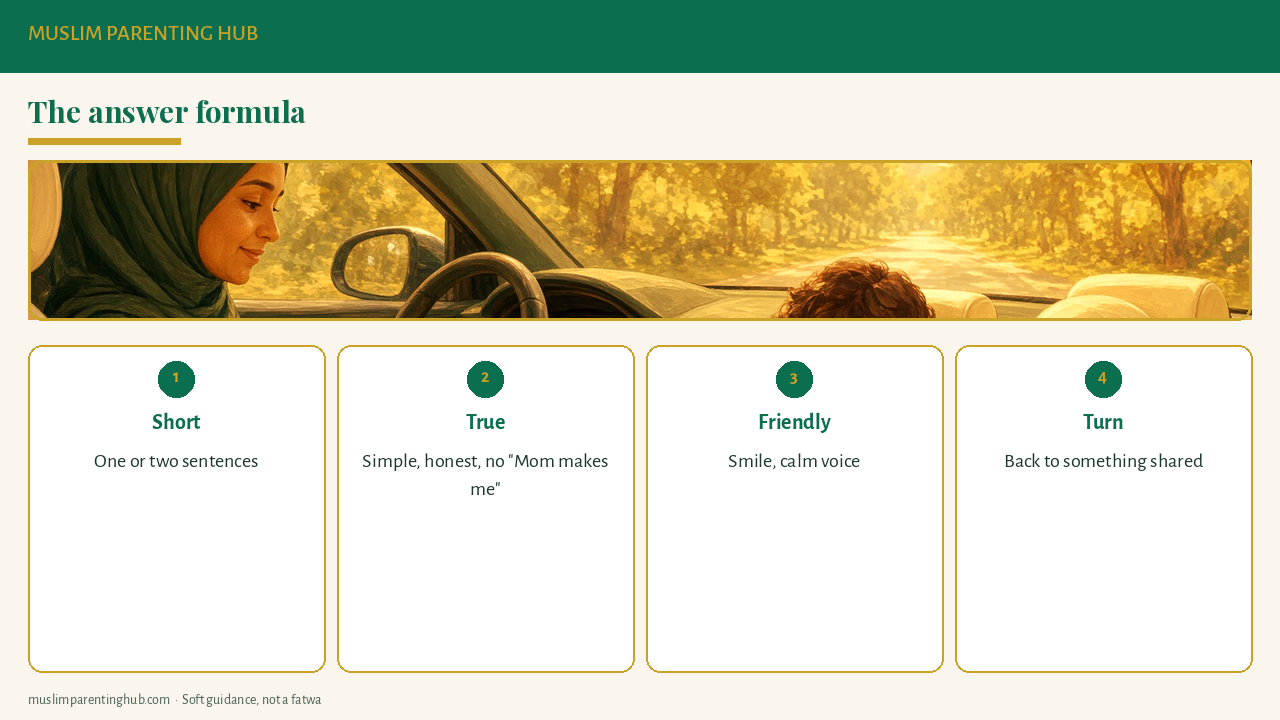
Kids don’t need speeches. Teach them this four-part formula:
- Short: One or two sentences.
- True: Simple and honest, not “my mom makes me.”
- Friendly: A smile and a calm voice.
- Turn: Move the conversation back to something shared. “Want to trade snacks?” “Are you playing kickball?”
Example:
Classmate: “Why don’t you eat pepperoni?” Your child: “It’s pork, and Muslims don’t eat pork—it’s part of our religion. I’m having cheese! Do you like cheese pizza?”
That’s it. Short, true, friendly, turn.
Ready Answers for the 12 Most Common Questions
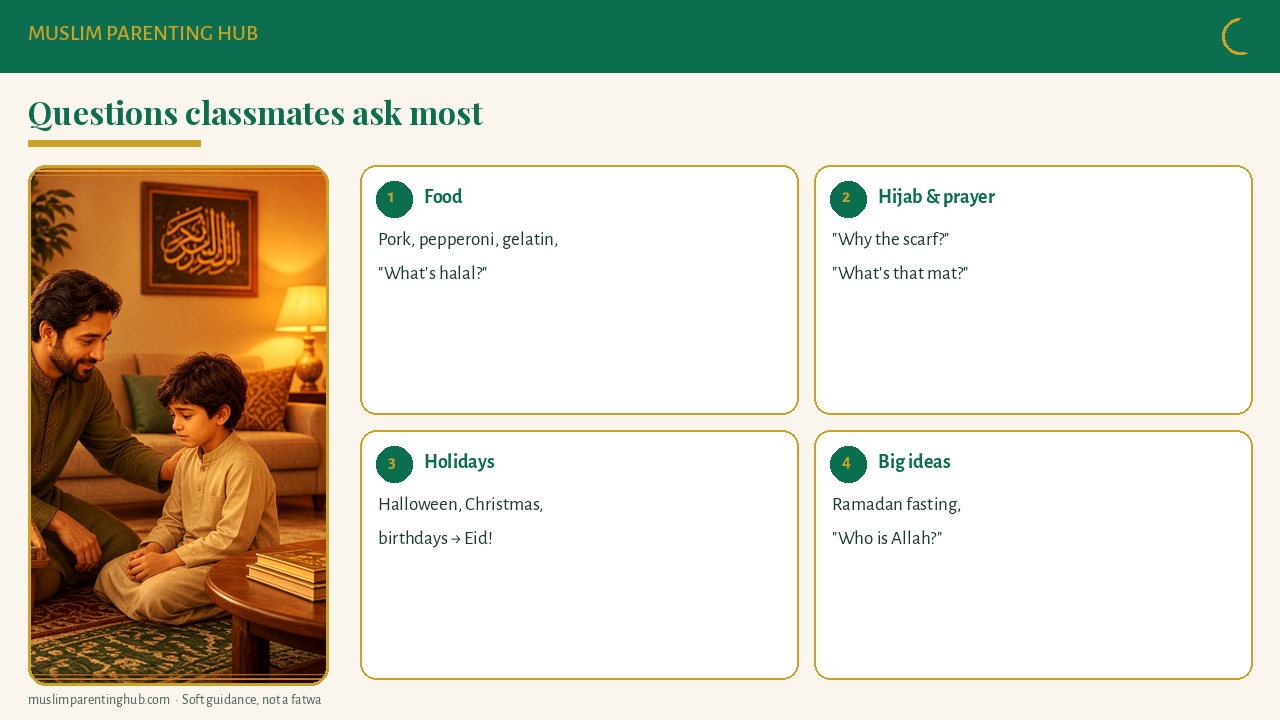
1) “Why don’t you eat pork / pepperoni / that gummy?”
“Muslims don’t eat pork. Some candies have gelatin from pork, so I check. It’s like how some people are vegetarian.”
2) “What’s halal?”
“It means food that’s allowed for Muslims. It’s kind of like kosher for Jewish people.”
3) “Why does your mom (or you) wear a scarf?”
“It’s called a hijab. Muslim women wear it because they believe Allah asked them to, and it’s part of who we are. It’s like a sign of our faith.”
4) “What are you doing on that mat?”
“I’m praying. Muslims pray five times a day. It only takes a few minutes. It helps me feel calm and close to God.”
Using “God” with non-Muslim friends is fine and clear. Some kids like adding, “In Arabic we say Allah.”
5) “Do you celebrate Christmas / Halloween?”
“We don’t celebrate it, but we have our own holidays—Eid! There are two, and we get presents and go to the masjid and eat a lot.”
For October specifically, our Halloween at a US public school plan covers costume days and parades.
6) “What’s Ramadan? You’re not eating?”
“Ramadan is a month when Muslims fast from sunrise to sunset. Kids don’t have to fast, but some of us try. At night we have a big dinner called iftar!”
7) “Why can’t you come to my birthday party?”
“My family doesn’t do birthday parties, but I’d love to hang out another time. Want to play at the park this weekend?”
(Adjust if your family does attend. The point is a friendly answer, not a lecture.)
8) “Who is Allah?”
“Allah is the Arabic word for God—the One who created everything.”
If your child gets deeper questions, our guide to answering “Where is Allah?” helps you prepare them with simple, true wording.
9) “Are you from another country?”
“I’m American! My family is from [country].” Or simply: “I was born here in Ohio.”
Help your child separate faith from ethnicity. Muslims are every race and nationality.
10) “Why do you say ‘Inshallah’ / ‘MashaAllah’?”
“It’s Arabic. ‘Inshallah’ means ‘if God wills.’ ‘MashaAllah’ is like saying ‘wow, that’s amazing, God made that happen.’”
11) “Is it true Muslims are…?” (something negative from the news)
“No, that’s not what Islam teaches. Islam teaches peace and being kind. I’m Muslim, and I’m your friend.”
Tell your child they can always walk away and tell a teacher—and you—if it feels unkind.
12) “Can I try your lunch?”
“Sure, want some? This is [samosa / hummus / my mom’s chicken].”
A shared snack has started more friendships than any explanation.
Tricky Moments (and What to Do)
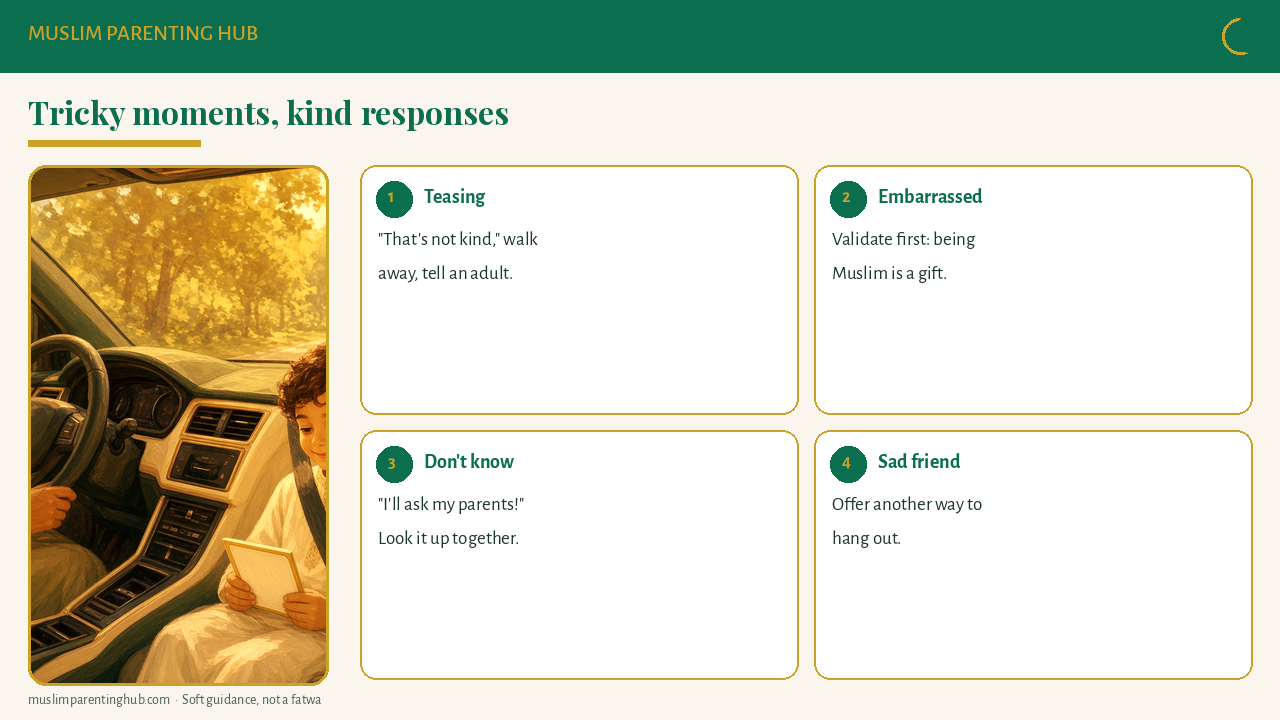
When the question is really teasing. Teach the difference between curious and unkind. If a kid laughs, repeats, or gets a group involved, your child can say “That’s not kind,” walk away, and tell an adult. Teasing about religion is something US schools take seriously; it’s okay to report it.
When a teacher asks your child to “explain Ramadan” to the class. Your child can say yes, no, or “Can my mom come help?” Many families love offering a short classroom visit with dates and a picture book around Ramadan or Eid.
When your child feels embarrassed. Validate first: “It’s hard to feel different.” Then remind them: “Being Muslim is a gift. You don’t have to explain everything—just the parts you want.”
When a friend is sad your child can’t do something. Model the “turn”: offer an alternative. “I can’t come to the party, but I’ll sit with you at lunch tomorrow.”
When your child doesn’t know the answer. “I’m not sure! I’ll ask my mom/dad.” Then come home and look it up together. That’s a great teachable moment.
If a classmate is upset or left out, your child can also flip the script and be the kind one. Our scripts for comforting a sad classmate show what that looks like at recess and on the bus.
Age Bands: What Kids Can Handle
Ages 4–6 (preschool to kindergarten)
One short sentence plus a turn. “I don’t eat pork. Want to share grapes?” Practice two or three answers at most.
Ages 7–9 (early elementary)
The formula plus five or six ready answers: pork, hijab, prayer, holidays, Ramadan, Allah. They can start telling curious from unkind.
Ages 10–12 (upper elementary)
They can handle “news” questions and explain more (“It’s like kosher”). They can help younger siblings and even offer a class presentation if they want.
A 7-Day Role-Play Plan at Home
Keep each session to 5 minutes—over dinner, in the car, or before bed.
| Day | Practice |
|---|---|
| 1 | Learn the formula: Short + True + Friendly + Turn |
| 2 | Food questions (pork, halal, gelatin) |
| 3 | Prayer and hijab questions |
| 4 | Holiday questions (Halloween, Christmas, birthdays, Eid) |
| 5 | Ramadan and “Who is Allah?” |
| 6 | Tricky moments: curious vs teasing |
| 7 | Switch roles: your child asks, you answer |
Make it fun. Let them play the curious classmate and ask you silly questions in a goofy voice. Laughing together takes the fear out.
What Parents Should Avoid
- Scripts that sound like debates. “Actually, your religion is wrong because…” creates conflict and isn’t our adab.
- “Just tell them your parents make you.” That teaches kids their faith is a rule imposed from outside.
- Over-preparing for hostility. Most questions are curious. Prepare for kindness, plan for the rare unkind moment.
- Making your child the class spokesperson. They’re a kid, not an ambassador. Let them decide how much to share.
Partnering With Your Child’s School
- Send a short, friendly email at the start of the year mentioning dietary needs and upcoming Islamic holidays.
- Offer to bring a book about Ramadan or Eid for a class read-aloud.
- Ask whether there’s a quiet place for older kids to pray Dhuhr if needed.
- If teasing happens, document it and speak to the teacher calmly and early.
FAQ
How do I prepare my child to answer questions about Islam at school?
Teach a simple formula—short, true, friendly, then turn back to something shared—and practice five or six common answers at home through role-play. Short daily practice works better than one long talk.
What should my child say when asked why they don’t eat pork?
Something like: “Muslims don’t eat pork—it’s part of our religion. It’s like being vegetarian.” Then offer to share another snack.
Should my child say “God” or “Allah” with non-Muslim friends?
Either is fine. Many kids say “God” for clarity and add “In Arabic we say Allah.” Both refer to the same Creator.
What if classmates tease my child about being Muslim?
Teach your child to say “That’s not kind,” walk away, and tell a teacher and you. Contact the school early and calmly, and keep reassuring your child that their faith is a gift.
How do I explain Halloween and Christmas to my child’s friends?
Keep it positive: “We don’t celebrate it, but we have Eid!” Focus on what your family does celebrate rather than criticizing others.
My child feels embarrassed about being different. What can I do?
Validate the feeling, share stories of proud Muslim kids and adults, connect them with other Muslim families, and remind them they only have to share what they want to.
Related guides
- When your Muslim child is left out of birthday parties
- Teach kids to comfort a sad classmate
- Halloween at a US public school
- Islamic manners for kids: daily adab checklist
Closing: Proud, Kind, and Short
Your child doesn’t need to win every conversation. They need to walk away from the lunch table feeling proud of who they are and kind toward the friend who asked. Practice a few answers tonight, laugh through the role-play, and trust that a calm, confident “I’m Muslim—want to share my snack?” opens more hearts than you’d expect.
Related articles
Halloween at a US Public School: A Gentle Plan for Muslim Families
A calm US public-school Halloween plan for Muslim families—parades, costumes, candy, teacher email scripts, and options that don't shame friends.
Read guide →
When Your Muslim Child Is Left Out of Birthday Parties: Scripts That Protect Their Heart
Soft scripts when Muslim kids are left out of birthday parties—validate feelings, protect identity without shaming others, and build warm family alternatives.
Read guide →
Teach Kids to Comfort a Sad Classmate: Rahma Scripts for US Public School
Teach Muslim kids rahma scripts to comfort a sad classmate at US public school—kind words, consent, inclusion tips, and what not to say.
Read guide →
10 Rahma Activities to Teach Muslim Kids Kindness This Month
Teach Muslim kids rahma with 10 kindness activities—kindness jar, neighbor drops, Prophet ﷺ mercy stories, age charts, and tonight scripts. Soft, practical monthly plan.
Read guide →