
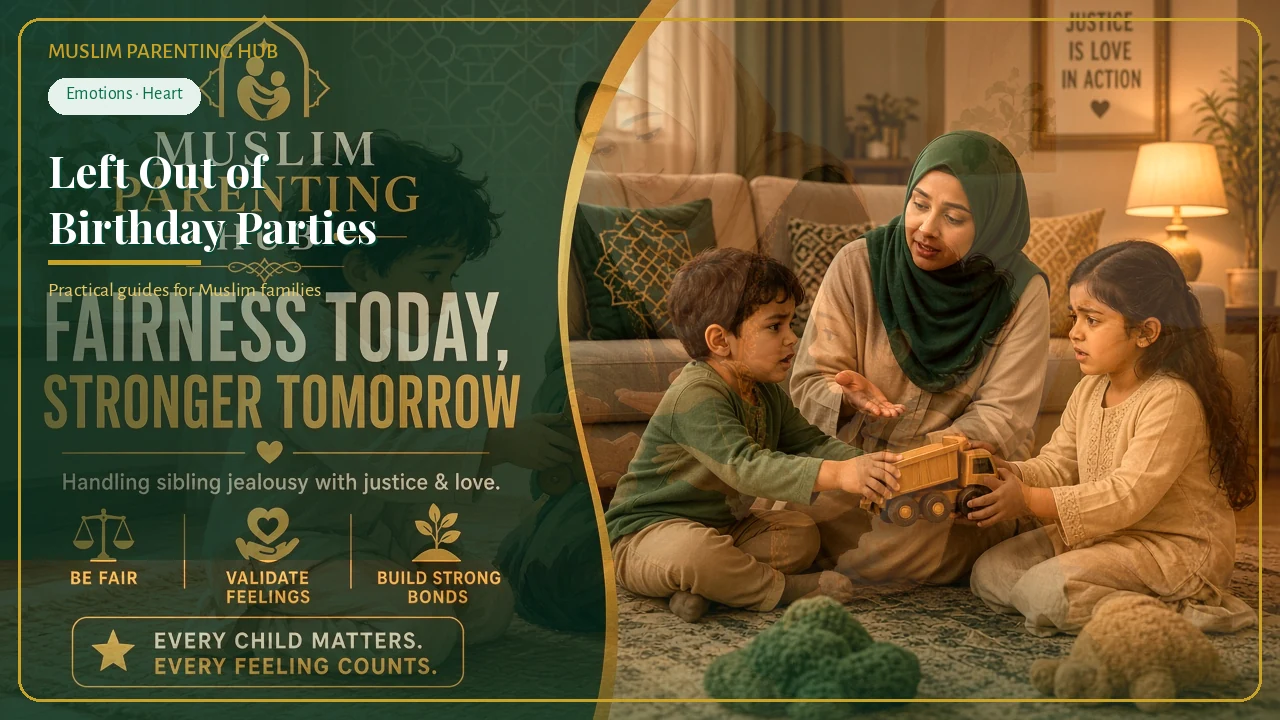
When Your Muslim Child Is Left Out of Birthday Parties: Scripts That Protect Their Heart
The invitation never comes. Or it comes with a cake, music, and activities your family does not attend. Your child watches friends post photos. Their shoulders drop. Your stomach drops with them.
This guide is for that ache.
Muslim families differ on birthday gatherings—some attend carefully, some skip parties, some host alternatives. This article does not settle fiqh debates. It focuses on what every parent needs either way: protecting a child’s heart, teaching empathy without bitterness, and building belonging at home. Soft guidance, not a fatwa.
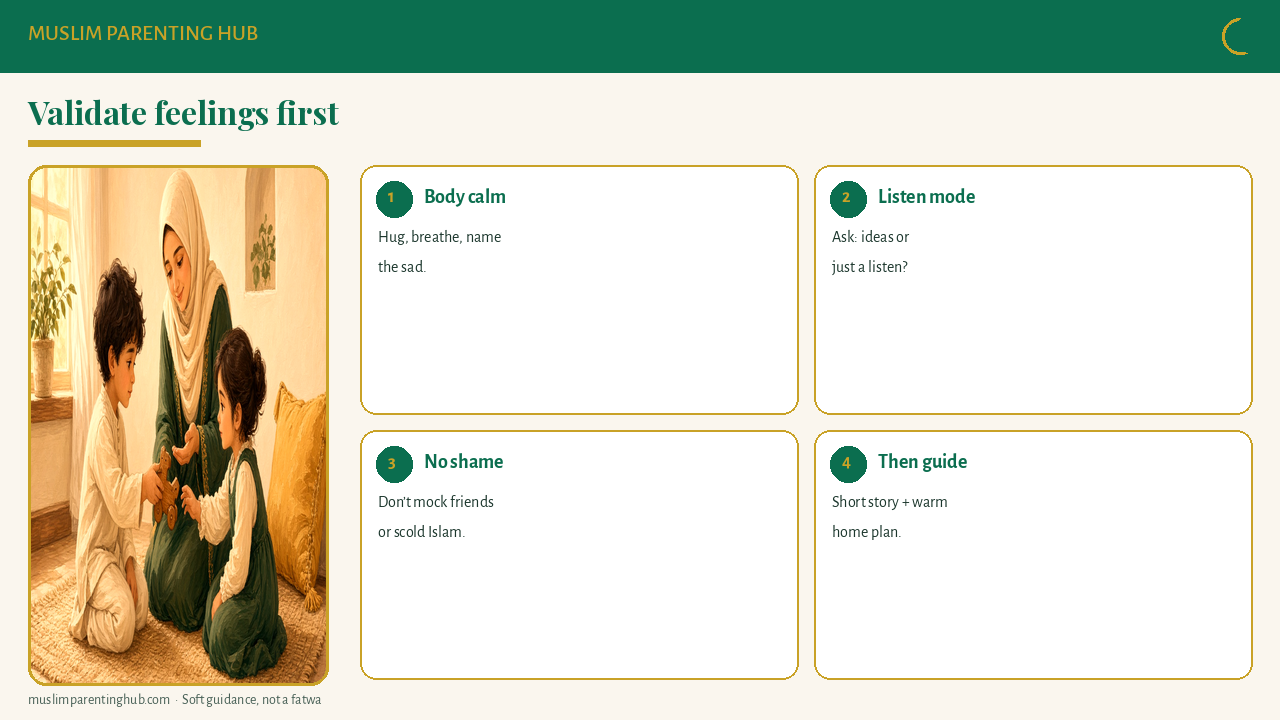
First: Validate the Feeling Before You Teach
A hurt child cannot hear theology while their chest is tight.
Body-first script:
“You feel left out. That is a real sad. I’m here. Breathe with me.”
Meaning-second script (after a hug):
“Friends’ parties can look fun. Your feelings matter to Allah and to me.”
Avoid:
- “It’s just a party—get over it.”
- “Those kids are bad for inviting you to haram.”
- “If you were nicer, you’d get invited.”
Those lines plant shame or superiority. Neither is rahma.
This emotional repair skill pairs with how we teach kids to apologize and repair—naming hurt honestly without crushing anyone’s dignity.
Name the Situation Without Villains
Kids often invent a story: “Nobody likes me” or “Muslims aren’t allowed to be happy.”
Offer cleaner stories:
Story A — Different family rules
“Some families celebrate birthdays with big parties. Our family chooses differently sometimes. That can feel lonely—and it can also feel special when we make our own joy.”
Story B — Friendship bumps (secular too)
“Sometimes kids forget. Sometimes class groups are messy. Being left out hurts whether the reason is religion or not. We still choose kindness.”
Story C — You declined
“We said no because the plan didn’t fit our home. Saying no can sting. We can still love your friends and plan something warm here.”
If sibling jealousy is already loud at home, watch for “they always get invited and I don’t” comparisons. Separate fairness talks from party FOMO.
Faith Identity Without Shaming Others
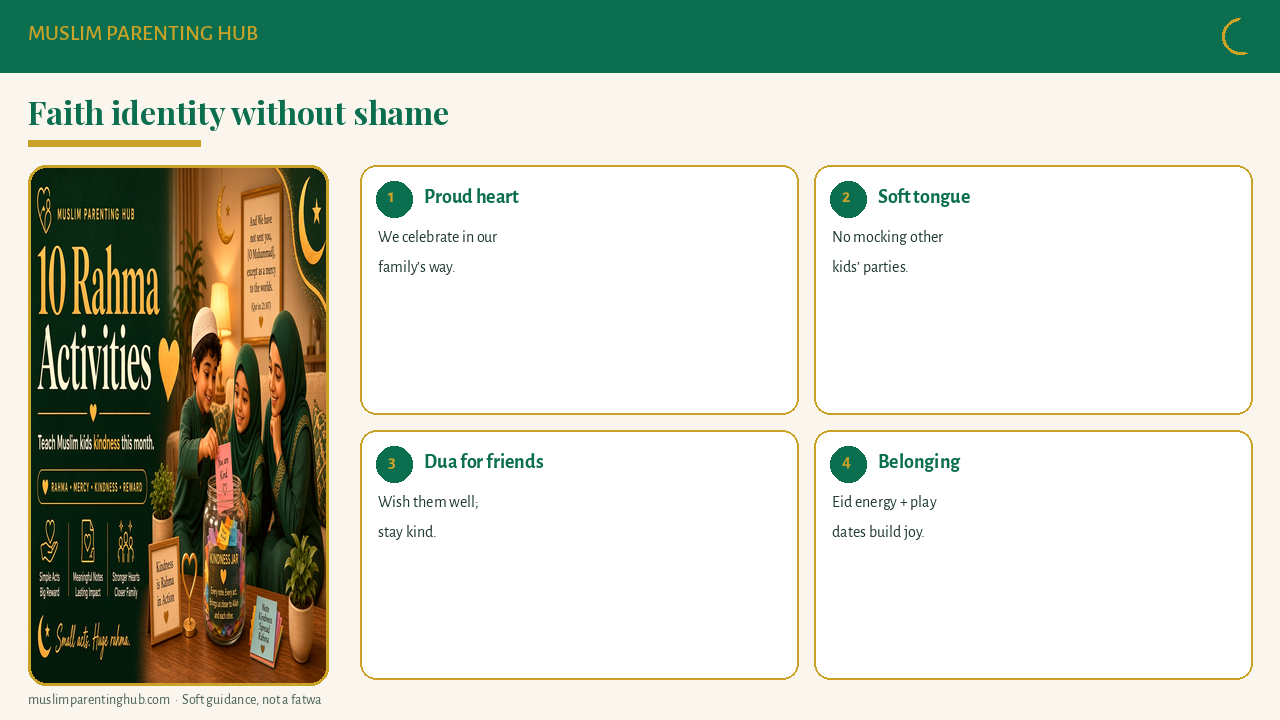
Goal: proud Muslim heart + soft tongue about classmates.
Helpful lines:
“Allah gave us beautiful ways to celebrate—Eid, Jumu’ah joy, family days. We don’t need to mock someone else’s party to love our way.”
“We can disagree with an activity and still make dua that our friends are happy and guided.”
Unhelpful lines:
“Their parties are dirty / stupid / against Allah—never go near them.”
Children turn that into playground superiority or secret craving. Teach conviction with adab.
Connect identity warmth to talking about Allah with toddlers—Allah as near and loving, not only as a list of bans.
Parent Scripts for Common Moments
After school (“Everyone went except me”)
- Hug / snack / sit
- Reflect: “Left out feels heavy.”
- Ask one question: “Do you want ideas, or just a listen?”
- If ideas: choose from alternatives below
- End with dua: “Ya Allah, fill their heart with friends who feel safe.”
When they beg to go to a party you will decline
“I hear how much you want to be with them. Tonight the answer is no, and I will help your heart with a yes at home. Let’s plan it together.”
Offer agency: pick the snack, the game, or the friend to invite later (if appropriate).
When they are invited and you are unsure
Pause. Check details. Decide as adults first. Then speak with unity:
“Mom and Dad decided ___ . Here’s how we’ll still care about your friends.”
When social media pours salt
“Photos are highlights, not the whole friendship. Let’s put the phone to sleep and make a real memory.”
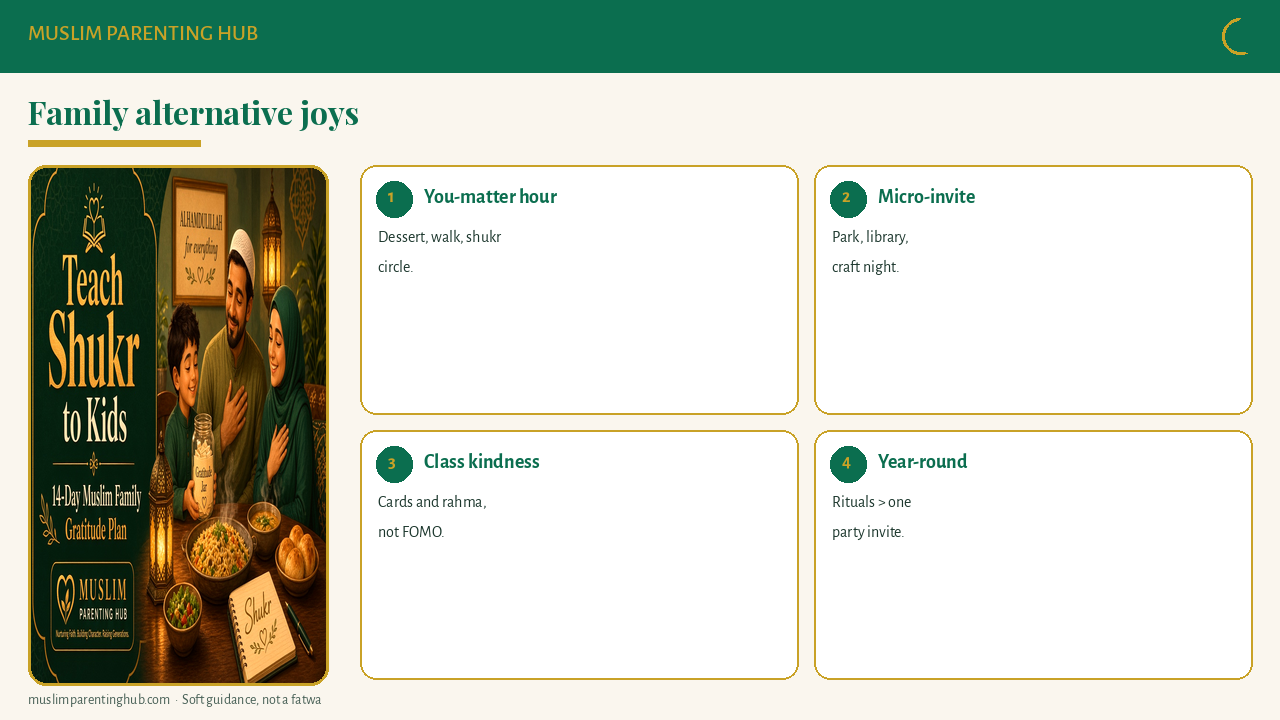
Family Alternative Celebrations (Eid Energy on Ordinary Days)
Borrow the joy pattern of Eid without copying every birthday custom:
The “You Matter” Hour (30–60 minutes)
- Special drink / dessert your family is comfortable with
- One-on-one walk or game
- A short shukr circle: three things you love about them
- Optional gift that is not tied to calendar pressure (book, puzzle, experience)
Friendship micro-invites
- Park playdate (no cake required)
- Library afternoon
- Ice cream after soccer (halal-friendly plan)
- Craft night with one classmate
Class kindness without party pressure
- Non-birthday treat share on a random Friday (teacher-approved)
- Handmade card for a friend who is sick
- Rahma activities that build belonging through giving, not getting invited
School Note Templates (Copy-Paste Soft)
Use a calm tone. Assume good intent.
Template 1 — Declining a classroom party activity
Assalamu alaikum / Hello [Teacher’s name],
Thank you for including our child. Our family will sit out the birthday party portion for faith/family reasons. Please let us know if there is a quiet alternative activity in the room or library corner. We appreciate your care.
Warmly, [Name]
Template 2 — Asking for inclusive non-party options
Hello [Teacher’s name],
We’re grateful for classroom community. Could you share non-food or non-party ways our child can still help celebrate classmates (cards, classroom jobs, reading buddy)? We want them to practice kindness while following our home guidelines.
Thank you, [Name]
Template 3 — After exclusion hurt (fact-finding, not accusing)
Hello [Teacher’s name],
[Child] felt left out of a celebration conversation today and came home sad. No blame—just checking whether groups or invites are happening so we can support friendship skills at home. Any gentle insight is appreciated.
JazakAllahu khairan / Thank you, [Name]
Age Bands: What Kids Can Understand
Ages 3–5
Keep it body + simple story. “We do family joy day.” Don’t overload with rulings.
Ages 6–8
Add: families choose differently; we stay kind; we can feel sad and still be okay.
Ages 9–12
Discuss peer pressure, social media, and how to answer “Why don’t you celebrate?” with one calm sentence they practice aloud.
Practice sentence:
“My family does celebrations differently. Want to play at the park this weekend?”
When Exclusion Is Actually Bullying
Party FOMO is common. Targeted isolation is different.
Watch for:
- Repeated “you can’t sit with us” linked to hijab, food, or prayer
- Mocking of Islamic practices
- Group chats designed to exclude one child
Respond: document, contact school calmly, support your child’s dignity, and get adult allies. Teach kids they can tell you early—no shame.
Guarding Your Own Heart as a Parent
Parents spiral too: anger at the school, shame about rules, envy of “easy” households.
Private adult script:
“Allah sees my child’s tear. Guide me to respond with hikmah, not ego.”
Do not vent your bitterness through your child’s mouth. They will carry your tone into friendships.
Building Belonging All Year (So One Invite Doesn’t Define Them)
- Weekly family ritual that feels “special”
- Masjid friends + school friends (two circles)
- Skills clubs where invitations are less central
- Character goals: kindness, honesty, courage—not popularity metrics
Belonging is a garden. Parties are weather. Tend the garden.
Practice Answers Kids Can Rehearse (Role-Play at Home)
Role-play for two minutes after dinner. Parent plays the classmate.
Classmate: “Why didn’t you come to the party?”
Child: “My family does celebrations differently. Want to play tag at recess?”
Classmate: “That’s weird.”
Child: “It’s normal for us. I still like being your friend.”
Classmate: “You’re missing cake.”
Child: “That’s okay. We do fun stuff at home too.”
If the child freezes, give a shorter line: “Family rules—still friends?” Practice until their shoulders drop. Confidence is a kindness to themselves.
When the child wants a long religious speech
Coach brevity. Playgrounds reward short, kind clarity—not a lecture. Deeper talks belong at home with you.
A 7-Day Heart Reset After a Hard Invite Week
Use when FOMO is loud.
- Day 1 — Feelings night: draw the sad, then crumple or keep—child chooses.
- Day 2 — Friendship inventory: list people who are kind (school, cousins, masjid).
- Day 3 — One micro-invite outward (message/play ask) with parent help.
- Day 4 — Family joy hour (no phones).
- Day 5 — Service: make a card for someone else who might feel left out.
- Day 6 — Dua walk: thank Allah for three unseen gifts.
- Day 7 — Review: “What protected your heart this week?”
FAQ
What should I say when my Muslim child is left out of a birthday party?
Validate the sadness first, then offer a simple story (different family rules or normal friendship bumps). Plan a warm alternative at home and make dua together. Avoid shaming the other children.
How do I explain we don’t do birthday parties without making my child resent Islam?
Emphasize what you do celebrate—Eid energy, family joy hours, friendship playdates. Present faith as a source of meaning and fun, not only as a stop sign.
Is it okay if some Muslim families attend birthday parties and ours does not?
Yes—families differ. Teach your child that Muslims can share core faith and still make different social choices. Focus on adab toward others either way.
What if my child is invited but the party includes things we avoid?
Decide as adults, explain briefly, and offer a parallel yes (earlier playdate, gift drop-off if you choose, or home celebration). Unity between parents reduces bargaining wars.
How can teachers help Muslim kids feel included?
Quiet alternatives during party time, non-food celebration jobs, and advance notice help a lot. Use the soft note templates above.
My child says nobody likes them. What then?
Separate feelings from facts. Ask about other friendship evidence, coach one social step, and watch for bullying patterns. Consider school counselor support if sadness persists.
Should we host a birthday-like party at home to compensate?
Only if it fits your values. Many families prefer “you matter” hours, Eid-style joy, or friendship outings without copying every party custom.
How do siblings factor in when one gets invited and another doesn’t?
Acknowledge uneven social luck. Avoid scorekeeping. Use fairness scripts from your home toolkit so one child’s invite doesn’t become the other’s wound.
Related guides
Related articles
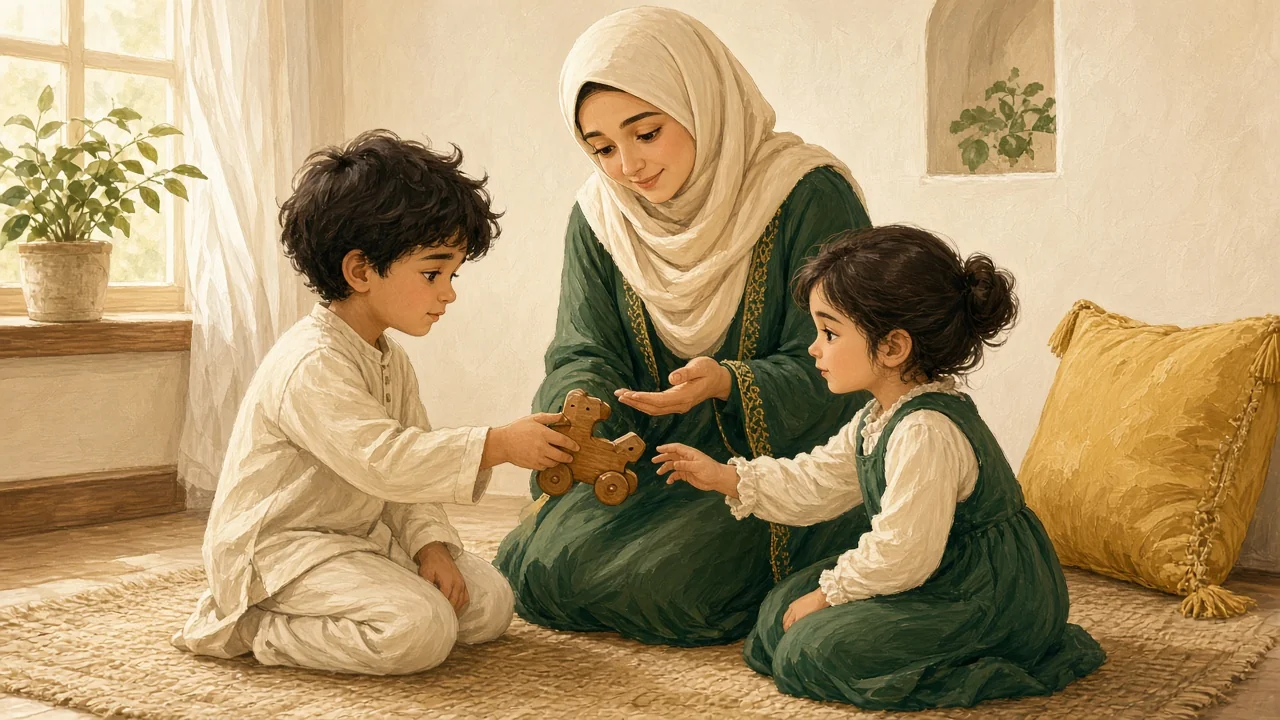
Teach Kids to Apologize with Heart: Islamic Repair Scripts (Plus Soft Istighfar)
Teach kids to apologize with Islamic repair scripts—pause, name the hurt, make it right—plus soft istighfar without shame. Age bands, what not to force, sibling tips.
Read guide →
Sibling Jealousy in a Muslim Home: Fairness, Scripts & What Not to Say
Practical Islamic parenting scripts for sibling jealousy—fairness vs sameness, what not to say, conflict coaching, and age tips. Calm tools for Muslim homes.
Read guide →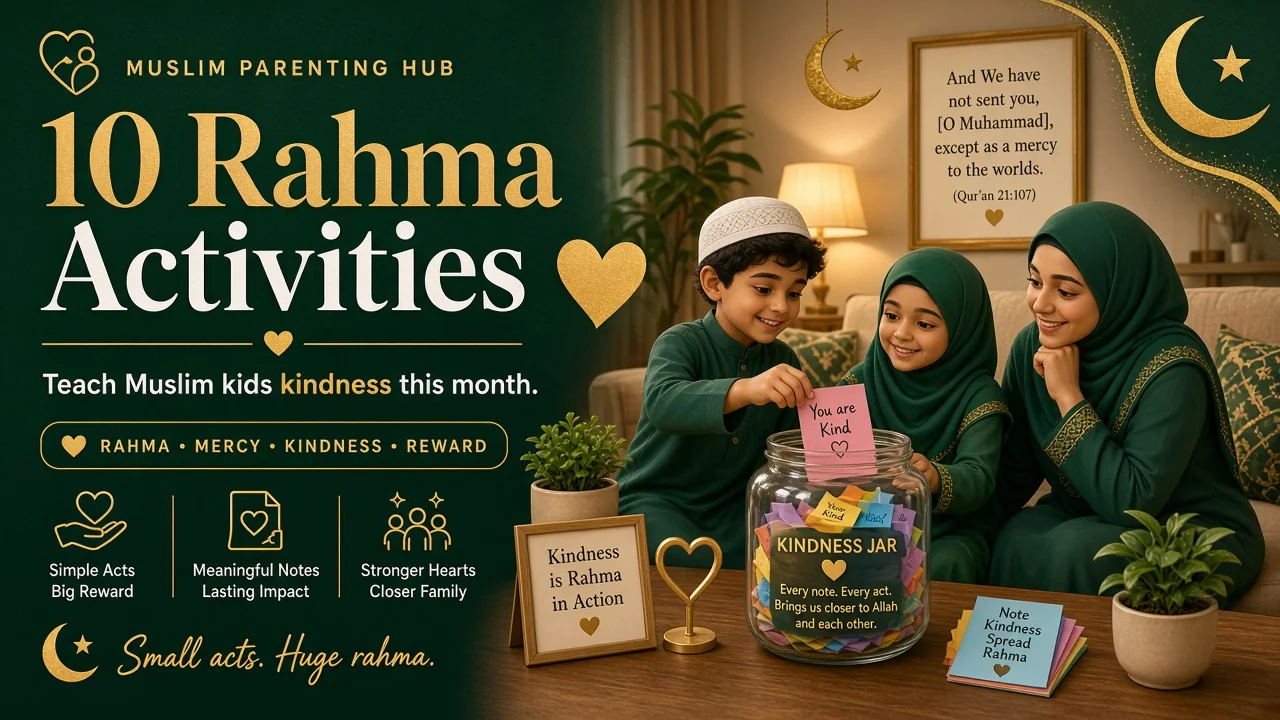
10 Rahma Activities to Teach Muslim Kids Kindness This Month
Teach Muslim kids rahma with 10 kindness activities—kindness jar, neighbor drops, Prophet ﷺ mercy stories, age charts, and tonight scripts. Soft, practical monthly plan.
Read guide →
How to Talk About Allah With Toddlers: Simple Words That Stick
Age-0–3 scripts to talk about Allah with toddlers—creation walks, Alhamdulillah reflexes, bedtime lines. Soft, practical, no abstract lectures.
Read guide →