

Halloween at a US Public School: A Gentle Plan for Muslim Families
October 31 shows up in US public schools whether your family “does Halloween” or not: classroom parties, costume parades, candy desks, and hallway decorations. Muslim parents often feel stuck between two extremes—total panic or silent discomfort while kids absorb everything.
This guide offers a gentle plan: talk to your child without shaming friends, choose options that fit your values, email the teacher calmly, handle candy, and keep Eid as your big celebration energy. It pairs with scripts from when Muslim kids feel left out of birthday parties.
Soft guidance for homes—not a fatwa. Families and scholars differ on details; follow what you trust for your household while staying kind in public spaces.
Why Halloween Comes Up at School
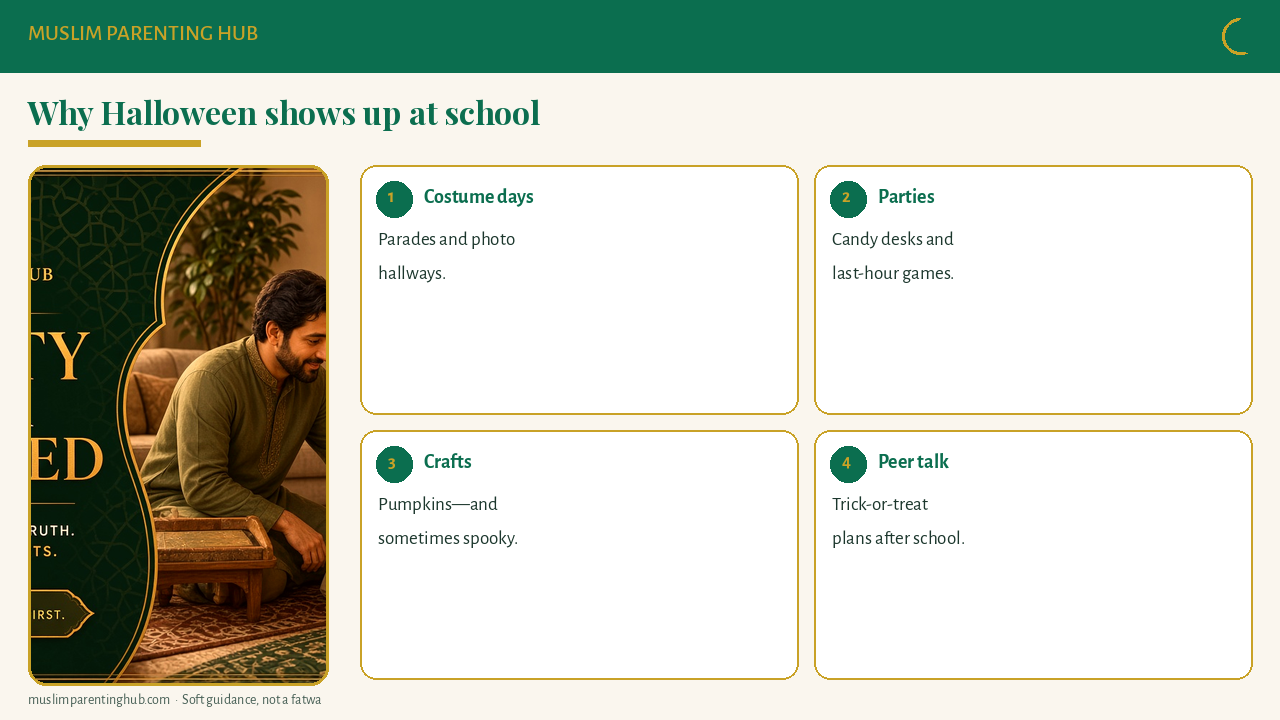
Public schools use Halloween as a seasonal social event:
- Costume days or “orange and black” dress themes
- Parades through hallways for parents with phones ready
- Candy, cupcakes, and party games during the last hour
- Art projects with pumpkins, bats, and sometimes spooky themes
- Peer talk about trick-or-treating after school
Your child may not care about the religious history debate. They care about belonging, photos, and sugar. Start there emotionally—then add values.
Talk to Your Child Without Shaming Friends
Lead with belonging:
“Some families celebrate Halloween. Our family makes different choices. That doesn’t make other kids bad. We can be friendly and still follow what we believe.”
Avoid:
- Calling classmates “evil” or “wrong” for dressing up
- Mocking costumes in the carline where other kids hear
- Forcing a public speech about theology in second grade
If your child feels left out, use the same validation tools you use for birthday FOMO: feelings first, identity without villains, then a plan.
Options Menu (Pick What Fits Your Home)
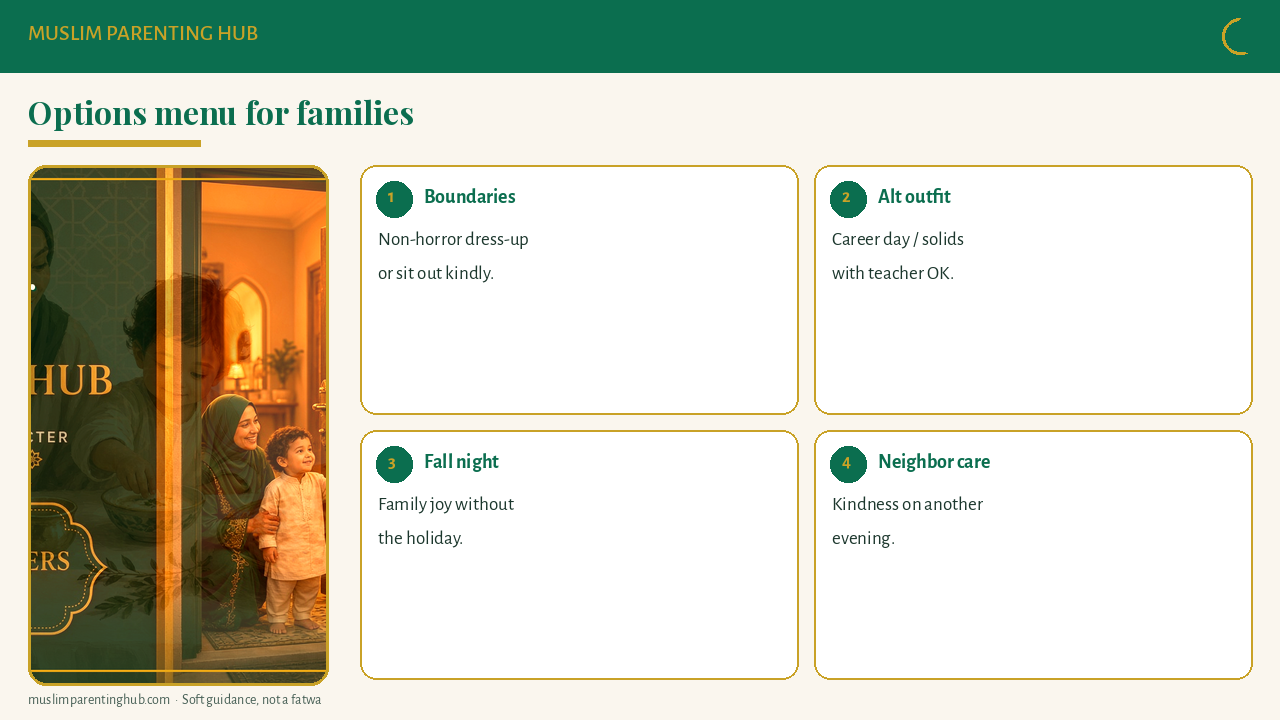
Option A — Participate with boundaries. Some families allow a non-horror costume (animal, astronaut, book character, “favorite color day”) if the school frames it as dress-up, while skipping occult themes. Others avoid all costume days. Neither choice needs to insult the other.
Option B — Alternative dress day. Coordinate with the teacher: modest solid colors, cultural clothing, or “career day” outfit instead of costume.
Option C — Quiet sit-out with dignity. Child stays for the academic morning, sits out party games kindly, helps the teacher pass papers, or joins the library for twenty minutes if the school allows.
Option D — Family fall night instead. Hot chocolate, pumpkin muffins (no scare props required), lantern walk in the backyard, dua of gratitude for autumn, and a mini gift—similar “you matter” energy to party alternatives. Point forward to calm Eid morning as your big celebration set.
Option E — Neighbor kindness without adopting the holiday. A plate of cookies for neighbors on another evening teaches neighbor kindness without requiring trick-or-treat theology debates on the porch.
Choose before October 20 when possible so kids are not negotiating in the costume aisle under fluorescent lights.
Teacher Email Script (Copy and Soften)
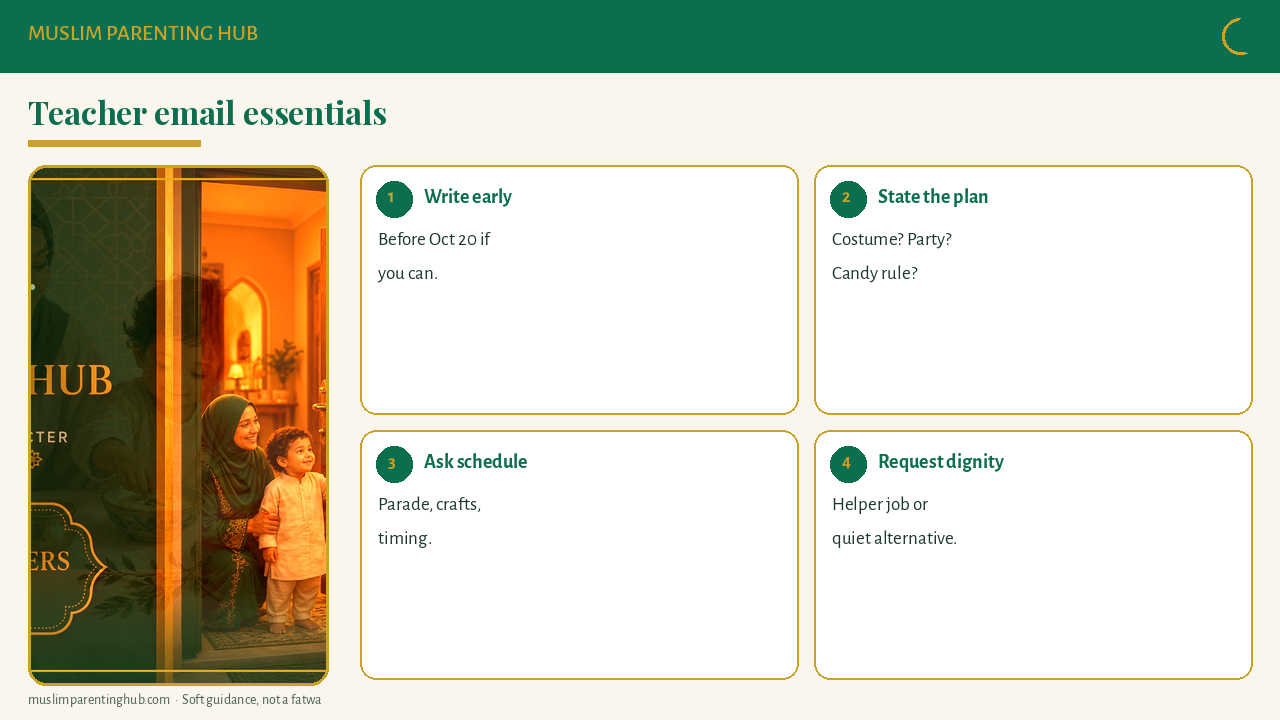
Subject: October 31 classroom activities — family plan for [Child’s Name]
Assalamu alaikum / Hello [Teacher Name],
We are a Muslim family and we keep Halloween low-key / we do not participate in costume and party activities (pick your line). We want [Child] to stay respectful and included academically.
Could you please let us know what the class plans for October 31 (parade, party, crafts)? If there is a costume parade, we will [send an alternative outfit / have them wear regular clothes / keep them for morning academics only]. For candy and party games, we prefer [sit-out / non-candy alternative / join crafts only].
We appreciate inclusive options when possible—reading corner, helper jobs, or a quiet activity. Thank you for supporting [Child] kindly.
Warmly,
[Parent Name]
[Phone]
Send once. Do not flood the inbox. If the school is rigid, teach your child coping scripts rather than fighting every decoration on the wall.
For hosting playdates around the same week, lean on guest manners so your home remains a soft place regardless of the school calendar.
Candy at School: Practical Paths
- Pre-decide: eat none / eat one / trade for a small toy at home / donate unopened candy later.
- Pack a preferred snack so blood sugar is not only candy.
- Avoid shaming kids who eat candy at school—focus on your child’s plan.
- Check allergen rules before sending alternatives for the whole class.
What to Say to Friends
Peer: “Why aren’t you dressed up?”
Child script: “My family does something different. I like your costume—that astronaut is cool.”
Peer: “Are you not allowed to have fun?”
Child script: “We have fun—just different holidays. Eid is our big one.”
Parent gossip: Stay brief. You do not owe a fiqh lecture at pickup.
Spooky Themes, Fear, and Nightmares
If classroom crafts get gory or ghost-heavy, pair school talk with comfort at home: night light, short protection dua, and no horror movies stacked on the same week. Keep Allah talk love-based if fears spike—see your faith conversation tools rather than using Hellfire as a Halloween counter-scare.
Age Bands
Pre-K–1: Keep explanations tiny. Focus on “our family choices” and teacher logistics. Costumes (if any) should not terrify them.
Grades 2–4: Practice friend scripts. Let them help write the teacher email line. Offer a concrete alternative night.
Grades 5–8: Discuss peer pressure and identity more openly. Collaborate; pure decrees without conversation often breed secret costume bags at school.
Classroom Party Helper Roles (If Sitting Out)
Ask whether your child can:
- Hand out non-candy stickers
- Be line leader back from specials
- Help reset the room after the party
- Read in a calm corner with a buddy
Belonging is often about having a job, not about wearing ears and a tail.
Couples and Extended Family Alignment
Parents should agree before involving grandparents. If one parent wants full participation and the other wants none, negotiate privately. Kids should not be messengers of a marital debate about October 31.
Relatives overseas may not understand US school culture—explain “optional social school event” without asking them to litigate your parenting online.
Common Mistakes
- Waiting until the morning of the parade to decide
- Shaming classmates’ costumes in public
- Overloading kids with adult khilaf debates
- Forbidding everything without offering joy elsewhere
- Fighting the school so hard that your child feels like a problem
Dual Households and Divorce Calendars
If parents share custody and disagree about Halloween, put the plan in writing for October. Kids should not costume-swap secrets between homes. Mediators and parenting plans can include holiday language; until then, aim for “no shaming the other parent’s house” as a baseline mercy.
Social Media and Class Group Chats
Mute parent costume group threads if they spike anxiety. Your child does not need a highlight reel of every peer’s makeup. If your family posts Eid photos with joy, keep that energy—do not feel pressured to post an anti-Halloween essay for strangers.
Special Education and IEP Considerations
Kids with sensory needs may find parades overwhelming even if the family allows costumes. Ask for noise-reducing options, earlier exits, or alternate activities. Faith choices and disability accommodations can stack kindly—advocate for both.
After October 31: Debrief Without a Lecture
Ask three questions: What felt fair? What felt hard? What should we try next year? Write one note for your October 2027 self. Continuous improvement beats annual panic.
Then pivot the calendar talk toward gratitude season and—more importantly—toward Ramadan and Eid preparation when those seasons approach, so identity stays bigger than one candy night.
PTA and Room-Parent Politics
If you are a room parent, you can help plan inclusive fall crafts (leaves, gratitude trees, book characters) without centering horror. Offer to bring non-candy stickers. You do not have to run the Halloween committee to have a voice—one helpful email with alternatives is enough.
If other parents pressure you to “just let them be American,” answer: “We are American and Muslim. Both are true. Thanks for understanding.” Then change the subject to soccer carpools.
Costume Aisle Strategy (If Your Family Allows Dress-Up)
Shop early. Avoid aisles that spike fear. Choose characters from books they love, animals, athletes, or occupations. Set a budget. Leave if the child spirals into horror masks. A calm exit teaches more than winning a costume argument under fluorescent lights.
If your family does not costume at all, skip the store entirely and plan the family fall night supplies instead—cider, board game, craft leaves.
Your calm plan teaches kids that faith can be clear without being cruel—and that belonging can look like kindness in regular clothes.
FAQ
Can my child dress up for school?
Families differ. Some allow non-horror dress-up; some decline all costumes. Choose with your values and a trusted teacher if needed—and skip shaming other Muslim families who choose differently.
How do I talk to the teacher?
Send one calm email early: state your plan, ask what is scheduled, and request a dignified alternative if needed.
What should we do with candy?
Pre-decide a house rule (none, one piece, trade, donate). Pack a preferred snack. Avoid candy shame wars.
How do we explain our choice without sounding judgmental?
“Different families celebrate different things. We can be kind and still choose our way.”
What if the parade is graded for participation points?
Ask the teacher for an alternate participation task. Document kindly if needed through the school channels you already use.
How do we keep Eid special if October feels loud?
Invest energy in Eid planning early—clothes, morning checklist, guests—so the calendar has a bigger joy spike than candy week.
Related guides
- Left out of birthday parties — scripts
- Calm Eid morning checklist
- Guest manners when hosting
- Neighbor kindness 7-day plan
Closing
Halloween at a US public school is a logistics-and-heart problem more than a culture-war stage. Decide early. Email once. Coach kindness. Offer a joyful alternative. Keep Eid bright.
Your child can walk the hallway in regular clothes, compliment a friend’s costume, and still know exactly who they are—and whose Lord they love.
Related articles

When Your Muslim Child Is Left Out of Birthday Parties: Scripts That Protect Their Heart
Soft scripts when Muslim kids are left out of birthday parties—validate feelings, protect identity without shaming others, and build warm family alternatives.
Read guide →
Neighbor Kindness for Muslim Kids: A Gentle 7-Day Practice Plan
A gentle 7-day plan to teach Muslim kids neighbor kindness—scripts for Muslim and non-Muslim neighbors, quiet hours, food sharing tips, and safety.
Read guide →
A Calm Eid Morning Checklist for Muslim Kids (Night-Before + Day-Of)
A calm Eid morning checklist for Muslim kids—night-before prep, day-of timeline, helper jobs by age, and soft Fitr vs Adha notes. Less stress, more joy at home.
Read guide →
Guest Manners for Muslim Kids: Hosting at Home with Islamic Adab
Teach Muslim kids guest manners for hosting at home—shoes, greetings, serving, privacy, and soft scripts. Islamic adab parents can practice tonight.
Read guide →