

When Your Child Hides a School Mistake: Soft Islamic Honesty Repair Scripts
The folder looks too neat. The planner has mysterious blank boxes. A library book “vanished.” A graded quiz never made it to the fridge. Or you find a crumpled notice about a missing assignment stuffed in the backpack’s bottom pocket.
Hiding a school mistake is not the same as a calculated con—but it is a honesty moment. How you respond teaches whether truth feels survivable at home.
This guide pairs with when your child lied and focuses on the US school context: homework, grades, broken classroom items, and teacher notes.
Why Kids Hide School Mistakes
Common drivers:
- Fear of yelling, phone confiscation, or lost privileges
- Shame in front of siblings
- Perfectionism (“good Muslim kids don’t mess up”)
- Confusion about what counts as a big deal
- Hoping the problem dissolves if ignored
- Protecting a friend who was also involved
Your first job is curiosity, not cross-examination. A child who expects humiliation will keep hiding. A child who expects help plus accountability learns to bring problems sooner.
The First Ten Minutes After You Find Out

- Regulate yourself. If you are furious, take water, make wudu, or step into another room for sixty seconds.
- Name the fact softly. “I found the missing homework notice in your bag.”
- Invite their story. “Help me understand what happened.”
- Separate person from action. “You’re still beloved. The choice to hide made a second problem.”
- Park consequences until the story is clear. Rash punishments teach better hiding next time.
This mirrors the trust-protecting approach in our broader honesty guide—school just adds backpacks, portals, and teacher emails.
Soft Scripts for Common School Hides
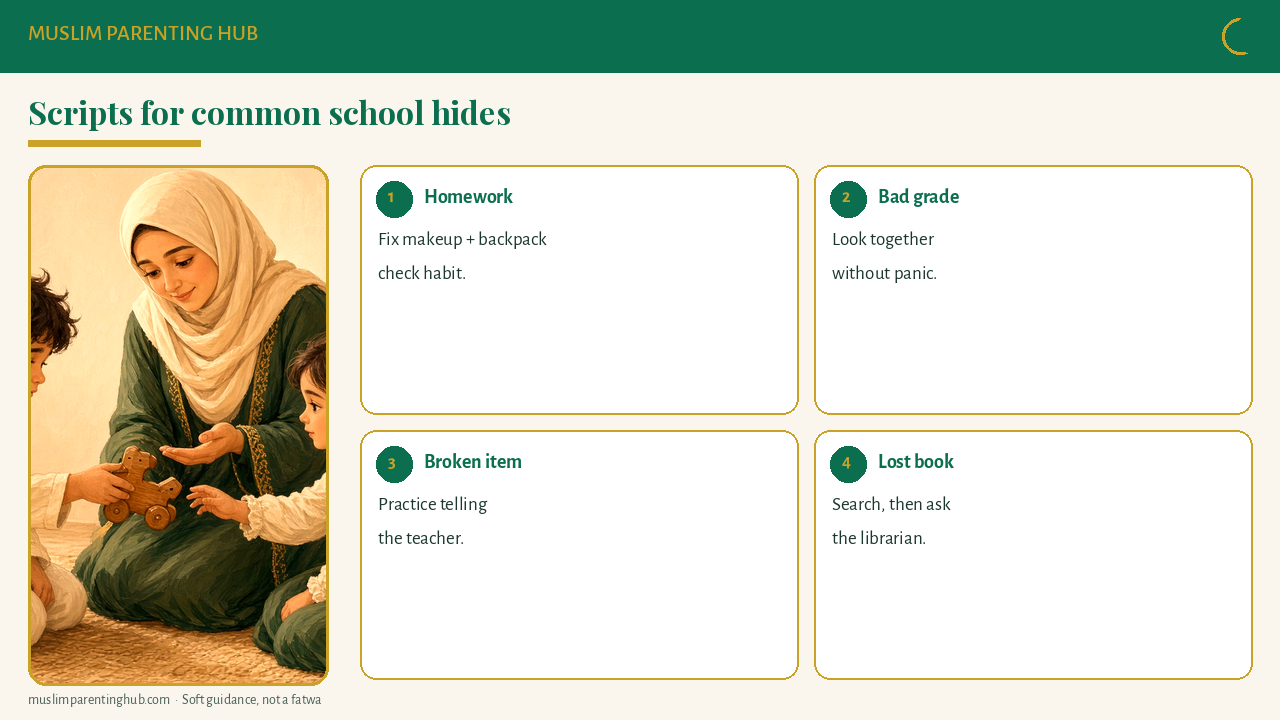
Forgotten homework:
“Homework got missed, and then it got hidden. Tonight we fix both: we email/ask the teacher about makeup, and we make a backpack check habit. I’m glad I know now.”
Bad grade stuffed away:
“Grades tell us where to practice. Hiding them makes me less able to help. Let’s look together without panic.”
Broken classroom item (glue bottle, headset, shared supply):
“Accidents happen. Hiding them leaves teachers confused. We’ll practice how to tell Mr. Lee tomorrow, and we’ll help replace what we can.”
Copying or letting a friend copy:
“That choice over honesty needs repair. We’ll talk about amanah with schoolwork, and you’ll need a truthful conversation with the teacher if that’s required.”
Lost library book ignored for weeks:
“Lost things are solvable. Silence turns them into bigger fees and worry. Let’s search, then ask the librarian about next steps.”
Islamic Framing Without Terror
Use hope and responsibility, not hellfire lectures for a fourth-grade planner fail.
- Allah loves those who turn back and make things right.
- Truthfulness is part of good character; hiding piles worry on the heart.
- Repair is worshipful when it includes apology, fixing what we can, and changing a habit.
For apology language that teaches heart—not just “say sorry”—use Islamic repair scripts. For follow-through on “I’ll turn it in tomorrow,” lean on keeping promises as amanah.
Age Bands: What Coaching Looks Like
Ages 5–7: Keep words few. Help them practice a one-sentence truth to the teacher: “I forgot my worksheet. What should I do?” Role-play twice at home.
Ages 8–10: Co-write the email or note if needed, but let them deliver the spoken part. Add a simple system: nightly backpack dump on the kitchen chair.
Ages 11–13: More ownership. Discuss digital grade portals, the temptation to minimize alerts, and how amanah includes academic honesty. Consequences can include earning back unsupervised portal privacy after a week of open check-ins.
A Repair Plan That Teaches (Not Humiliates)

- Truth to the right person. Parent first, then teacher/librarian as needed.
- Practical fix. Makeup work, replacement item, payment plan for a lost book.
- Habit patch. One system change (alarm, checklist, Sunday bag prep).
- Relationship reset. A calm snack together after the hard talk so shame does not linger overnight.
- Dua. Short own-words ask: “Ya Allah, help me be brave with the truth.”
Public family announcements of the child’s failure are not repair—they are spectacle.
When You Discover It via the Parent Portal
US schools often post grades and missing work online before kids narrate anything. If you see a zero first:
“The portal showed a missing assignment. I want to hear your side before we decide anything.”
Give them a chance to tell the story. If they still minimize, stay factual. Avoid “gotcha” energy even when you already know.
Classroom Lies vs Home Lies
Sometimes kids hide school mistakes because classroom culture feels harsh, or a teacher interaction went poorly. Ask: “Is school feeling scary in some way?” Collaborate with teachers when patterns repeat. Do not automatically assume your child is the only variable.
Also watch for kids hiding mistakes to protect a sibling who distracted them during homework hour—solve the home environment, not only the child’s courage.
Preventing the Next Hide
- Predictable homework time after snack, not after meltdown
- Weekly backpack and folder reset (Sunday works for many US families)
- Praise early truth: “You told me about the quiz before I found it—that builds trust.”
- Reasonable responses to bad grades: coaching first, privilege changes only if needed and proportional
- Model your own honesty: “I missed an email at work; here’s how I fixed it.”
What If They Keep Hiding?
Repeated hiding despite calm responses may signal anxiety, learning struggles, ADHD-related forgetfulness misread as deceit, or fear rooted in past harsh discipline. Adjust systems, consider educational evaluation, and keep the door open. Persistent deceit about serious issues deserves more structured support—but start with safety and skill-building, not labels.
Group Projects and Shared Blame
Middle-grade group work creates fuzzy honesty moments: “I thought Ahmed was submitting it.” Teach kids to verify their piece, screenshot confirmations when appropriate, and speak early if a teammate drops a ball—without becoming harsh. Truth includes clarity about your own part.
Script:
“Tell me what you owned in the project and what still needs a message to the group. We’ll practice a respectful text together.”
Screens, Games, and Avoidance
Sometimes the “hide” is really avoidance: games or YouTube after school crowd out the hard folder. Address the screen pattern kindly but firmly, then return to the honesty repair. Do not let the argument about devices erase the need to tell the teacher the truth.
A Soft Dua After Hard Truths
After the conversation, sit together for twenty seconds:
“Ya Allah, make us people of sidq—truthfulness—and help us repair what we break.”
Then move on. Lingering lectures after dua can undo the mercy you just modeled.
Truth-telling grows where love is obvious and repair is possible. Make your home that place—especially on the messy school nights.
Parent Portal Boundaries
Agree on how often you check grades. Surprise midnight portal raids can recreate the fear that fuels hiding. A scheduled Sunday check with your child present models partnership. If trust is broken, temporary closer monitoring should come with a clear end date so hope stays alive.
When the Mistake Involved a Friend
Kids sometimes hide to protect a classmate who talked during a test or broke something together. Coach loyalty that still tells the truth: name your own part first, avoid gossip, and let adults handle fair consequences. Protecting a friend does not require burying reality.
Homework Avoidance Dressed as Hiding
Sometimes the crumpled paper is less about deceit and more about overwhelm: too many assignments, unclear directions, or fear of looking “dumb.” Sit beside them and sort tasks into “start now,” “ask teacher,” and “done.” Honesty coaching plus executive-function help beats lectures alone.
A useful line:
“If the work feels too big, tell me early. Hiding makes two problems. Asking makes a plan.”
FAQ
Is hiding a mistake the same as lying?
It is a form of dishonesty by omission. Treat it seriously and proportionally. The coaching overlap with open lies is large: truth, repair, habit change.
Should I punish every hidden homework?
Prefer repair plus a system. If hiding becomes a pattern after you have stayed calm, add a logical consequence (earlier homework start, temporary check-ins). Avoid shame-based punishments.
What do I say to the teacher?
Keep it collaborative: “We’re working on honesty and organization at home. Please tell us how makeup work should run.” Do not overshare private discipline details.
My child says they were scared of me. What now?
Take that as useful data. Apologize for past explosions if they happened, describe how you will respond differently, and prove it on the next small mistake.
How do I handle cheating?
Name it clearly as unfair and a break of trust. Require truth with the teacher per school policy, remove benefit gained if any, and rebuild amanah with closer homework supervision for a defined period.
Can dua replace the hard conversation?
No. Dua supports hearts while actions repair. Do both.
Closing: Make Truth Survivable
Kids hide what feels unsurvivable. Your calm, Islamic, practical response turns a crumpled notice into character training. Tell the truth, fix what you can, patch the habit, and keep love obvious.
School mistakes are inevitable. Secret-keeping does not have to be.
Sibling Comparisons and Report-Card Season
US report-card weeks can turn living rooms into scoreboards. If one child hides a lower grade because a sibling’s fridge gallery looks brighter, shrink the public display culture. Celebrate effort and honesty privately. Keep comparisons off the table—literally.
A helpful line:
“In this family, we care more about brave truth and next steps than about matching anyone else’s numbers.”
After-School Timing Matters
Many hides happen because homework talk starts when kids are hungry and overstimulated from public school noise. Offer snack and a short decompress first—even ten minutes of quiet or Maghrib-centered calm—before opening the planner. A regulated child confesses more easily than a cornered one.
Sample Night-Of Script (Full Arc)
- “I noticed X.”
- “Tell me what felt hard.”
- “Thank you for filling in the gaps.”
- “Here’s how we’ll repair tonight/tomorrow.”
- “Here’s the one habit we’ll try for seven days.”
- “I love you. Squish hug optional.”
Practice the arc once when nothing is wrong so it feels familiar when something is.
Related articles

My Child Lied: An Islamic, Trust-Building Response Guide for Parents
What to do when your child lies—Islamic, trust-building scripts by age. Fear-based vs imaginative lies, no “liar” label, repair plans, and taqwa without terror.
Read guide →
Teach Kids to Keep Promises: An Amanah Habit Plan for Muslim Families
Teach Muslim kids to keep promises with an amanah habit plan—parent modeling, age scripts, trust deposits, and what not to promise. Soft & practical.
Read guide →
Teach Kids to Apologize with Heart: Islamic Repair Scripts (Plus Soft Istighfar)
Teach kids to apologize with Islamic repair scripts—pause, name the hurt, make it right—plus soft istighfar without shame. Age bands, what not to force, sibling tips.
Read guide →
When Your Muslim Child Is Left Out of Birthday Parties: Scripts That Protect Their Heart
Soft scripts when Muslim kids are left out of birthday parties—validate feelings, protect identity without shaming others, and build warm family alternatives.
Read guide →