

Teach Kids to Keep Promises: An Amanah Habit Plan for Muslim Families
“I promise I’ll play after Maghrib.”
Maghrib ends. Emails win. The Lego stays in the box. A small face learns a big lesson: words are cheap.
This guide is about promise-keeping and amanah—trust deposits between parents and children—not about what to do after a lie. For lying aftermath, use when your child lied: Islamic parenting response. Here we build the habit before trust breaks.
Soft home guidance. Not a courtroom. Not a fatwa.
Amanah in Kid Language
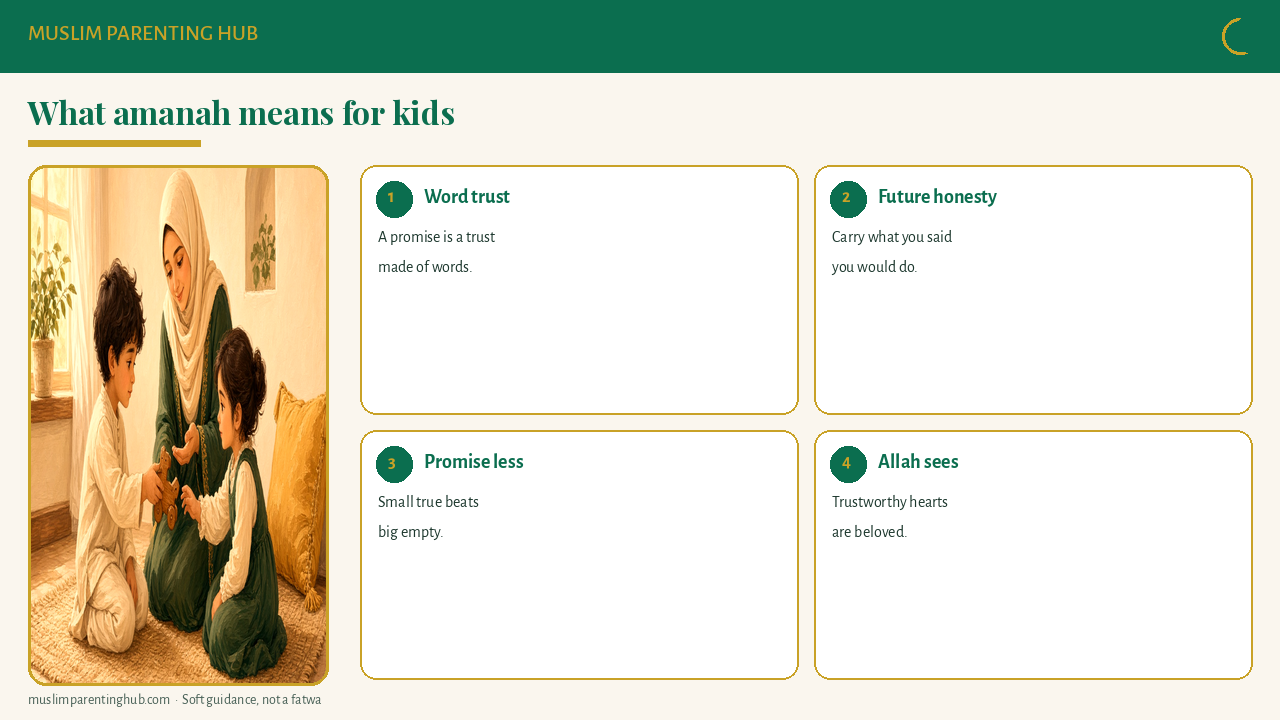
Amanah means a trust. A promise is a trust made of words.
Child-friendly line:
“When we say we will do something, our words become a trust. Allah loves trustworthy people.”
Promises teach:
- Honesty of the future (not only honesty about the past)
- Respect for other people’s waiting hearts
- Self-control (“I won’t promise what I can’t carry”)
Tie this to responsibility habits like Islamic chores by age—chores are promises to the household too.
Parent Modeling: The Real Curriculum
Kids track parental promises with forensic accuracy.
Trust deposits
- “I’ll sit with you for five minutes” → sit for five
- “No yell tonight” → repair if you slip
- “Park on Saturday” → put it on the calendar where they can see
Trust withdrawals
- Bargaining you never meant
- “Maybe” that sounded like “yes”
- Threatening punishments you will not carry out
Script when you must change a plan:
“I promised park today. It’s raining hard, so I can’t keep that exact promise. I’m offering indoor fort now and park tomorrow after lunch. Thank you for trusting me to reschedule honestly.”
That is amanah in adult clothes.
What NOT to Promise
Teach kids—and remind yourself—these are risky promises:
- Promises about other people’s feelings — “I promise Mom won’t be mad.”
- Promises you don’t control — “I promise we’ll never move.”
- Forever entertainment promises — “I promise screens every day.”
- Secret promises that hide harm — “Promise you won’t tell Dad.” (Unsafe—teach safe secrets vs. unsafe secrets.)
- Punishment promises made in anger — “I promise you’ll never see that toy again.”
Replacement language:
“I will try.” / “I plan to.” / “Let’s put it on the calendar.” / “I need to check first.”
Age Scripts for Promise-Keeping
Ages 2–3
Keep promises tiny and soon: “Two books, then lights out”—then do two books.
Child practice: “I said I’ll put the block in the box”—one block counts.
Ages 3–5
Introduce the word promise carefully. Use a promise hand (gentle handshake) for big yeses only.
“We only promise when we mean it. Small try-words are okay too.”
Ages 5–8
Use a promise notebook: date, promise, done check. Celebrate follow-through more than perfect memory.
Link broken promises to repair:
“We fix it—like when we apologize and repair.”
Ages 9+
Talk peer pressure promises (“Promise you won’t tell the teacher”). Teach courage to break unsafe vows and tell a trusted adult.
A 14-Day Amanah Habit Plan
Days 1–2 — Family definition
Poster: “Promise = I mean it.” Practice saying “I’ll try” vs “I promise.”
Days 3–4 — Parent audit
Parents only: list open promises to kids. Close or reschedule each one out loud.
Days 5–6 — Micro-promises
Each child makes one tiny promise they can keep the same day (shoe rack, water plant).
Days 7–8 — Calendar promises
Anything beyond today goes on a visible calendar. Kids help write it.
Days 9–10 — Repair drills
Role-play: broken promise → admit → sorry → new plan → follow through.
Days 11–12 — Peer scenarios
“I can’t promise I’ll never play with anyone else—but I can promise I’ll tell you if plans change.”
Days 13–14 — Forever cue
Choose: “Words are trusts.” Review weekly at Friday night or weekend breakfast. Pair with shukr practice—thank Allah for people who keep their word to us.

Soft Scripts When Kids Break a Promise
-
Name the miss without shame labels
“You promised to put the crayons back. They’re still out.”
-
Ask what got in the way
“Did you forget, or did something feel hard?”
-
Repair action
“Let’s keep the promise now. I’ll help for one minute.”
-
Future plan
“Next time, should we set a timer so the promise is easier?”
Avoid: “You always lie.” Promise-breaking and lying overlap but are not identical. Stay precise.
When Adults Break Promises (Repair Template)
“I broke my promise about ___ . That was my responsibility. I’m sorry. Here is how I’ll make it right: ___. You can remind me once kindly.”
Let kids remind without becoming little prosecutors. If they nag harshly, coach tone—but still honor the content.
Promises vs. Bribes vs. Consequences
| Tool | Healthy use |
|---|---|
| Promise | Commitment you intend to keep |
| Bribe | “If you… I’ll…” used carefully, not constantly |
| Consequence | Known result, not a theatrical new vow |
Don’t promise gifts for every chore forever. Do keep the chore chart you already agreed on.
Classroom and Friendship Angles
- Project partners: only promise what they can deliver
- “Best friends forever” pressure: offer kinder accurate words
- Sports: “I’ll come to your game if work ends on time—I’ll confirm Friday”
Accuracy is mercy.
Classroom Promise Scenarios (Practice at Dinner)
Scenario 1: A friend says, “Promise you’ll sit with only me forever.”
Healthy reply: “I like sitting with you. I can’t promise forever-only, but I can plan lunch tomorrow.”
Scenario 2: A teammate says, “Promise you won’t tell we broke the rule.”
Healthy reply: “I don’t keep secrets that hide broken rules. I can help you tell the teacher with me.”
Scenario 3: A sibling says, “Promise you’ll give me half your candy every day.”
Healthy reply: “I can share today. I won’t promise every day.”
Role-play once a week. Laugh. Keep it light. Skills stick better than lectures.
Amanah Beyond Promises (Widen the Lens)
Promises are one doorway. Also name:
- Borrowed library books
- Masjid shoes left in racks
- Class chromebook chargers
- A friend’s toy at your house
Script:
“This is an amanah in our hands until it goes home.”
When kids return things without being asked, celebrate specifically: “You brought the toy back before she asked. That’s trust.”
Marriage-Team Agreement (Two-Home or Busy Homes)
If caregivers disagree—“Dad promises candy, Mom says no”—kids learn promises are political.
Adult agreement:
- No major promises without a check when possible
- If one adult promised wrongly, they repair; the other doesn’t mock
- Shared calendar for kid-facing commitments
This is character infrastructure.
A Short Story You Can Tell
A boy promised his little sister he would push her swing ten times. He pushed three and ran to a game. She cried—not because of swings, but because words felt empty. Their mother helped him finish seven more and say sorry. The next week he promised only five—and kept five. He learned that smaller true promises beat big empty ones.
Ask your child: “Which promise was stronger—ten broken, or five kept?”
When Anxiety Makes Kids Over-Promise
Some children promise everything to avoid conflict, then collapse. Teach exit ramps:
“I need time to think before I promise.”
“I can help for ten minutes, not all afternoon.”
Honoring limits is part of amanah to your own capacity—an advanced lesson for older kids and parents alike.
Fridge Promise Card (Template)
Our family promise rules
1. We promise less and mean it more.
2. Big yeses go on the calendar.
3. If we must change a plan, we say so early and offer a new plan.
4. We repair broken promises without name-calling.
Forever cue: Words are trusts.
Photograph it. Revisit monthly. Let kids decorate the border so they feel ownership.
Connecting Amanah to Worship Without Heavy Pressure
You can mention that being trustworthy is beloved in our faith—then return to practice. Avoid frightening children with severe adult warnings. Warm identity + daily follow-through beats fear-based obedience.
Example line:
“Prophets were known as trustworthy. We practice that in small home ways.”
Then go put the crayons away together.
Closing Encouragement for Tired Parents
You will break a promise this month. What matters is the repair speed and the next kept word. Kids do not need perfect parents; they need parents whose words slowly become safe ground. Start with one kept micro-promise today.
FAQ
How do I teach my kids to keep promises in Islam?
Model keeping your own promises, teach kids to promise less and mean it more, use tiny same-day practice promises, and repair quickly when anyone slips. Frame promises as amanah—word-trusts Allah cares about.
What is amanah for children?
Amanah is a trust. For kids, it includes returning borrowed toys, doing agreed chores, and keeping promises they freely made.
What should parents not promise children?
Avoid promising other people’s reactions, outcomes you don’t control, forever entertainment deals, or angry punishment vows. Prefer “I plan to” and calendar commitments.
What if my child breaks promises often?
Shrink the promise size. Help with reminders. Check if ADHD, overwhelm, or unclear instructions are involved. Repair without calling them a liar every time.
How is this different from dealing with lying?
Lying is about false words regarding what happened. Promise-keeping is about carrying future words. Use your lying-response toolkit when truth is twisted; use this plan for follow-through muscles.
Should we make kids swear Islamic oaths?
Keep home practice gentle. Everyday “I promise” is enough for character training. Avoid frightening oath language with young children.
Can toddlers learn this?
Yes—through tiny, immediate follow-through (one book, one block). Toddlers learn reliability from your consistency more than from lectures.
How do we rebuild trust after many broken parental promises?
Admit the pattern, apologize, start a visible promise list, keep the next three promises perfectly, and invite kind reminders. Trust returns in deposits, not speeches.
Related guides
Related articles

My Child Lied: An Islamic, Trust-Building Response Guide for Parents
What to do when your child lies—Islamic, trust-building scripts by age. Fear-based vs imaginative lies, no “liar” label, repair plans, and taqwa without terror.
Read guide →
How to Teach Shukr to Kids: A 14-Day Muslim Family Gratitude Plan
Teach shukr to Muslim kids with a 14-day family plan—Alhamdulillah habits, dinner and bedtime scripts, gratitude jar, age tips, and edge cases. Soft, practical.
Read guide →
Teach Kids to Apologize with Heart: Islamic Repair Scripts (Plus Soft Istighfar)
Teach kids to apologize with Islamic repair scripts—pause, name the hurt, make it right—plus soft istighfar without shame. Age bands, what not to force, sibling tips.
Read guide →
Islamic Chores for Kids: Age-by-Age Responsibility Chart for Muslim Homes
Age-by-age Islamic chores chart for Muslim kids—Prophetic helping-at-home framing, tonight scripts, sticker-free tips, and responsibility without shame.
Read guide →