
Does Allah See Me Everywhere? Gentle Answers for Curious Kids
Your child freezes in the hallway. “Mama… does Allah see me in the bathroom?” Or at bedtime: “Can Allah see me when the lights are off?” Or after a playground shove they hope nobody noticed: “Does Allah see me everywhere?”
These questions are not traps. They are a child’s way of asking, Am I alone? Am I safe? Am I loved when no one is clapping?
This guide gives US Muslim parents gentle, age-fit answers for preschool and early elementary kids. You will get short scripts, what to avoid (fear-first “Allah is watching you”), a five-day habit for the moments the question returns, and links to deeper aqidah talk when they are ready. Soft home guidance—not a fatwa. Follow teachers you trust for detailed creed wording.
If “Where is Allah?” is the big map question, this article is the zoom lens: what it means that Allah sees—with care.
Why Kids Ask “Does Allah See Me?”
Kids locate everything. If a teacher can see the back row, and Grandma can see the tablet screen from the couch, then Allah—who is greater—must “see” somehow. Their brain is doing honest work.
Common triggers in US homes:
- Bathroom privacy (the #1 setting for this question)
- Nighttime and dark rooms
- Being home alone in another room while you cook
- A mistake they hope stayed secret (snack cabinet, sibling shove)
- Classroom talk about cameras, “God sees everything,” or science videos about space
Your job is not to deliver a surveillance lecture. Your job is to keep Allah’s seeing framed as nearness, care, and dignity—the same warmth you use when you talk about Allah with toddlers, just one step more precise for ages 4–8.
The Core Answer (Keep It Short)
For most kids, start here:
“Yes. Allah sees you everywhere—with care, not to scare you. He sees you when you’re kind and when you need help. That is why we try to choose good even when we’re alone.”
For a 4-year-old, even shorter:
“Allah sees you and loves you. He is not like a camera. He cares for you wherever you are.”
For a child looping on fear:
“Allah’s seeing is protection. You are never alone in a scary way. I’m here too—and we can make a short dua together.”
This pairs with your fuller map in Where is Allah? Answers for kids’ questions. Use that guide for “Where?” and this one for “Does He see me?”
What “Allah Sees” Is — and Is Not
It is:
- Care and knowledge that never sleeps
- Comfort when a child feels small
- A reason to choose good without an audience
- Part of why we make dua even in a whisper
It is not:
- A behavior remote (“Allah saw that—now you’re in trouble”)
- A bathroom scare tool
- A comic-book laser eye
- Permission for adults to shame a child “in Allah’s name”
Kids who only hear “Allah is watching” during scolding often grow a policeman image of God. Kids who hear it during kindness, night fears, and quiet help grow a Lord who is near.
When you want a Quran line that matches this comfort—“Neither drowsiness nor sleep overtakes Him”—use the gentle line-by-line habit in Ayatul Kursi for kids.
Scripts for Real US Moments
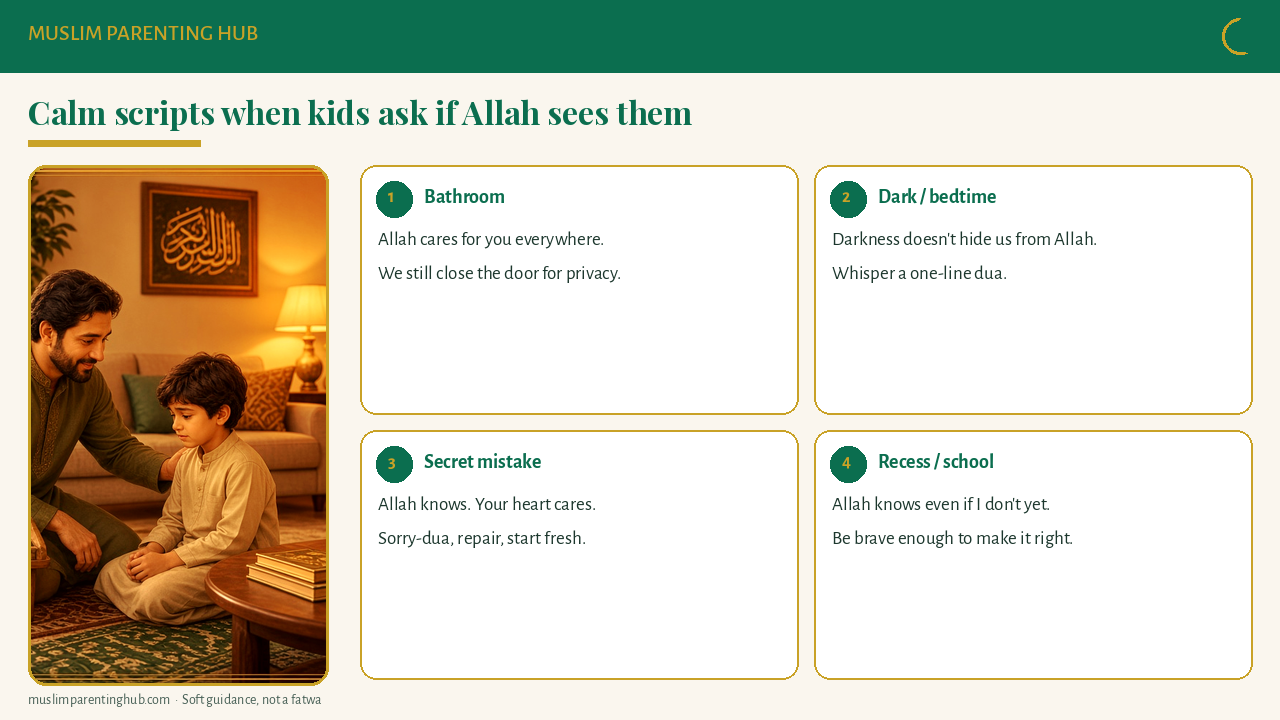
In the bathroom
Child: “Does Allah see me when I go potty?”
“Allah knows and cares for you everywhere—including private places. We still close the door because privacy is part of good manners. Allah’s care is not embarrassing. It is kind.”
Never joke. Never film. Never use the question to rush a shy child.
At school / after school
Child: “If I mess up at recess and nobody tells you, does Allah still know?”
“Yes. Allah knows. And when we mess up, we say sorry to Allah and try to repair—with a friend, a teacher, or you and me at home. Knowing Allah sees us helps us be brave enough to make things right.”
At bedtime in the dark
Child: “Can Allah see me when the lights are off?”
“Yes. Darkness doesn’t hide us from Allah. That’s why night duas feel so cozy—He hears you even in a whisper.”
When they did something secret
Child (guilty face): “Does Allah see me if I hid the cookie?”
“Allah knows. I’m glad your heart cares. Let’s say a short sorry to Allah, put the cookie back or ask properly next time, and start fresh. Allah loves when we turn back.”
Grow that repair muscle with dua from the heart so repentance feels like a conversation, not a courtroom.
When a classmate says “God isn’t real”
“People believe different things. We believe Allah is real and cares for us. We stay respectful. We can talk more at home.”
Ages 4–5 vs 6–8
Ages 4–5: One or two sentences. Heavy warmth. Repeat weekly; they will ask again.
Ages 6–8: Add a little more: “Allah’s knowledge is not like a phone camera. Cameras can miss things. Allah never misses—and His care never takes a break.” Invite their question back: “What made you wonder?”
If they ask “Who is Allah, really?” after the seeing question, Surah Al-Ikhlas is the Quran’s short answer. Our Surah Al-Ikhlas for kids guide walks each line with simple meanings.
A 5-Day Habit: Answer the Question When It Shows Up
You do not need a curriculum binder. You need the same soft answer ready five days in a row so the nervous system learns safety.
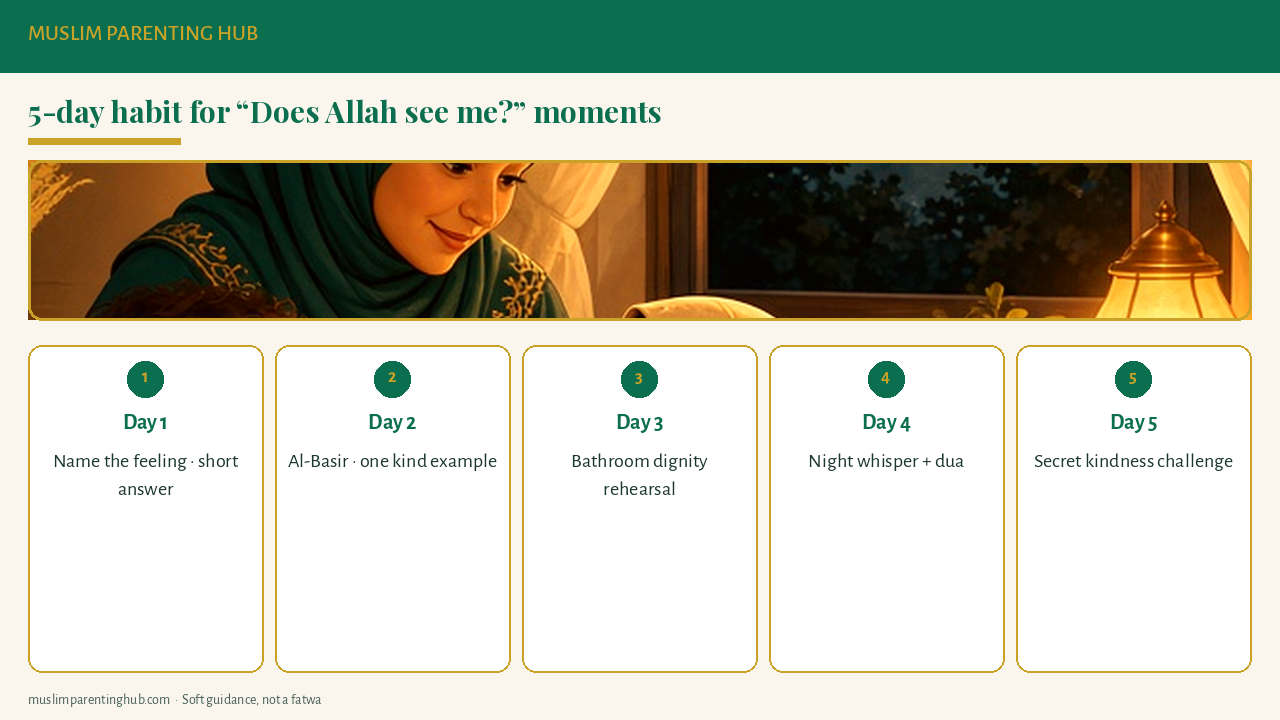
Day 1 — Name the feeling
When the question comes, first say: “That’s a brave question.” Then give the core two-sentence answer. No lecture.
Day 2 — Pair with a Name
Introduce Al-Basir (The All-Seeing) in kid language: “Allah sees kind acts nobody clapped for.” One Name, one example from your day (sharing a crayon, holding the door).
Day 3 — Bathroom dignity rehearsal
At a calm daytime moment (not mid-accident), practice the bathroom script once. Emphasize privacy + care. Smile. Done in under a minute.
Day 4 — Night whisper
At bedtime lights-out, whisper: “Allah sees you and hears you. Want a one-line dua?” Let them lead if they want.
Day 5 — Alone-and-kind challenge
Invite a tiny “secret good”: put a sibling’s toy back, clear one plate, or make dua for a friend—without posting it. Debrief: “Allah saw that kindness. How did your heart feel?”
Keep each day under three minutes. Consistency beats intensity.
What to Avoid (Fear Frames)
- “Allah is watching so He can punish you if you…”
- Graphic punishment talk as the main image of Allah for young kids
- Laughing off the bathroom question
- Inventing details you do not know
- Comparing Allah to Santa, cameras, or “invisible parents”
Fear may produce short-term obedience and long-term distance. Love-based awe lasts longer—the same principle behind your where-is-Allah answers.
Connecting Seeing → Dua → Character
When kids trust that Allah sees with care, three habits grow:
- Whispered dua in the carline and at night
- Private kindness (rahma nobody filmed)
- Honest repair after mistakes
If your home is still building everyday Allah talk for littles, stay with talking about Allah with toddlers for the under-four crowd, and use this guide when the “see me” question lands.
Home Edge Cases
Autistic / concrete thinkers: Avoid metaphors that sound like a floating eyeball. Prefer: “Allah knows everything and cares for us. He is not like people.”
Night fears: Separate “Allah sees you” (comfort) from monsters. Night-light + short dua + your presence.
Over-questioning at bedtime: Answer once warmly, then: “We’ll talk more after breakfast. Right now we rest with Allah’s name.”
Grandparents using scare lines: Protect the child’s heart politely: “We’re teaching Allah’s mercy first. Please don’t use ‘Allah is watching’ as a threat for spilled juice.”
Convert / mixed-knowledge homes: You are allowed to learn beside your child. Write the question down and ask a trusted teacher together.
Using Nature Without Turning It Into a Lecture
On a weekend walk, notice three things you can see—and one you cannot (wind, love, wifi). Say: “Our eyes see some things. Allah’s knowledge covers everything—and His care never blinks.” Keep walks shorter than lectures. Wonder first.
If your child loves space videos, clarify: planets are created; Allah is the Creator who knows every orbit. Amazement can feed iman when guided.
A Mini Al-Basir Jar (Ages 5–8)
Keep a small jar and paper slips labeled “Allah saw…” Each evening, help your child name one quiet kindness from the day—a held door, a shared crayon, a whispered dua for a sick friend. Write it, drop it in, say Alhamdulillah.
Once a week, pull three slips and reread them. You are training the eye of the heart to notice good that never went viral. No points. No public ranking. Just affection for a Lord who sees.
If Names talk feels new, start with ten easy Names in our Names of Allah for kids guide, then return to Al-Basir as the “seeing” Name of the month.
When the Question Comes From Fear Videos
Some kids hear loud online clips about punishment and then ask whether Allah sees them as a threat. Decompress first:
“Some videos are not for kids. Allah’s mercy is vast. You’re safe. Ask me, not the tablet.”
Then tighten filters. Answer the seeing question with the care frame again. If night fears spike, pair with your usual night dua and a night-light—faith talk mid-panic rarely lands.
US school weeks are busy: carpools, soccer, early bedtimes. Keep this topic to micro-moments. One calm sentence in the carline beats a twenty-minute creed class after homework tears.
Parent Heart Check
Some of us grew up with “Allah is watching” as the sharp end of every scolding. You get to rewrite that story:
- Firm on manners, soft on Allah’s tone
- Curious about meaning, not obsessed with perfect Arabic wording tonight
- Consistent on privacy and dignity in the bathroom
- Ready to say “I don’t know—let’s ask Teacher together”
Your child will remember how your face looked when they asked “Does Allah see me?” more than they will remember a paragraph.
FAQ
Does Allah see me everywhere?
Yes. Allah’s knowledge and care reach everywhere—home, school, bathroom, and the dark. Teach it as nearness and love, not as a scare camera. One or two warm sentences are enough for young kids.
How do I answer “Does Allah see me in the bathroom?” without shame?
Affirm that Allah cares for them everywhere, then add that we still close the door because privacy is good manners. Keep your face calm. Never use the question to embarrass them.
Is “Allah is watching you” a good discipline line?
Not as a first frame for spilled juice or sibling squabbles. Hold boundaries yourself (“Hitting stops”). Save Allah’s seeing for comfort, private kindness, and gentle repair after real mistakes.
What if my child is scared that Allah sees their mistakes?
Lead with mercy: Allah loves when we turn back. Help them say a short sorry-dua, repair if needed, and start fresh. Pair with heart-based dua practice so repentance feels safe.
How is this different from “Where is Allah?”
“Where is Allah?” maps that Allah is not stuck in one room. “Does Allah see me?” zooms into care and knowledge. Use both gently; link them when your child is ready for slightly longer answers.
What ages is this guide for?
Mostly ages 4–8. Toddlers need shorter creation-and-thanks talk. Older kids can add Names like Al-Basir and short ayah meanings with a trusted teacher’s wording.
Related guides
- Where is Allah? Answers for kids’ questions
- Talk about Allah with toddlers
- Surah Al-Ikhlas for kids
- Ayatul Kursi for kids
- Dua from the heart
Closing
“Does Allah see me?” is a door to trust. Walk through it with short truths, warm eyes, and zero shame about private places. Ages 4–8 do not need a surveillance creed—they need a Lord who hears carline whispers and sees kind acts on the playground.
Tonight, if the question comes, breathe. Answer with care. If you do not know a detail, write it down and ask someone trustworthy together. That is parenting as worship.
Quick steps
5-day habit to answer “Does Allah see me?” moments. A short daily plan that turns the seeing question into warmth: name the feeling, introduce Al-Basir, rehearse bathroom dignity, add a night whisper, then practice private kindness.
- Day 1 — Name the feeling — When the question comes, say it is brave, then give the core two-sentence care-based answer with no lecture.
- Day 2 — Pair with a Name — Introduce Al-Basir in kid language: Allah sees kind acts nobody clapped for, with one example from your day.
- Day 3 — Bathroom dignity rehearsal — At a calm daytime moment, practice the bathroom privacy-plus-care script once in under a minute.
- Day 4 — Night whisper — At lights-out, whisper that Allah sees and hears them, then offer a one-line dua.
- Day 5 — Alone-and-kind challenge — Invite a tiny secret good deed, then debrief that Allah saw the kindness and ask how their heart felt.
Related articles

Where Is Allah? Gentle Answers Kids Ages 4–8 Can Understand
Where is Allah? Simple, love-based answers for ages 4–8—scripts for “Can He see me?” and “Who made Allah?”, what to avoid, and when you don’t know.
Read guide →
Surah Al-Ikhlas for Kids: Meaning, Easy Transliteration and How It Answers "Who Is Allah?"
Teach kids Surah Al-Ikhlas line by line: Arabic, easy transliteration, a simple meaning, how it answers "Who made Allah?" and a 7-day plan for home and school.
Read guide →
How to Talk About Allah With Toddlers: Simple Words and a 7-Day Plan
What to say when your toddler asks “Who made the moon?” Loving phrases about Allah for ages 0–3, bedtime lines and a 7-day plan—no fear, no lectures.
Read guide →
Ayatul Kursi for Kids: Meaning, Easy Transliteration and a Line-by-Line Way to Learn It
Teach your child Ayatul Kursi with simple kid meanings, easy transliteration in 9 short lines, a bedtime habit and a line-by-line plan for ages 3–10.
Read guide →