
How to Teach Children About Angels in Islam Without Scaring Them
Your four-year-old hears “angels” at the masjid… then asks at bedtime, “Will they watch me when I sleep?”—and suddenly what felt beautiful feels spooky.
Many Muslim parents freeze here. We want our children to love the unseen world Allah created—not fear it. We want soft aqidah, not nightmares. The good news: you can teach kids about angels in Islam with warmth, age-fit language, and a calm bedtime frame that feels like protection, not surveillance.
This guide gives you a gentle framework, age bands, tonight scripts, and simple activities for roughly ages 4–8 (with toddler and school-age notes). Soft parenting guidance—not a fatwa. For detailed aqidah questions, ask a trusted local scholar or teacher.
Why Angels Matter—and Why Tone Matters More
Belief in angels is part of iman. Angels are creations of Allah who never disobey Him. They pray, deliver messages, record deeds, and—by Allah’s permission—guard and help. For children, angels can become:
- Comfort — “Allah cares for me with helpers I cannot see.”
- Identity — “Muslims believe in a world bigger than screens and toys.”
- Conscience — “My choices matter; kindness is seen.”
- Wonder — not horror movies, not cartoon ghosts—holy wonder.
Tone is everything. If we introduce angels mainly as “they’re writing down every bad thing,” a sensitive child may feel watched and unsafe. If we start with love, light, and Allah’s care, the recording angels become part of a merciful story later—not a threat first.
Soft note: Keep explanations short. Children build aqidah in layers over years. One warm conversation beats one long lecture.
The Big Idea: Light First, Details Later
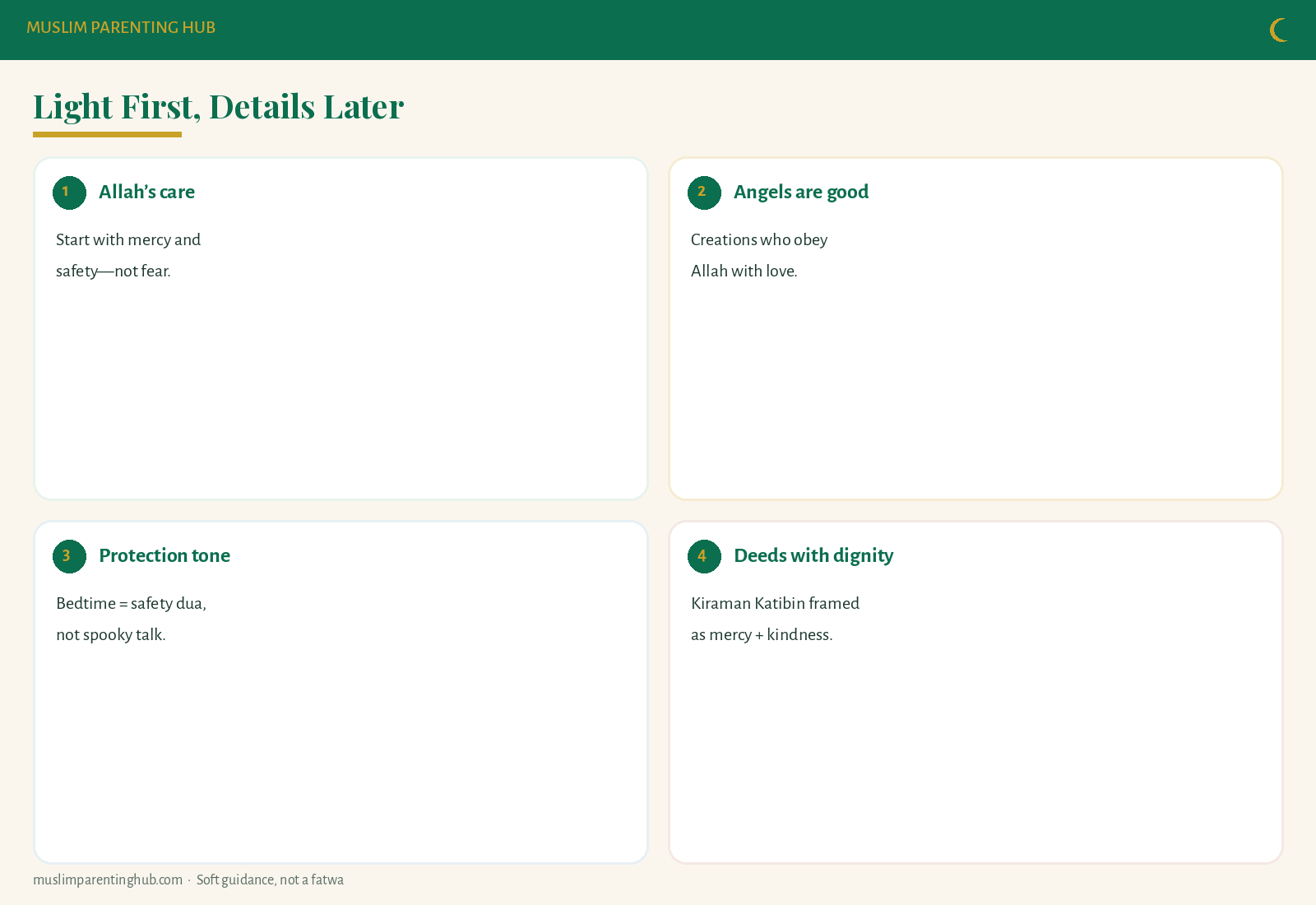
Use a simple teaching order at home:
- Allah is near and merciful.
- Angels are good creations who obey Allah.
- Some angels protect and care (by Allah’s permission).
- Some angels write our deeds (Kiraman Katibin)—framed as dignity, not dread.
- We respond with kindness, honesty, and dua.
Skip graphic details, battle imagery, or “gotcha” guilt. Save advanced topics for later (and for a teacher when appropriate).
Soft Scripts You Can Use Tonight
Opening script (ages 4–7)
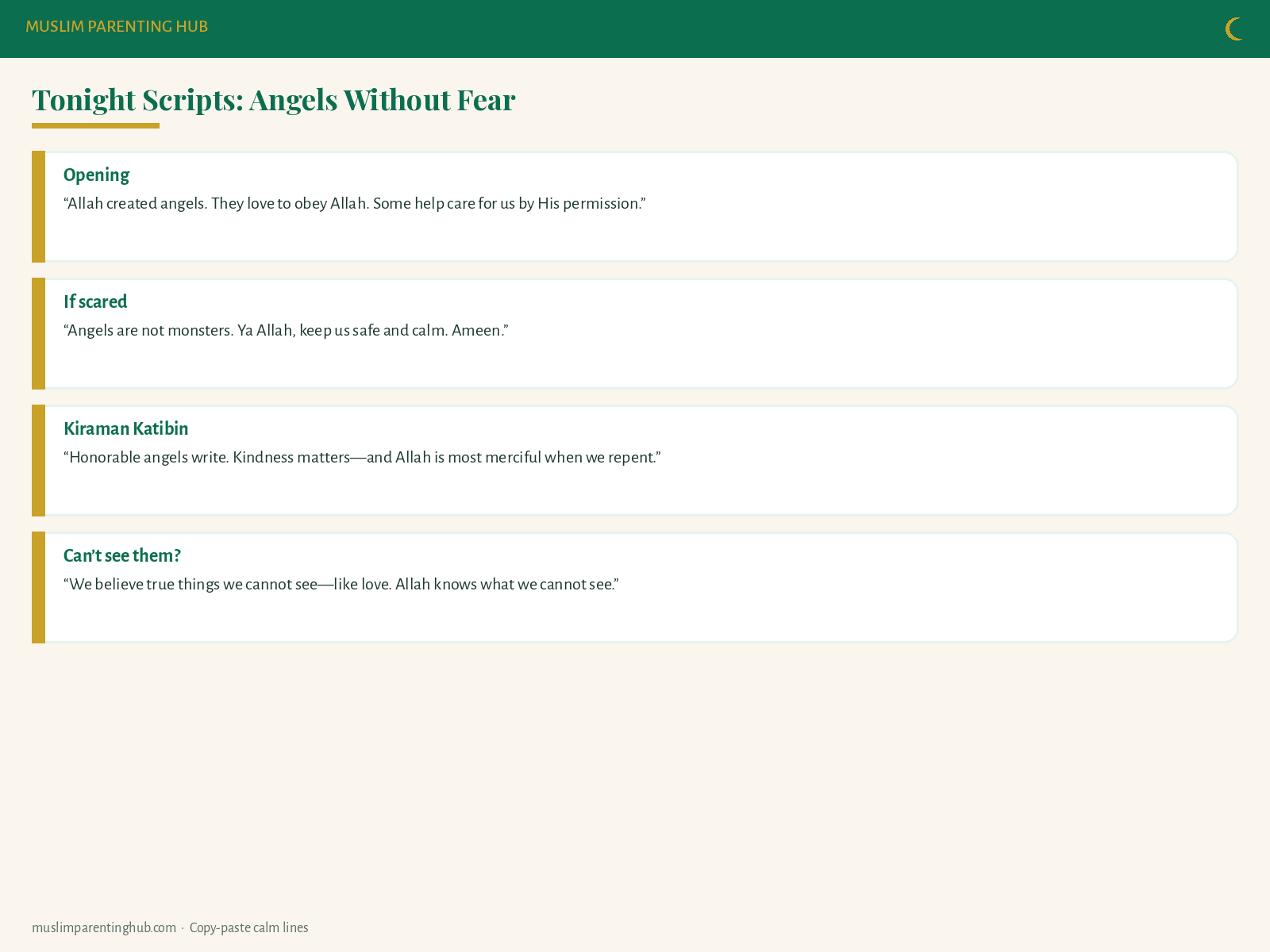
“Allah created angels. They are not like people or animals. They love to obey Allah. Some of them, by Allah’s permission, help take care of us. When we sleep, we ask Allah to keep us safe—and we trust His care.”
If they ask “Can I see them?”
“Usually we don’t see angels. That’s okay. We believe many true things we cannot see—like love in our hearts, or wind we feel but don’t hold. Allah knows what we cannot see.”
If they sound scared
“Angels are not monsters. They are not here to frighten you. Allah is kind. If your heart feels jumpy, we can make dua together: Ya Allah, keep us safe and calm. Ameen.”
Pair fear moments with the heart-dua habit from Teach Kids Dua From the Heart—own-words dua turns scary questions into connection.
Kiraman Katibin (gentle first mention)
“Allah has honorable angels who write. They write good things we do—and they notice when we try again after a mistake. That helps us remember: kindness matters. Allah is most merciful when we say sorry and do better.”
Avoid: “They’re watching you so you’d better not mess up.” Prefer: “Our choices matter because Allah loves goodness.”
What to Emphasize by Theme (Without Overloading)
1) Angels obey Allah (identity + awe)
Keep it concrete: angels do what Allah commands. Children understand “listening to the One in charge.” Link to manners: we also try to obey Allah with love.
2) Protection framing at bedtime
Many families already recite bedtime adhkar. You can softly connect: “We ask Allah for safety. He is our Protector. Angels—by His permission—are part of how He cares for His creation.” Stay vague if your child is sensitive; specificity can wait.
3) Recording angels as dignity
When your child shares a kind act, celebrate: “MashaAllah—that’s the kind of good the angels love to write.” When they mess up, coach repair: “We say sorry, make it right, and ask Allah to forgive. Allah’s mercy is wide.”
4) Jibreel and revelation (school-age)
For older kids, a simple line: “Angel Jibreel brought Allah’s message to the Prophets, including our Prophet Muhammad ﷺ.” Wonder, not a theology exam.
Age Bands: How Much Is Enough?
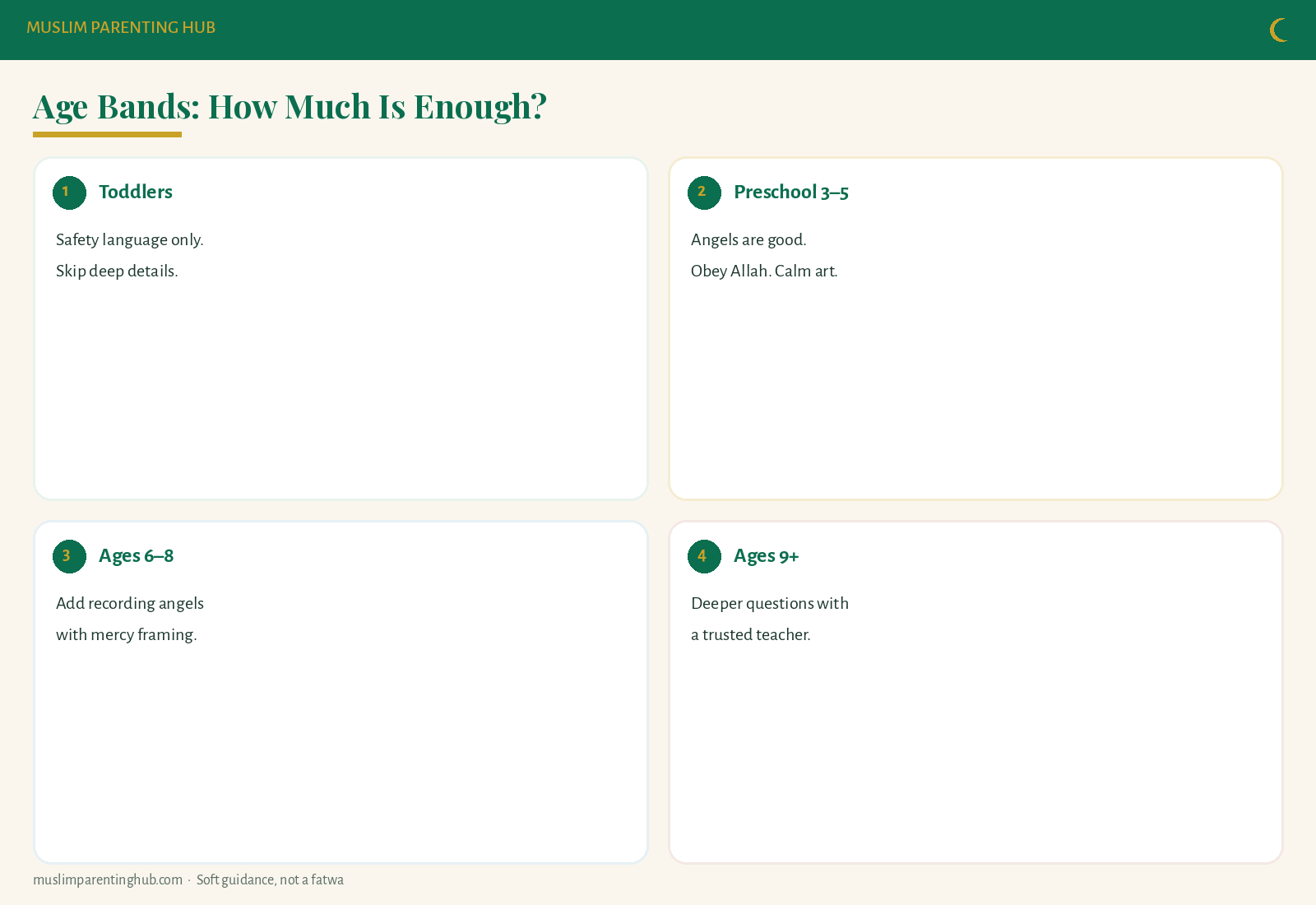
Toddlers (roughly 1–3)
- Do not lecture about the unseen.
- Use feelings and safety: “Allah keeps us safe. Alhamdulillah.”
- Bedtime: short dua, cuddles, calm voice.
- Skip Kiraman Katibin details.
Preschool (roughly 3–5)
- One idea at a time: “Angels are good. They obey Allah.”
- Bedtime protection language is enough.
- Answer “Are they scary?” with a clear no + hug + dua.
- Picture books with gentle, non-frightening art (no dark gore aesthetics).
Early school-age (roughly 6–8)
- Add Kiraman Katibin with mercy framing.
- Connect to daily choices: honesty, salam, sharing.
- Invite one question per talk; stop while curiosity is still warm.
- Link good deeds to joy, not anxiety.
Older kids (9+)
- Deeper questions may come (names, roles, differences from jinn).
- Stay honest: “Some details we’ll learn with a teacher.”
- Protect against internet rabbit holes and scary videos—your YouTube Kids setup guide helps keep aqidah media calm and approved.
A 10-Minute Home Lesson (Once a Week)
Use this mini-plan instead of a heavy “aqidah class” at the kitchen table.
- Warm-up (1 min) — “What is one good thing you did today?”
- One sentence teaching (2 min) — pick one theme from above.
- Story nugget (3 min) — e.g., revelation to the Prophet ﷺ in kid words, or “angels love what Allah loves.”
- Action (2 min) — choose one kindness for tomorrow.
- Dua (2 min) — model, then invite one child sentence.
End early if attention drops. Consistency beats completeness.
Activities for Ages 4–8 (Calm, Not Creepy)
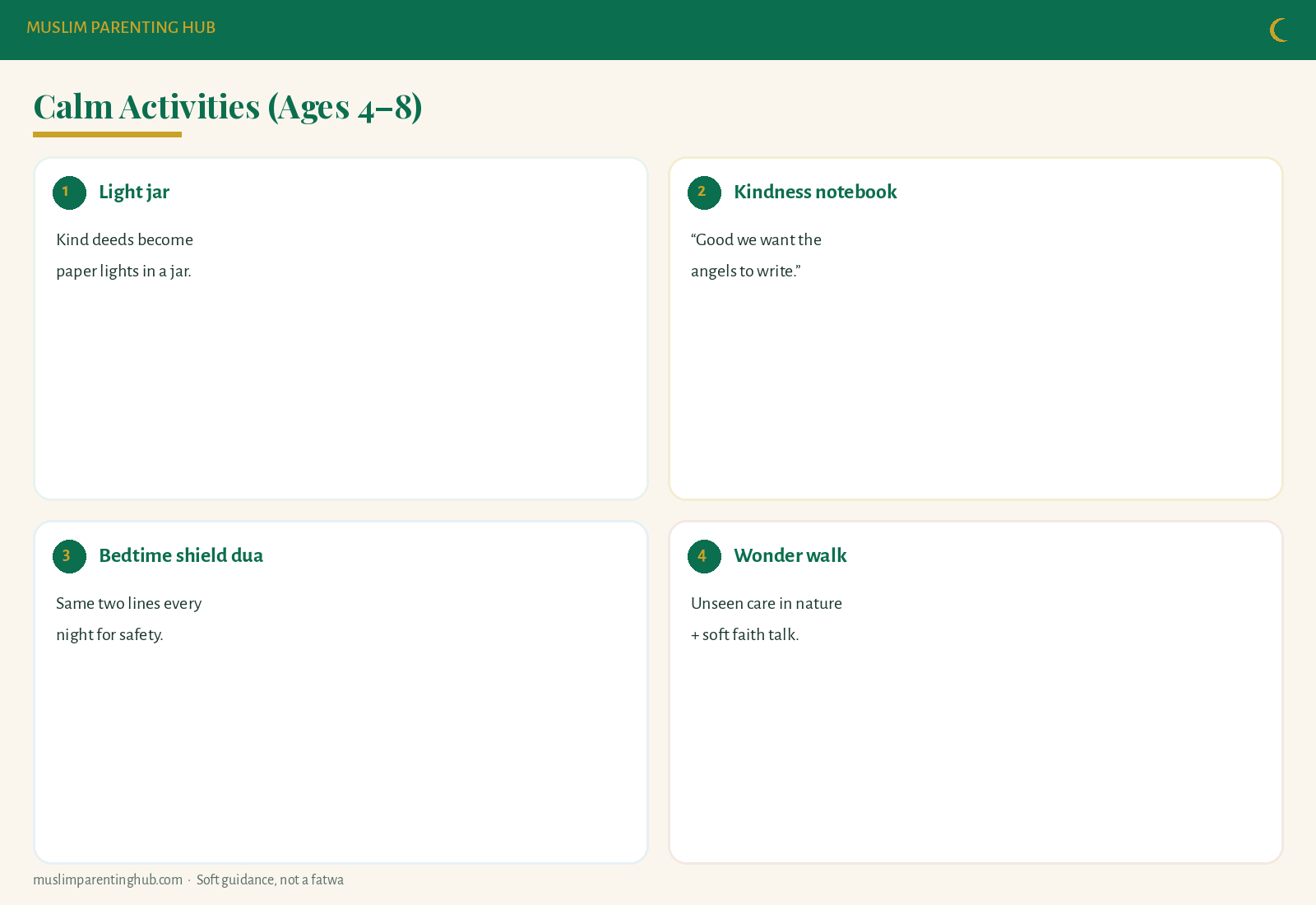
- Light jar — decorate a jar; each kind deed gets a paper “light.” Talk about how good deeds brighten a home.
- Kindness recorder — a family notebook titled “Good we want the angels to write.” Children dictate; you write.
- Bedtime shield dua — same two lines every night so the body learns safety.
- Salam practice — angels love remembrance and goodness; greeting with salam is a beautiful daily deed (see our upcoming toddler salam plan when you teach manners).
- Nature wonder walk — “Allah made a world full of unseen care—like roots under soil. Angels are part of the unseen Allah told us about.”
Avoid Halloween-adjacent crafts, “ghost angel” play, or horror filters. Keep aesthetics cream, gold, soft green—warm, not eerie.
What Not to Say (Common Accidental Scares)
| Instead of… | Try… |
|---|---|
| “Angels are watching you sleep.” | “Allah keeps you safe. We ask Him every night.” |
| “They write every bad thing so you’ll get in trouble.” | “They write our deeds. Allah is most merciful when we repent.” |
| “If you’re bad, the angels will be angry.” | “When we make a mistake, we repair and ask Allah to forgive.” |
| Long lists of angel names and battles | One role, one feeling, one dua |
Children hear threat faster than theology. Your face and voice teach more than your vocabulary.
Linking Angels to Real Home Life
- After Maghrib connection: one soft unseen-world sentence, then a hug—pair with your After-School Maghrib Routine.
- Friday glow: wonder and gratitude fit Jummah evenings—see Friday Night Muslim Family Routine.
- When jealousy or fighting rises: “We want good words written today—how can we repair?” (deeper sibling scripts live in our sibling jealousy guide).
Faith sticks when it visits ordinary evenings—not only Sunday school energy.
FAQ: Teaching Kids About Angels in Islam
How do I teach kids about angels in Islam without scaring them?
Start with Allah’s mercy and that angels are good creations who obey Him. Use short sentences, protect bedtime with calm dua, and delay detailed “recording” talk until your child feels safe. Always answer fear with presence + dua, not more information.
What are Kiraman Katibin for kids?
Kiraman Katibin are the honorable recording angels. For kids, frame them as a reminder that kindness matters and that Allah is merciful when we repent—not as spy cameras. Celebrate good deeds out loud; coach repair after mistakes.
At what age should I teach my child about angels?
Toddlers need safety language only. Preschoolers can handle “angels are good and obey Allah.” Around early school age, many children can meet Kiraman Katibin gently. Follow your child’s questions and sensitivity more than a rigid age.
What if my child has nightmares after hearing about angels?
Pause new details. Return to comfort: cuddles, night light if needed, short bedtime adhkar, and a clear line—“Angels are not here to scare you.” Review who said what (siblings, videos, peers). Reduce intense Islamic media at night.
How are angels different from cartoon “fairies” or ghosts?
Say: “Stories on screens are make-believe. Angels are real creations of Allah—but they are not spooky characters. We speak about them with respect and calm.” Keep comparisons brief so you don’t fuel fascination with scary fiction.
Can we use books and videos about angels?
Yes—if you preview them. Choose calm art, accurate basic aqidah, and no horror tone. Prefer parent-approved playlists and Approve Content mode on kids’ platforms. When unsure, read aloud yourself so you control pace and framing.
What dua can we say at bedtime about safety?
Keep it simple and consistent, for example: “Ya Allah, keep us safe while we sleep and wake us on good. Ameen.” Add Arabic adhkar your family already uses. Heartfelt English is a beautiful bridge while Arabic grows.
Closing: Wonder Without Fear
Your child does not need a complete angel curriculum this week. They need a parent who can say, with a soft face: Allah is caring. Angels are good. You are safe. Let’s talk to Allah together.
That is how Muslim homes grow aqidah—layer by gentle layer—until the unseen feels like belonging, not dread.
May Allah fill your children’s hearts with light, protect their sleep, and make your teaching a means of love. Ameen.
FAQs
How do I teach kids about angels in Islam without scaring them?
Start with Allah’s mercy and that angels are good creations who obey Him. Use short sentences, calm bedtime dua, and delay detailed recording-angel talk until your child feels safe. Answer fear with presence and dua, not more information.
What are Kiraman Katibin for kids?
Kiraman Katibin are the honorable recording angels. For kids, frame them as a reminder that kindness matters and that Allah is merciful when we repent—not as spy cameras.
At what age should I teach my child about angels?
Toddlers need safety language only. Preschoolers can handle that angels are good and obey Allah. Early school-age children can meet Kiraman Katibin gently. Follow sensitivity more than a rigid age.
What if my child has nightmares after hearing about angels?
Pause new details. Return to cuddles, short bedtime adhkar, and a clear line that angels are not here to scare them. Review media and sibling talk that may have intensified fear.
How are angels different from cartoon fairies or ghosts?
Explain briefly that screen stories can be make-believe, while angels are real creations of Allah—spoken about with respect and calm, not spooky character energy.
Can we use books and videos about angels?
Yes if you preview them for calm art and basic accurate aqidah. Prefer parent-approved playlists. When unsure, read aloud yourself so you control pace and framing.