

25 Short Duas for Kids to Learn (By Age, With Meaning and Transliteration)
Many US Muslim parents search for a simple list: What duas should my kids learn first? The answer is not “everything at once.” Kids thrive when short phrases match their age, come with meaning, and show up in real life—lunchboxes, car seats, bedtime, and bathroom doors at school.
This guide gives 25 short duas in age bands (2–4, 5–7, 8–10), with soft transliteration and plain English meaning. Pair it with teaching duas from the heart so memorization never replaces sincerity.
Soft guidance for homes—not a fatwa. Local teachers and imams can refine pronunciation and rulings for your family.
How to Pick Duas by Age
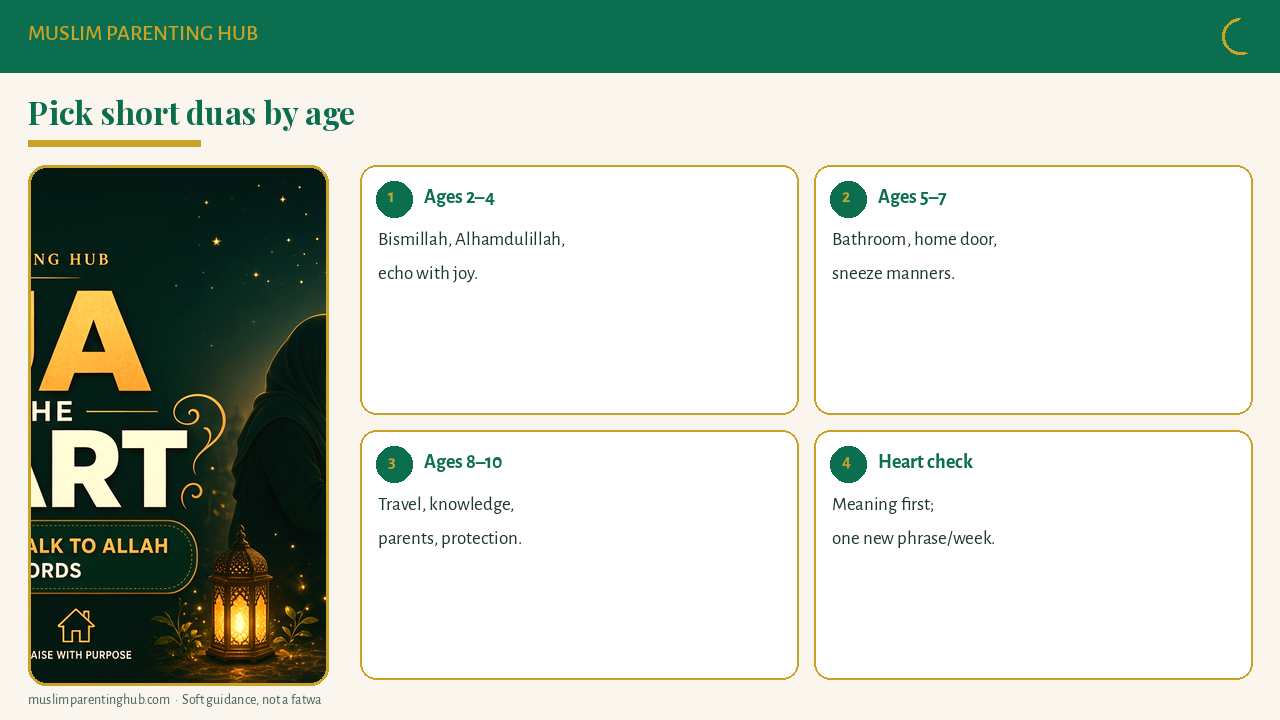
Choose duas that:
- Fit moments your child already lives (eating, sleeping, leaving the house)
- Are short enough to finish without frustration
- Carry a meaning you can say in one sentence
- Can grow later into longer forms without shame for the short form
Rule of thumb: one new phrase every week or two beats a binder of twenty forgotten lines.
Ages 2–4: Tiny Phrases, Big Warmth
Toddlers and young preschoolers learn by echo and joy. Keep Arabic soft; celebrate attempts.
1. Bismillah
Transliteration: Bis-mil-laah
Meaning: In the name of Allah.
When: Before eating, starting homework scribbles, or opening a door. See also everyday Bismillah moments.
2. Alhamdulillah
Transliteration: Al-ham-du lil-laah
Meaning: All praise is for Allah.
When: After a sip of water, finishing snack, or noticing a pretty cloud on the way to preschool.
3. SubhanAllah
Transliteration: Sub-haan-Allaah
Meaning: Glory be to Allah.
When: Seeing something amazing—moon, snow, a ladybug on the sidewalk.
4. Allahu Akbar
Transliteration: Al-laa-hu Ak-bar
Meaning: Allah is the Greatest.
When: Softly after hearing adhan on a phone app, or when a big feeling needs grounding.
5. JazakAllahu khayran
Transliteration: Ja-zaa-kal-laa-hu khay-ran
Meaning: May Allah reward you with good.
When: After a sibling shares a toy or a parent helps with shoes.
6. Eating — Bismillah (start)
Same as #1, practiced at the high chair or booster seat until it is automatic.
7. After eating — Alhamdulillah (short)
Meaning: Thank You, Allah, for the food.
You can later add longer post-meal formulas; start here.
8. Bedtime — short sleep ask
Own-words + Arabic seed: “Ya Allah, keep me safe while I sleep.” Add a short Arabic line when ready; many families use a simple sleep dua from a trusted children’s book. For a fuller night plan, see bedtime duas for kids.
Parent tip (2–4): One phrase per week. Clap, smile, repeat—never quiz at the dinner table when guests are watching.
Ages 5–7: Daily Life Duas
Early elementary kids can link phrases to school routines: backpacks, bathroom stalls, and carpool.
9. Before sleep (short classical line families often teach)
Transliteration (common short form): Bismika Allahumma amutu wa ahya
Meaning: In Your name, O Allah, I die and I live (a gentle sleep remembrance).
Confirm exact wording with a trusted teacher if you want a specific narration.
10. Upon waking
Transliteration: Alhamdulillahil-ladhi ahyana ba’da ma amatana wa ilayhin-nushur
Short kid meaning: Praise Allah who gave us life after sleep; we will return to Him.
For younger 5-year-olds, keep only the first few words plus English until ready.
11. Entering the bathroom
Transliteration: Allahumma inni a’udhu bika minal-khubthi wal-khaba’ith
Kid meaning: O Allah, I seek Your protection from anything unclean.
Practice at home before school bathrooms; see Islamic bathroom manners at school.
12. Leaving the bathroom
Transliteration: Ghufraanaka
Meaning: I ask Your forgiveness.
Short, perfect for stalls and busy mornings.
13. Leaving the house
Transliteration: Bismillahi tawakkaltu ‘alallah
Kid meaning: In Allah’s name, I trust in Allah.
Say it with the door handle—same cue as Bismillah days.
14. Entering the house
Transliteration: Bismillahi walajna… (use the short form your teacher recommends)
Kid meaning: We enter with Allah’s name; ask Him for goodness in the home.
If the full line is long, start with Bismillah + “Ya Allah, make our home peaceful.”
15. When sneezing (sneezer)
Transliteration: Alhamdulillah
Meaning: Praise be to Allah.
Then teach the reply culture kindly—see sneezing and yawning manners.
16. Reply to a sneeze
Transliteration: Yarhamukallah
Meaning: May Allah have mercy on you.
Practice with stuffed animals first so school hallways feel easy.
17. Before studying / homework
Transliteration: Rabbi zidni ‘ilma (preview—fuller at ages 8–10)
Kid meaning: My Lord, increase me in knowledge.
Even a whispered English “Ya Allah, help me learn” counts while Arabic grows.
Parent tip (5–7): Attach each dua to a physical cue (door, faucet, backpack zipper). Cues beat lectures.
Ages 8–10: Longer Short Duas
Upper elementary kids can handle slightly longer lines and deeper meanings—still without pressure.
18. Car / travel
Transliteration (opening idea): Subhanalladhi sakhkhara lana hadha…
Kid meaning: Glory to Allah who made this ride possible for us.
Use your family’s trusted travel dua; build the full habit with the car travel dua routine.
19. Seeking knowledge
Transliteration: Rabbi zidni ‘ilma
Meaning: My Lord, increase me in knowledge.
Perfect before tests, Quran class, and science projects.
20. For parents
Transliteration: Rabbir-hamhuma kama rabbayani saghira
Meaning: My Lord, have mercy on them as they raised me when I was small.
Teach gently—never as guilt when kids are upset with a parent.
21–22. Morning / evening protection (short seed)
Many families use Ayat al-Kursi, the last three Quls, or short morning/evening remembrances. Start with one short protection habit, then expand with your morning protection dua routine.
23. After hearing adhan (simple response practice)
Teach a short response line your local teacher prefers, then practice at home when the adhan app plays—pair with teaching kids to answer the adhan.
24. When angry (cooling ask)
Own-words + Arabic seed: “A’udhu billahi minash-shaytanir-rajim” (I seek Allah’s protection from Shaytan) plus a sip of water and quiet.
Meaning first; theatrical scolding never.
25. Gratitude for a win
Transliteration: Alhamdulillah
Plus own words: “Ya Allah, thank You for helping me.”
Keeps sports trophies and spelling bees from becoming ego-only moments.
A 10-Minute Daily Practice Method
Use this when you want structure without a weekend crash course.
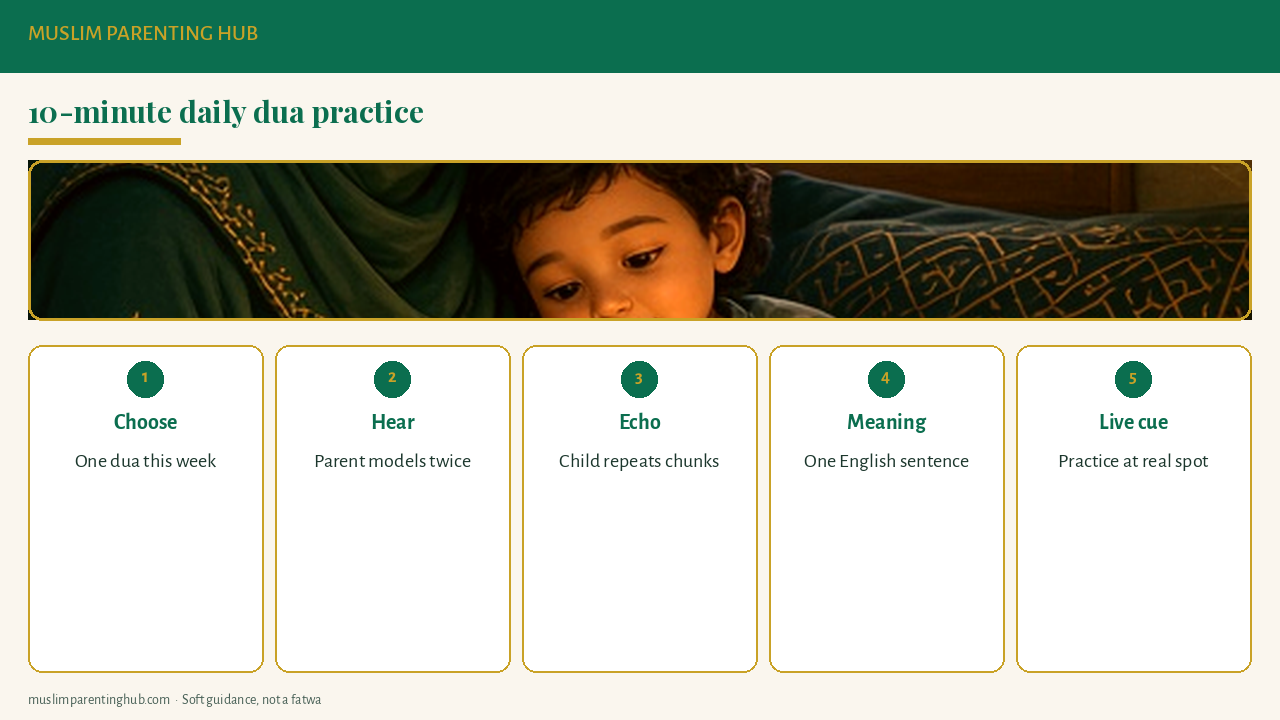
- Minute 0–2 — Choose one dua. Only one focus phrase for the whole week.
- Minute 2–4 — Hear it. You say Arabic slowly twice; child listens.
- Minute 4–6 — Echo. Child repeats in chunks; smile at brave tries.
- Minute 6–8 — Meaning. One English sentence + one real-life “when we use it.”
- Minute 8–10 — Live cue. Practice at the real spot (door, sink, bed)—not only on the couch.
Do this after Maghrib or before bed when brains are softer. Skip nights that are meltdown-heavy; consistency across the week matters more than perfect calendars.
Printable-Style Checklist (Copy Into a Notes App)
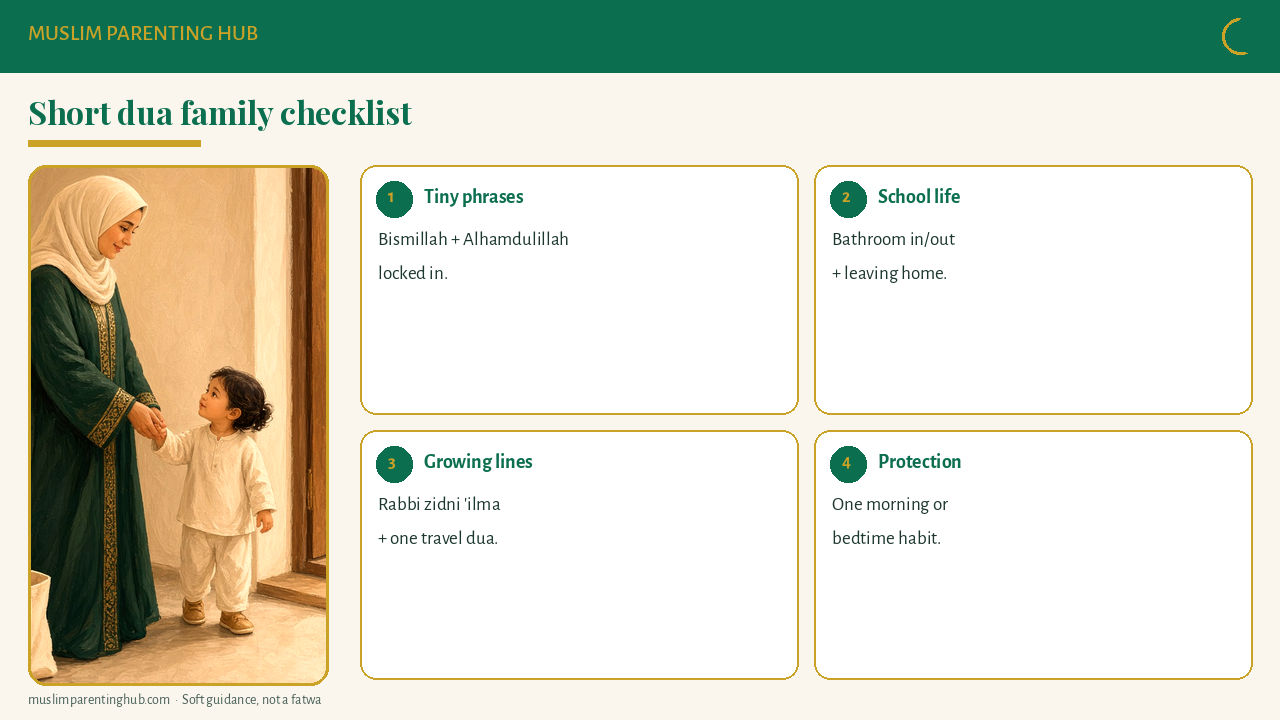
- [ ] Ages 2–4: Bismillah + Alhamdulillah locked in
- [ ] Ages 5–7: Bathroom in/out + leaving home
- [ ] Ages 8–10: Rabbi zidni ‘ilma + one travel or parent dua
- [ ] Family: one shared morning or bedtime protection habit
- [ ] Heart check: kids can say what the dua means
Common Mistakes
- Teaching ten duas in one weekend “so they catch up”
- Correcting pronunciation harshly in front of cousins
- Skipping meaning until teens (hearts go offline)
- Using dua lists as punishment (“Go say your duas”)
- Forgetting own-words dua beside memorized lines
Pronunciation Without Pressure
US kids hear Arabic at different rates—some attend weekend school; some only hear parents. Keep a “soft model” rule: you say the line clearly once, they echo, you smile. Record your own voice memo if grandparents overseas pronounce differently; pick one household version for six months so kids are not corrected three ways at dinner.
If a child mixes English and Arabic in one breath (“Bismillah—in Allah’s name—go!”), celebrate the bridge. Mixing is learning, not failure.
Classroom and Public School Quiet Practice
Many short duas are private. Teach kids that sincerity does not require a hallway performance. A whispered Alhamdulillah after water fountain sips is enough. Bathroom duas stay quiet in stalls. If a curious classmate asks, a short line works: “It’s a prayer phrase my family says—like a thank-you to God.”
Never force a child to demonstrate Arabic for adults as entertainment.
Pairing Memorized Lines with Own-Words Dua
Twice a week, after the memorized line, add one English sentence from the heart: help with a test, mercy for a sick relative, thanks for a soccer win. Memorization without conversation becomes brittle; conversation without any shared Arabic can feel unrooted. Kids need both lanes.
Tracking Progress Softly
Use a sticker only if it stays joyful. Better metric: “Did we use this week’s dua in real life at least three times?” Real-life use beats couch recitation contests.
When a phrase stalls for two weeks, pause teaching new material. Return to Bismillah and Alhamdulillah until confidence rises.
FAQ
What is the best first dua for a toddler?
Bismillah and Alhamdulillah. They are short, frequent, and easy to celebrate.
How many new duas per week?
Often one. Two only if the first is already easy and life is calm.
Should kids learn Arabic or meaning first?
Both, in tiny doses. Meaning keeps love alive; Arabic connects them to a shared phrase. If you must sequence, lead with warmth and meaning while Arabic echoes grow.
How do I keep practice fun?
Games, stuffed-animal “students,” door-handle races, and letting the child teach a doll. Stop when joy leaves.
What if grandparents want longer classical duas immediately?
Thank them, then hold your pace: “We’re building love first so the longer lines stick later.”
Do kids need perfect tajweed for short duas?
Clarity grows with modeling. Soft re-models beat public correction. Ask a trusted teacher for age-appropriate precision later.
Related guides
- Teach kids dua from the heart
- Bedtime duas — 7-night plan
- Morning protection dua routine
- Car travel dua routine
Closing
Short duas are seeds. Water them with meaning, habit cues, and kindness. In a busy US home—soccer bags, Chromebooks, and early sunsets—one well-loved phrase beats a forgotten poster on the fridge.
Pick one dua for this week. Practice ten soft minutes. Use it in real life tomorrow. That is how kids learn to talk to Allah for a lifetime.
Quick steps
10-minute daily short-dua practice for kids. A gentle daily method to teach one short dua with Arabic, meaning, and a real-life cue.
- Choose one dua — Pick a single focus phrase for the whole week.
- Hear it — Say the Arabic slowly twice while the child listens.
- Echo — Have the child repeat in chunks and celebrate brave tries.
- Meaning — Give one English sentence and one real-life moment to use it.
- Live cue — Practice at the real spot—door, sink, or bed—not only on the couch.
Related articles

A 5-Minute Morning Protection Dua Routine Muslim Kids Can Grow Into
A gentle 5-minute morning protection dua routine for Muslim kids—wake-up words, short adhkar by age, and scripts that grow with toddlers to school-age.
Read guide →
Bedtime Duas for Kids: What to Recite Before Sleep (With a 7-Night Plan)
Bedtime duas for kids made simple: the sleeping dua, the 3 Quls, Ayat al-Kursi and a calm Sunnah sequence, with meanings, age bands and a 7-night plan.
Read guide →
Duas for Kids to Learn: 10 Easy Duas + How to Make Dua From the Heart
10 easy duas for kids to learn, with meanings, plus a simple way to help children make dua from the heart in their own words. Scripts for tonight.
Read guide →
Teach Kids to Say Bismillah Across Everyday US Moments: A Habit Plan
Teach kids to say Bismillah at meals, homework, car rides, and leaving the house—a gentle US-family habit plan that supports duas and manners.
Read guide →