Surah Al-Falaq and An-Nas for Kids: Meaning, Easy Words and a Bedtime Protection Habit
Lights are low. The night-light glows. Your child asks the question that shows up in so many American Muslim homes after a loud movie trailer, a hard day at public school, or a shadowy hallway: “Who will protect me when I sleep?”
Fourteen centuries ago, Allah gave the ummah two short surahs that answer that fear with beauty: Surah Al-Falaq and Surah An-Nas. Together they are called the Mu’awwidhatayn—the two surahs of seeking protection.
They are short enough for preschoolers to start hearing, clear enough for elementary kids to understand, and gentle enough for nights when scary dreams visit. This guide gives you kid meanings, easy transliteration, a bedtime-plus-after-nightmare habit, and a soft two-week listening plan—no fear lectures, no peg-doll drama, just warm parent tools.
What Are the Mu’awwidhatayn?
Mu’awwidhatayn means “the two (surahs) of seeking refuge.” They are the last two chapters of the Quran:
- Surah Al-Falaq (chapter 113) — “The Daybreak”
- Surah An-Nas (chapter 114) — “The People”
Muslims recite them in the morning and evening, at bedtime, when sick, and whenever the heart needs a shield. The Prophet ﷺ loved them. Aisha (may Allah be pleased with her) narrated that when he went to bed, he would cup his hands, recite the Mu’awwidhatayn (and Surah Al-Ikhlas), wipe over his body, and do that three times (Sahih al-Bukhari 5017).
For kids, the takeaway is simple: Allah taught us words to ask Him for protection. We don’t scare children with long lists of threats. We hand them a short, beautiful ask.
These two surahs pair beautifully with Ayatul Kursi for kids and Surah Al-Ikhlas in a bedtime sequence that stays under a few minutes.
Surah Al-Falaq Line by Line (Kid Meanings)
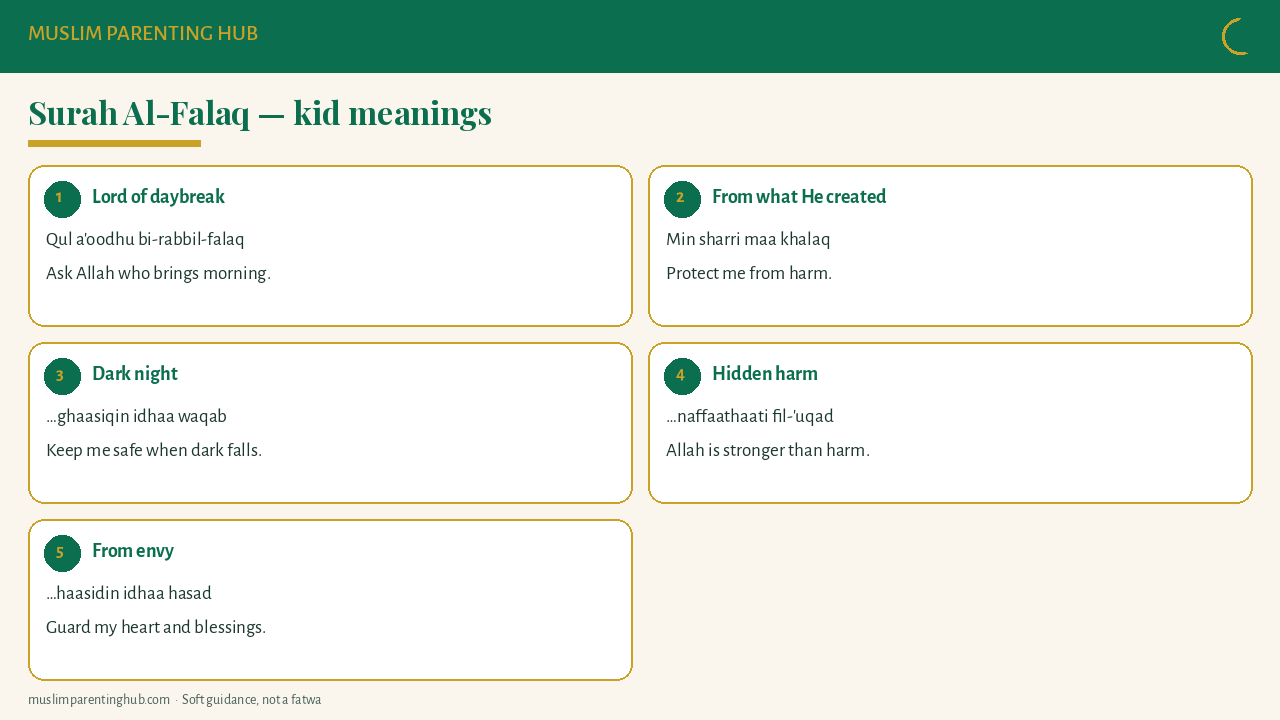
1. Qul a’oodhu bi-rabbil-falaq Say: I seek protection with the Lord of the daybreak. Kid meaning: “I ask Allah—the One who makes the morning come—to keep me safe.”
2. Min sharri maa khalaq From the harm of what He created. Kid meaning: “Allah made everything. I ask Him to protect me from anything that could hurt me.”
3. Wa min sharri ghaasiqin idhaa waqab And from the harm of the dark night when it settles. Kid meaning: “When it gets dark and I feel a little scared, I ask Allah to keep me safe in the night.”
4. Wa min sharrin-naffaathaati fil-‘uqad And from the harm of those who blow on knots (trying to hurt with magic). Kid meaning: “Some people try to hurt others in hidden, wrong ways. I ask Allah to protect me from that. Allah is stronger than anyone who tries to hurt.”
(Keep this line gentle. You do not need a lecture on sihr for a 5-year-old. “Hidden harm” + “Allah protects” is enough.)
5. Wa min sharri haasidin idhaa hasad And from the harm of the envier when he envies. Kid meaning: “Sometimes people feel jealous and wish bad things. I ask Allah to protect my heart and my blessings.”
If your child asks “Where is Allah when I’m scared at night?”, answer with height and care—not a map. Our guide on answering “Where is Allah?” for kids gives calm wording that fits right after Al-Falaq.
Surah An-Nas Line by Line (Kid Meanings)
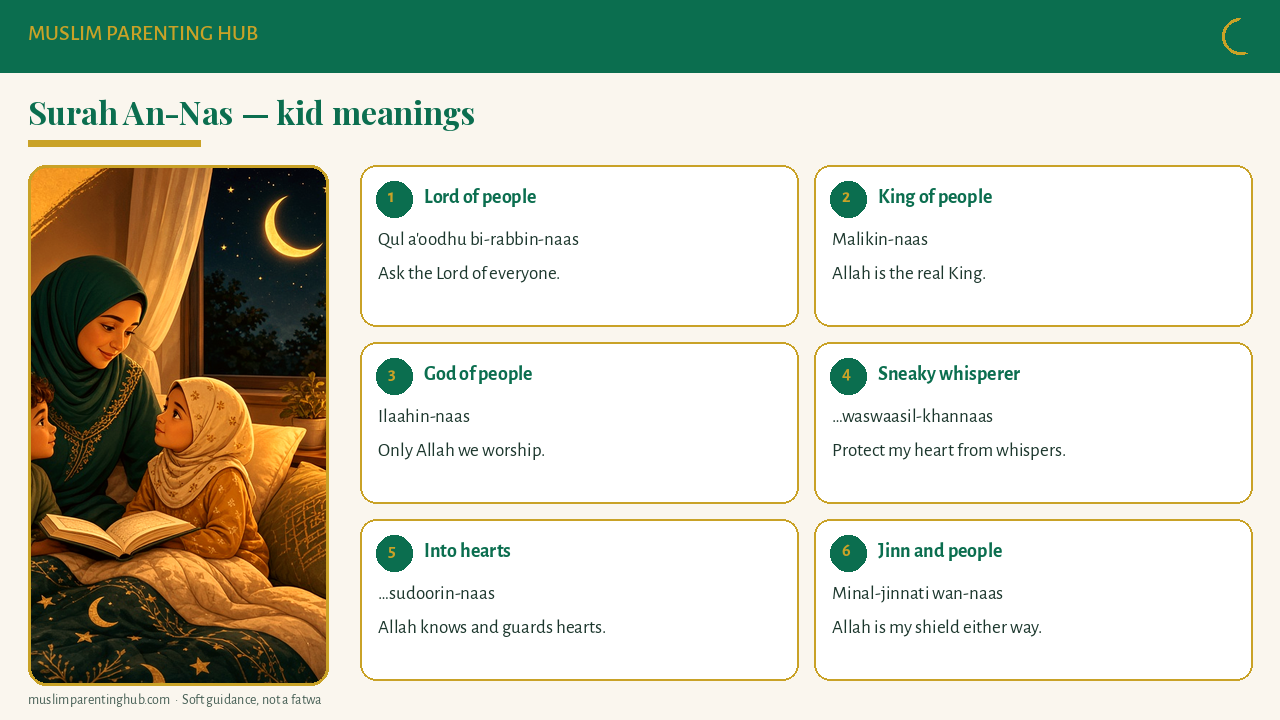
1. Qul a’oodhu bi-rabbin-naas Say: I seek protection with the Lord of people. Kid meaning: “I ask Allah, the Lord of every person, to keep me safe.”
2. Malikin-naas The King of people. Kid meaning: “Allah is the real King. No bully, no scary dream, no mean voice is the boss of me—Allah is.”
3. Ilaahin-naas The God of people. Kid meaning: “Allah is the only One we worship. We ask Him for help first.”
4. Min sharril-waswaasil-khannaas From the harm of the sneaky whisperer who pulls back. Kid meaning: “Sometimes a whisper tries to make me feel scared, mean, or unsure. I ask Allah to protect me from those whispers.”
5. Alladhee yuwaswisu fee sudoorin-naas Who whispers into the hearts of people. Kid meaning: “Those whispers try to sneak into hearts. Allah knows my heart and can protect it.”
6. Minal-jinnati wan-naas Among jinn and people. Kid meaning: “Whispers can come from unseen beings or from people. Either way, I ask Allah—not my own fear—to be my shield.”
For toddlers who are not ready for “whisperer” language, shorten it: “This surah asks Allah to protect our hearts.” Save deeper unseen topics for when they ask, and keep talking about Allah with toddlers concrete and warm (“Allah keeps us safe at night”).
Bedtime Habit: Two Surahs, Soft Hands, Steady Voice
A kid-friendly version of the Prophetic habit:
- Sit on the bed together (lamps low, phones away).
- Cup your hands lightly (kids love copying this).
- Recite Al-Ikhlas, then Al-Falaq, then An-Nas (or start with only the last two if you’re building slowly).
- Wipe gently over the head, face, and upper body three times—or once if toddlers wriggle.
- Add one short sleeping dua from your bedtime duas 7-night plan.
- Lights out with a calm line: “Allah is with you. These words are your soft shield.”
Keep the whole block under five minutes on school nights. Consistency beats length—especially during fall sports season, homework piles, and early Maghrib clocks.
After a Scary Dream: The 60-Second Reset
When your child wakes crying:
- Hold them. Safety before speech.
- Water sip if they want.
- Soft line: “You’re safe. Let’s ask Allah again.”
- Recite Al-Falaq and An-Nas slowly (you can recite; they can listen).
- Optional: spit lightly to the left and seek refuge, as taught in the Sunnah for bad dreams—keep it calm, never dramatic.
- Return to bed with the same night-light and one comforting phrase.
Pair this with the comfort scripts in our guide on scary dreams for Muslim kids. The Mu’awwidhatayn are the Quran piece; your arms are the rahma piece. Kids also rest easier when bedtime talk about angels stays protective, not spooky.
A Gentle 2-Week Learning Plan (Optional HowTo)
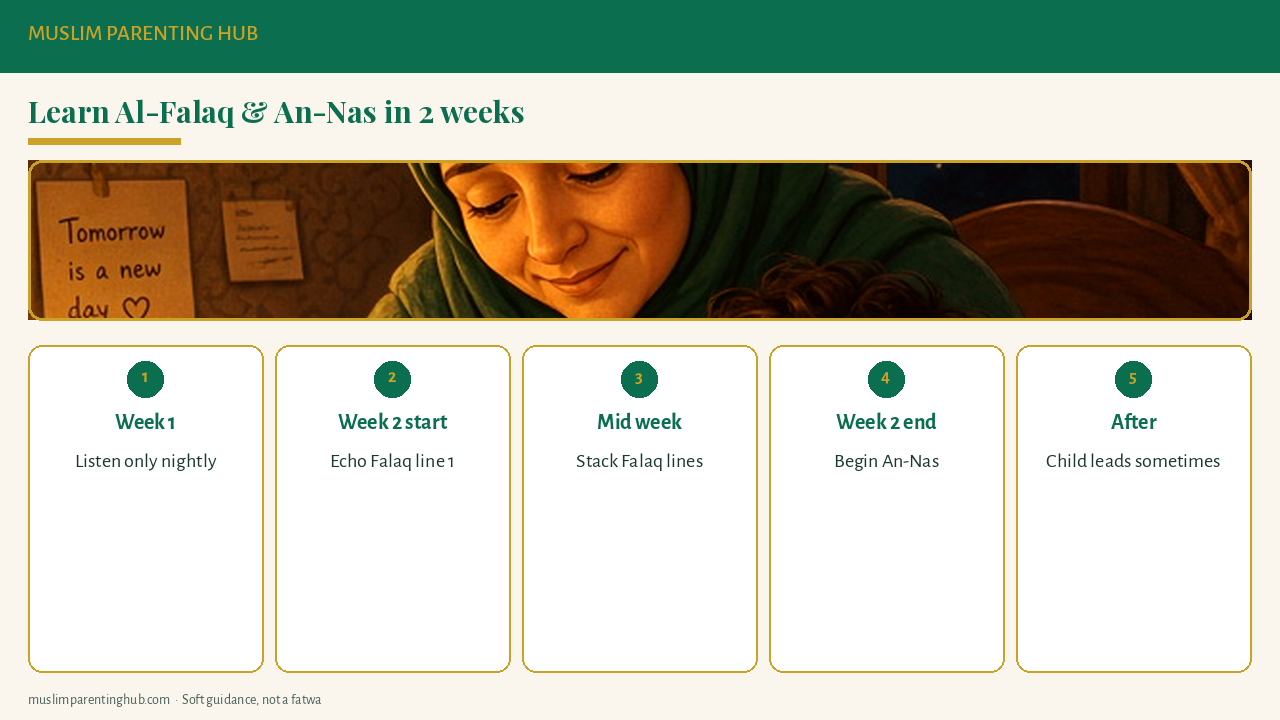
Week 1 — Listen only. Play Al-Falaq and An-Nas every night. No pressure to repeat. Point to “daybreak” and “people” with a smile.
Week 2 — Echo one line a night. Start with “Qul a’oodhu bi-rabbil-falaq.” Add one line every night or every other night. Always recite from the beginning when adding a new line.
If a line feels heavy (envy, whispering), give the kid meaning first, then the Arabic. Meaning lowers fear.
On car rides to school or soccer, replay the two surahs once. Repetition in ordinary US life—carpools, grocery runs, waiting at the dentist—turns memorization into companionship.
Age Bands
Ages 2–4: Listening + cupped hands + “Allah keeps me safe.” Don’t force full memorization.
Ages 5–7: Learn Al-Falaq first (five short lines), then An-Nas. Celebrate every line.
Ages 8–10: Full Mu’awwidhatayn + explaining envy and whispers in kid language. Let them lead bedtime once a week.
Tweens: Connect to morning/evening adhkar and to real social envy (group chats, grades, sports benches). The surahs become tools for the heart, not only the dark.
Common Parent Questions in Real Homes
“Will talking about whispers make nightmares worse?” Not if your tone stays steady and short. Fear grows from graphic stories, not from two quiet surahs ending in trust.
“Non-Muslim grandparents are visiting for Thanksgiving week—can we still recite?” Yes, softly in the bedroom. You can explain, “These are our night prayers asking God for safety,” without a debate at the dessert table.
“My child mixes up Falaq and Nas.” Smile. Say, “Falaq is morning light. Nas is people.” Order will come with listening.
“Should we skip the magic/envy lines?” Don’t delete Quran. Soften the meaning. Allah included those lines because protection includes the hidden and the social—not to terrify children.
Link Protection Words to a Bigger Faith Picture
The Mu’awwidhatayn sit inside a wider habit of remembering Allah: short morning duas, talking about Allah’s names of protection, and keeping bedtime from becoming a battle. If your nights are already full, add only these two surahs for two weeks before stacking more.
Remind kids: we ask Allah because He is the Lord, King, and God of people—An-Nas says it three ways so little hearts hear it three times.
Keep It Soft
You are not trying to raise a child who never feels scared. You are raising a child who knows where to turn when fear shows up. Surah Al-Falaq and Surah An-Nas are short enough for a school night and deep enough for a lifetime. Recite them with your child, wipe gently, and let the last sound before sleep be trust.
Pairing With Al-Ikhlas Without Overloading Bedtime
Many families recite Surah Al-Ikhlas before the Mu’awwidhatayn because that is how the Prophet ﷺ grouped them at bedtime. If your child is new to all three, sequence the learning:
- Nights 1–7: Al-Ikhlas only (or listening to all three while learning Ikhlas).
- Nights 8–14: Add Al-Falaq.
- Nights 15–21: Add An-Nas.
Or reverse it if nighttime fear is the bigger need—start with Falaq and Nas for protection feelings, then weave Ikhlas for tawhid clarity. Either path is fine. What matters is that bedtime does not become a twenty-minute exam.
When you teach Ikhlas meanings on other nights, point back: “Al-Ikhlas tells us who Allah is. Al-Falaq and An-Nas teach us how to ask Him for safety.”
Classroom and School-Night Edges
Public-school kids may hear Halloween hype, ghost stories, or scary news clips in October. You do not need to police every classroom moment. You do need a steady bedtime counterweight. A calm Mu’awwidhatayn habit after a loud day says: “We end with Allah’s words, not with leftover movie images.”
If your child asks whether classmates’ ghost talk is “real,” keep it short: “People tell spooky stories for fun sometimes. We ask Allah for protection and we don’t fill our heads with scary videos before bed.” Then recite. Action closes the loop better than a long theology Q&A at 8:40 p.m.
Memorization Games That Stay Soft
- Echo theater: You say a line with a smile; they echo like a tunnel.
- Car only: One surah exclusively for the school-run playlist for a week.
- Grandparent call: Child recites one line on FaceTime Friday; praise from elders is rocket fuel.
- Hand motions: Daybreak hands opening for Falaq; hand on heart for Nas whispers—keep motions reverent, not silly-chaotic.
Stop any game that turns into mocking the sounds. Adab around Quran is part of the lesson.
When Fear Spikes After Learning New Meanings
Occasionally a sensitive child hears “whispers” or “envy” and worries more for a few nights. Dial meanings back to the headline: “These surahs ask Allah to keep us safe.” Pause deeper explanations for two weeks. Add extra hugs and keep the Arabic rhythm familiar. If nightmares are frequent or daytime anxiety grows, use your scary-dreams scripts and talk to your pediatrician if sleep remains disrupted—faith tools and medical care can work together.
FAQ
What are Surah Al-Falaq and Surah An-Nas for kids?
They are the last two chapters of the Quran, called the Mu’awwidhatayn. Kids can learn that Al-Falaq asks Allah—the Lord of the morning—for protection, and An-Nas asks Allah—the Lord, King, and God of people—to protect our hearts from harmful whispers.
When should kids recite the Mu’awwidhatayn?
At bedtime, in the morning and evening remembrance, when sick, and after a scary dream. Many families also recite Surah Al-Ikhlas with them, following the Prophet’s ﷺ bedtime habit.
What age can a child memorize Surah Al-Falaq and An-Nas?
Toddlers can listen from age 2. Many children ages 5 to 7 can memorize both with nightly listening and one new line at a time. Older kids can learn meanings more deeply, including envy and whispers, without scary detail.
How do these surahs help with scary dreams?
They give children Quranic words to ask Allah for safety instead of lying awake inventing fears. Recite them calmly after comfort and a hug. Pair the words with a steady bedtime routine and gentle scripts.
Is it okay to explain “whispers” and “envy” to young kids?
Yes, in soft kid language: whispers try to make us scared or mean; envy is when someone wishes they had your blessing. Keep explanations short. Skip graphic stories. Emphasize that Allah is stronger and closer to help.
Should we recite Al-Falaq and An-Nas in English or Arabic?
Teach the Arabic for recitation, and always give a simple English meaning so the heart understands. Listening to a clear reciter helps pronunciation. Imperfect kid tajweed is still beloved effort.
Related guides
- Bedtime duas for kids: 7-night plan
- Scary dreams: comfort scripts for Muslim kids
- Ayatul Kursi for kids: meaning and plan
- Where is Allah? Answers for kids
Soft guidance, not a fatwa. For detailed questions, please ask a trusted local scholar or your masjid’s imam.
Quick steps
Learn Surah Al-Falaq and An-Nas over 2 weeks. Listen nightly for one week, then add one echo line at a time the second week, always restarting from the beginning.
- Week 1 — Listen only — Play Al-Falaq and An-Nas every night at bedtime with no pressure to repeat; smile and name daybreak and people.
- Week 2 Day 1–2 — First line — Echo Qul a'oodhu bi-rabbil-falaq together, then recite the rest while your child listens.
- Week 2 midweek — Stack Falaq lines — Add one Al-Falaq line every night or every other night, always starting from line 1.
- Week 2 end — Begin An-Nas — When Al-Falaq is familiar, start echoing An-Nas one line at a time using the same stack method.
- After 2 weeks — Child leads sometimes — Invite your child to lead the two surahs at bedtime once or twice a week and keep meanings soft.
Related articles
Ayatul Kursi for Kids: Meaning, Easy Transliteration and a Line-by-Line Way to Learn It
Teach your child Ayatul Kursi with simple kid meanings, easy transliteration in 9 short lines, a bedtime habit and a line-by-line plan for ages 3–10.
Read guide →
Bedtime Duas for Kids: What to Recite Before Sleep (With a 7-Night Plan)
Bedtime duas for kids made simple: the sleeping dua, the 3 Quls, Ayat al-Kursi and a calm Sunnah sequence, with meanings, age bands and a 7-night plan.
Read guide →
"Where Is Allah?" How to Answer Kids' Big Questions About Allah (Ages 4-8)
Gentle, love-based answers for ages 4–8: Where is Allah? Can He see me? Who made Allah?—plus scripts, what to avoid, and when you don't know.
Read guide →
Scary Dreams and Nighttime Fear: Islamic Comfort Scripts for Muslim Kids
Comfort Muslim kids after scary dreams with soft Islamic scripts, short dua, night lights, and parent calm—without fear-based stories. Practical tonight.
Read guide →