
Neighbor Kindness for Muslim Kids: A Gentle 7-Day Practice Plan
The neighbor’s door is three steps away—and somehow harder than a charity post online.
Kids learn Islam’s neighbor care best in small, repeatable acts: a salam, a quieter footstep, a plate returned washed, a wave to the elderly man on the bench. This is a genuine 7-day practice plan with scripts, safety rails, and age jobs. Soft guidance for family life—not a fatwa on every fiqh detail of gifts or greetings.
Why Neighbor Kindness Belongs in Childhood
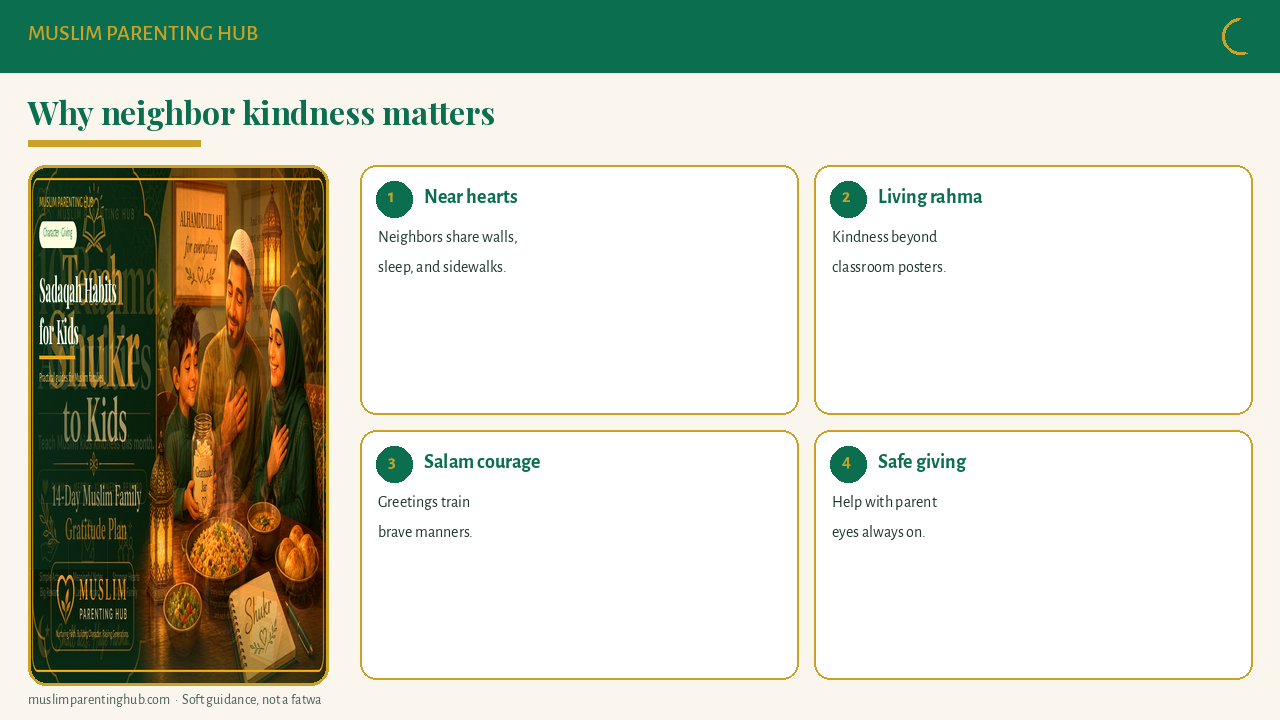
Neighbors are the people whose sleep, stairs, and sidewalks we share. Teaching kids to care here builds:
- Real-world rahma (not only classroom posters)
- Adab that matches guest manners at home
- Courage to greet, like in our toddler salam plan
- A bridge to sadaqah habits—giving that can be a smile, not only money
Link the heart of this plan to rahma activities for kindness so “be nice” becomes visible practice.
Safety and Consent Rules (Read First)
- Kids never enter a stranger’s home alone
- Food gifts only with parent planning (allergies, alcohol desserts, pork products—check)
- No ringing doorbells late; respect quiet hours
- Online neighbors / building chats: parents handle messages
- If a neighbor makes a child uncomfortable, believe the child and step back
Script:
“Kindness is brave—and safe. Grown-ups unlock doors. Kids bring smiles.”
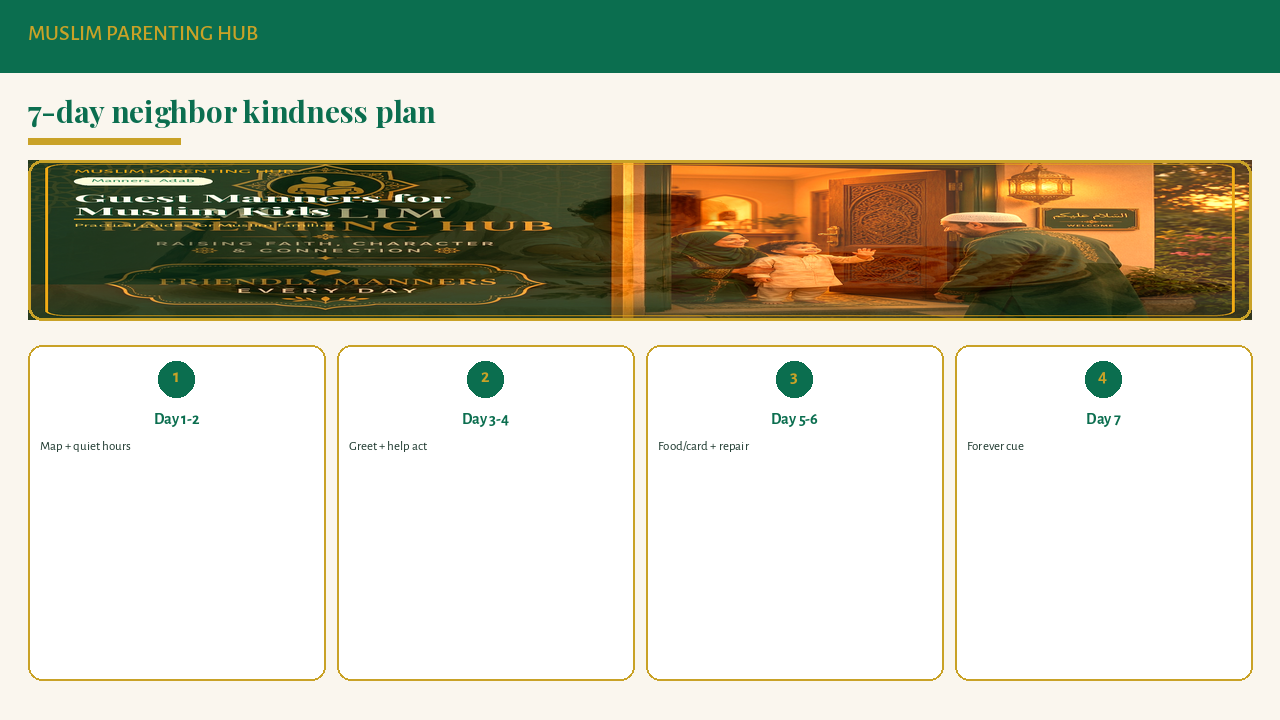
Quick Steps Overview
- Notice who lives near you
- Practice quiet feet and soft voices
- Offer a greeting that fits your family
- Do one helpful act
- Share food carefully (optional)
- Repair if you disturb someone
- Choose a forever neighbor habit
The Gentle 7-Day Practice Plan
Day 1 — Map the neighbors (eyes only)
Walk the hallway or block with your child. Whisper-count: “Who might hear our footsteps? Who has a stroller? Who is elderly?”
No knocking yet. Goal: notice humans, not only doors.
Toddler job: wave at a window plant.
School-age job: sketch a simple kindness map (stick figures OK).
Day 2 — Quiet hours game
Teach: after Maghrib or local quiet time, voices drop, shoes soft, ball games move away from shared walls.
Game: “Volume dimmer.” Parent says “dimmer,” kids practice library voices for sixty seconds.
Script:
“Neighbors need rest. Soft bodies are a gift.”
Day 3 — Greeting practice
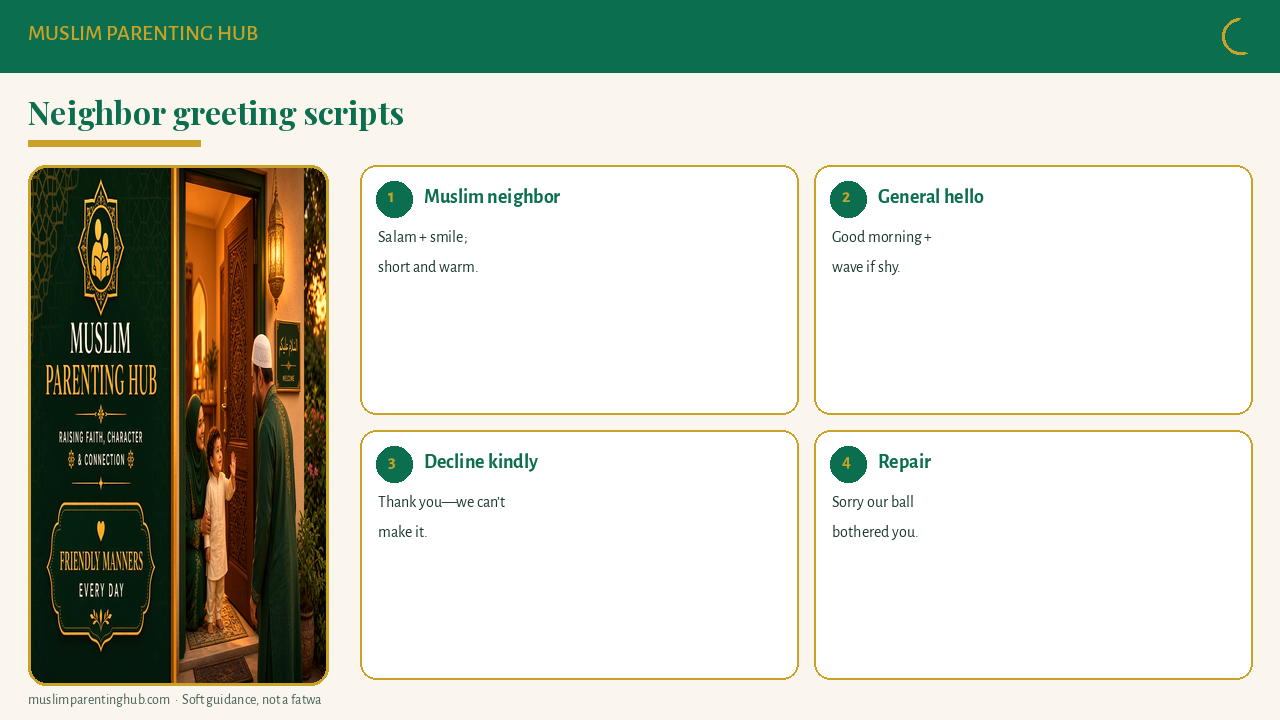
Muslim neighbors: salam with a smile.
Non-Muslim neighbors: warm hello / good morning your family is comfortable with—kids can wave if shy.
Rehearse at home doorway first (same muscle as guest hosting).
“Assalamu alaikum—smile eyes.”
or
“Good morning, Mr. Lee!” + wave
Never force a child to hug adults.
Day 4 — One helpful act
Ideas by age:
- Toddler: help carry mail from the box with you
- Preschool: hold the elevator door (carefully) with parent
- School-age: return a misdelivered package to the right door with you
- Older: offer to bring a trash bin back from the curb (scheduled, supervised)
Celebrate effort, not drama.
Day 5 — Food sharing edge cases (optional)
If you share food:
- Label ingredients simply
- Avoid surprise meat for unknown diets
- Prefer sealed snacks / fruit / baked goods you would eat yourself
- Return containers politely
Script for kids:
“This is a gift from our family. No pressure to eat it if it doesn’t work for you.”
If you do not share food, a card or smile still counts.
Day 6 — Repair day
Practice what to do after noise, ball-in-garden, or bike scratch.
“We’re sorry our ball bothered you. We’ll play farther next time.”
Parent owns cost/repairs; child owns apology presence. That is character training.
Day 7 — Forever cue + weekly rhythm
Choose one forever cue:
- “Neighbors are near—hearts are gentle.”
- Or: “Quiet feet, warm greetings.”
Pick a weekly micro-habit: Friday salaams, Sunday bin help, or monthly plate (if that fits).
Scripts for Muslim and Non-Muslim Neighbors
Meeting someone new
Muslim: “Assalamu alaikum, I’m ’s parent—we live in 4B.”
General: “Hi, I’m —we’re next door. Nice to meet you.”
Kids speaking
Short is best. Wave + name. Parent fills logistics.
Declining invitations politely
“Thank you so much. We can’t make it, but we appreciate you thinking of us.”
When politics or religion comes up
Kids: smile and find parent. Adults: brief, kind, exit to weather/kids topics if needed.
Quiet Hours, Hallways, and Shared Walls
Apartment adab is neighbor kindness.
| Situation | Kid job |
|---|---|
| Running indoors | Sock feet / hallway walk |
| Scooter in corridor | Ask parent; often “outside only” |
| Elevator | Hold space, don’t shout |
| Trash room | Help carry, don’t play |
| Prayer at home | Soft Quran volumes near thin walls |
Frame it as rahma, not fear of complaints.
Age Bands
1–3
Wave, quiet game, carry napkin to neighbor with you.
3–5
Salam/hello rehearsal, one supervised help act.
5–8
Remember a neighbor’s name, return a toy, apologize after mistakes.
9+
Plan a seasonal kindness (snow shovel help, Eid cookies if appropriate) with parental oversight.
Edge Cases
Hostile neighbor
Protect kids. Kindness can be distance + dua. Do not send children to “win them over.”
Neighbor who drinks / parties late
Teach quiet resilience and parent advocacy with building management—not child confrontation.
When you are the new family
Start with greetings and reliability (trash, noise). Trust grows before gift plates.
When kids fear dogs in the hallway
Safety first. Cross early. Kindness never requires petting an animal.
How This Differs From Guest Manners
Guest manners train hosting inside your door. Neighbor kindness trains the shared world outside your door. Teach both; they reinforce each other.
Weekly Tracker (Print or Fridge Photo)
| Day | Done? | Note |
|---|---|---|
| Notice map | ||
| Quiet hours | ||
| Greeting | ||
| Helpful act | ||
| Food/card optional | ||
| Repair practice | ||
| Forever cue |
Building-Specific Scenarios (Apartments, Condos, Houses)
Elevator adab mini-lesson
- Wait for people to exit first
- Hold the door with a hand, not a foot soccer kick
- Voices soft—metal boxes amplify chaos
- If someone is carrying groceries, kids can offer “Want me to push the button?”
Shared laundry / trash rooms
These are neighbor classrooms. No climbing on machines. Wipe spills you make. Do not leave soap mountains for the next family.
Houses with driveways
Teach kids not to cut through yards. Return stray balls with a ring + apology + step back. Never enter a garage alone.
Ramadan / Eid neighbor moments
If you share food in Ramadan, keep it simple and labeled. A card that says “Ramadan greetings from your neighbors” can open more hearts than a debate. Kids can help decorate the card—not negotiate theology at the door.
Parent Modeling Scripts for a Whole Month
Week 1: You greet first every time you see the neighbor.
Week 2: You lower your own phone volume in the hallway.
Week 3: You return a bin without announcing it to your kids—then mention it once later.
Week 4: You let your child lead a wave while you smile support.
Narrate lightly:
“We take care of the people closest to our door. That is part of our deen in daily clothes.”
When Kids Compare Neighbor Gifts
“They gave us candy—why didn’t we give more?”
Answer with contentment and intention:
“Gifts are not a contest. We give what we can with a good heart. Allah sees the intention.”
This pairs naturally with shukr and sadaqah talks without turning neighbors into a scoreboard.
Troubleshooting the 7-Day Plan
| Problem | Fix |
|---|---|
| Child refuses Day 3 greeting | Stay on waves for a week |
| Noise complaint arrives | Repair day early; reduce evening games |
| Allergy scare with food | Switch to cards only |
| Child over-shares family private info | Teach “smile topics” list |
| You forget midweek | Restart at the missed day—no guilt spiral |
Consistency across a month beats a perfect seven days once.
A Sample Week in a Real Family (Story Form)
Monday: Yusuf, age six, counts four doors on the floor and whispers “neighbors.”
Tuesday: He and his sister play the volume dimmer before Maghrib.
Wednesday: They practice salam at their own doorway five times, giggling.
Thursday: With Dad, Yusuf carries a misdelivered flyer to the correct slot.
Friday: Mom and kids drop a sealed date box with an ingredients note for the elderly couple—then leave without lingering.
Saturday: A soccer ball hits a wall; Yusuf knocks, says sorry, and moves the game.
Sunday: The family writes their forever cue on the fridge.
Nobody became perfect. The elevator still gets loud sometimes. But the children now see neighbors as people with sleep and feelings. That is the win.
Dua Kids Can Say for Neighbors
Short and sincere:
“Ya Allah, keep our neighbors safe and peaceful. Help us be gentle near them. Ameen.”
Say it on Day 1 and Day 7. Let kids add names if they know them. Dua turns manners into worship without a long speech.
Measuring Progress Without Pressure
Green flags after three weeks:
- Child lowers voice when asked once
- Child remembers a neighbor’s name
- Child wants to help with a package
- Child connects “quiet feet” to care, not only fear of anger
Yellow flags:
- Child only performs when guests watch
- Child judges neighbors harshly
- Child feels responsible for adult conflicts
If yellow flags appear, simplify: greetings + quiet hours only for two weeks.
FAQ
How can I teach neighbor kindness to Muslim kids?
Use a short daily practice: notice neighbors, keep quiet hours, greet warmly, do one safe helpful act, and repair mistakes. Model it yourself more than you lecture.
What if our neighbors are not Muslim?
Greet with respect using words that fit your family, help in practical ways, and keep children’s safety first. Kindness is not limited to people who share our faith.
Is sharing food with neighbors required?
No. It is a beautiful option when allergies and ingredients are considered. A smile, quiet feet, and help with a package also count.
What are quiet hours for kids?
Times when soft voices and soft feet protect neighbors’ rest—often evenings and early mornings. Make it a game (“volume dimmer”) instead of only scolding.
What if my child is too shy to say salam?
Wave first. Parent models the words. Celebrate any eye contact. Shyness is not disobedience.
How do we apologize after disturbing a neighbor?
Parent leads, child stands nearby with a short sorry when ready. Fix the problem (retrieve the ball, lower noise). Then practice prevention.
Can toddlers really practice this?
Yes—at toddler scale: waving, quieter feet, carrying something with you. The 7-day plan scales by age.
How do we keep this from becoming performative?
Skip public posting. Keep intentions for Allah. Prefer consistent small habits over one big viral plate of cookies.
Related guides
- Guest manners for Muslim kids
- Teach toddlers to say salam
- Sadaqah habits kids age chart
- Rahma activities for Muslim kids
Quick steps
7-day neighbor kindness practice for Muslim kids. A gentle week of noticing, quiet hours, greetings, helpful acts, careful food sharing, repair, and a forever cue.
- Day 1 — Map the neighbors — Walk the hallway or block and notice who might hear your footsteps—no knocking yet.
- Day 2 — Quiet hours game — Practice softer voices and softer feet with a volume-dimmer game.
- Day 3 — Greeting practice — Rehearse salam or a warm hello at your own doorway, then try a real greeting with a parent.
- Day 4 — One helpful act — Do one supervised helpful act such as returning a misdelivered item.
- Day 5 — Food or card optional — Share labeled food carefully or give a simple card—no pressure.
- Day 6 — Repair day — Practice apologizing and fixing after noise or ball mishaps.
- Day 7 — Forever cue — Choose a family phrase and a weekly micro-habit to keep neighbor care alive.
Related articles
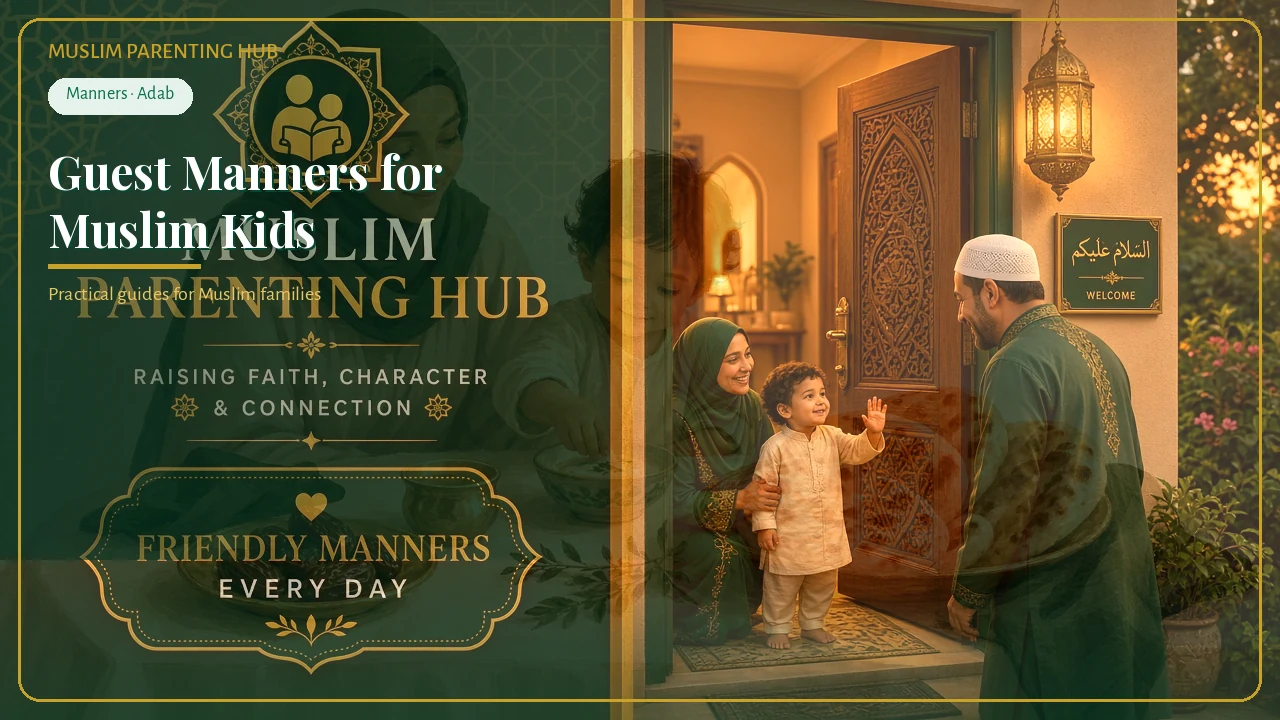
Guest Manners for Muslim Kids: Hosting at Home with Islamic Adab
Teach Muslim kids guest manners for hosting at home—shoes, greetings, serving, privacy, and soft scripts. Islamic adab parents can practice tonight.
Read guide →
Sadaqah Habits for Kids: An Age Chart for Charity at Home
Build sadaqah habits with kids using an age chart—charity jar, giving scripts, weekly rhythms, and soft Islamic charity practice at home. Practical & gentle.
Read guide →
How to Teach Toddlers to Say Salam: A Playful 7-Day Plan
Teach your toddler to say Assalamu alaikum in 7 playful days: mirror games, doorway role-play, shy-child scripts and age tips. Start today, no forcing.
Read guide →
10 Rahma Activities to Teach Muslim Kids Kindness This Month
Teach Muslim kids rahma with 10 kindness activities—kindness jar, neighbor drops, Prophet ﷺ mercy stories, age charts, and tonight scripts. Soft, practical monthly plan.
Read guide →